
ONMSi Solution Architecture: A Complete Guide for Telecom Network Management

ONMSi Solution Architecture: A Comprehensive Guide for Telecom Network Management
The need for high-performance, resilient, and easily managed telecom networks is growing alongside the advancements in 5G, IoT, and next-gen optical infrastructures. Unfortunately, traditional network management systems often struggle to provide the scalability, automation, and intelligent control that are crucial nowadays.
This is where ONMSi (Optical Network Management System – intelligent) comes in. It’s designed to centralize control, streamline operations, and integrate smoothly with IT systems, giving telecom operators a management framework ready for the future.
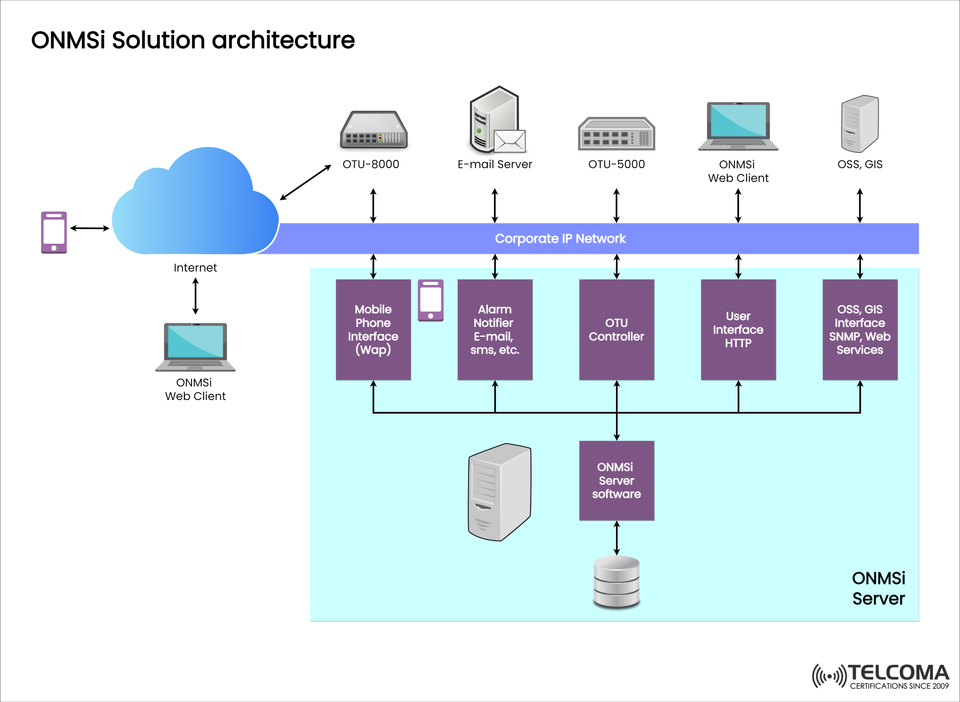
The diagram attached illustrates the ONMSi solution architecture, showcasing how various interfaces, controllers, and applications connect to the ONMSi server. In this blog post, we’re going to dive into the architecture, emphasizing its components, advantages, and its applications in telecom.
What is ONMSi?
ONMSi serves as a centralized optical network management solution that helps telecom operators with:
Fault Management – Quickly pinpointing and isolating network failures.
Configuration Management – Easing up the setup of devices and services.
Performance Monitoring – Keeping an eye on KPIs to ensure SLAs are met.
Automation – Minimizing the need for manual intervention through smart processes.
Integration – Connecting with OSS/BSS, GIS, and enterprise systems.
Its “intelligent” design makes ONMSi ideal for multi-vendor, multi-technology optical networks, making it a popular choice among operators globally.
Breakdown of ONMSi Solution Architecture
The ONMSi solution architecture revolves around the ONMSi server, which works with clients, controllers, notifiers, and OSS/GIS interfaces through a corporate IP network. Let’s go through it step by step.
The Core: ONMSi Server
At the heart of it all is the ONMSi server, which includes:
ONMSi Server Software – The core platform for managing alarms, configurations, and performance data.
Database Layer – Responsible for storing logs, event histories, topology data, and user records.
The ONMSi server acts as the control hub, coordinating with all components and allowing for real-time monitoring, analysis, and reporting.
Interfaces and Controllers
The ONMSi server connects to several specialized modules:
a. Mobile Phone Interface (WAP)
Provides remote access via mobile devices.
Utilizes Wireless Application Protocol (WAP) for lightweight and secure connections.
Great for field engineers needing live fault updates.
b. Alarm Notifier (Email, SMS, etc.)
Sends real-time fault notifications.
Supports various channels:
Email for detailed fault information.
SMS for urgent alerts.
Helps lower Mean Time to Repair (MTTR) by ensuring quick responses.
c. OTU Controller
Oversees Optical Transmission Units (like OTU-5000, OTU-8000).
Offers fault detection, provisioning, and performance monitoring at the optical transport layer.
Connects hardware with the ONMSi software platform.
d. User Interface (HTTP)
A web-based client dashboard accessible through browsers.
Features:
Topology maps
Alarm/event monitoring
Device management
Performance reports
e. OSS/GIS Interface (SNMP, Web Services)
Links ONMSi with higher-level systems:
OSS (Operations Support Systems) for workflows and service provisioning.
GIS (Geographic Information Systems) for visualizing location-based assets.
Uses SNMP, APIs, and web services for communication.
Connected External Components
The architecture integrates external elements through the corporate IP network:
OTU-8000 and OTU-5000 – Managed optical transmission units.
E-Mail Server – Sends out alarm messages.
ONMSi Web Clients – Allows remote access to dashboards via browsers.
OSS/GIS Systems – Utilize ONMSi’s data for enhanced telecom operations.
Benefits of ONMSi Solution Architecture
The ONMSi architecture brings several advantages:
- Centralized Management
Manage and monitor a multi-vendor optical network from one place.
- Proactive Fault Response
Integrated alarm notifier keeps operators informed at all times.
- Remote Accessibility
Mobile and web clients provide flexible access for engineers and administrators.
- Seamless Integration
Native support for OSS, GIS, SNMP, and web services ensures smooth workflows.
- Scalability
Accommodates everything from smaller to larger deployments, whether it’s FTTx projects or carrier-grade backbones.
Real-World Use Cases
Telecom operators utilize ONMSi for a range of applications:
Optical Transport Monitoring – Ensures backbone reliability.
FTTx Deployments – Supports fiber-to-the-home/business initiatives.
Smart Cities – Integrates GIS for visualizing network assets.
Enterprise Services – Provides SLA monitoring for corporate clients.
Disaster Recovery – Facilitates a quick response to outages with rerouting.
ONMSi vs Traditional NMS
Feature ONMSi Traditional NMS Mobile Access Yes, via WAP/mobile clients Rare/limited Alarm Notification Email, SMS, multi-channel Basic SNMP traps OSS/GIS Integration Native SNMP/APIs supported Often requires customization User Interface Web-based GUI (HTTP)Desktop-only tools Scalability Large optical networks Small/medium only
Challenges in ONMSi Deployment
Even though ONMSi is robust, it does come with some challenges:
Integration Complexity – Customization may be necessary for older OSS/BSS systems.
Training Needs – Engineers need to get used to the ONMSi workflows.
Deployment Costs – Initial expenses for servers and software can add up.
Security Concerns – Mobile/WAP access needs to be safeguarded.
Telecom operators often tackle these challenges with phased rollouts and vendor support.
Future Evolution of ONMSi
As telecom networks keep evolving, ONMSi will also advance with:
AI-driven Predictive Maintenance – Using machine learning for better fault prediction.
Cloud-native ONMSi – SaaS models for improved scalability and flexibility.
Closer OSS/BSS Integration – Merging billing, provisioning, and assurance in one ecosystem.
5G-enabled Mobility – Utilizing 5G for faster, richer mobile dashboards.
Conclusion
The ONMSi solution architecture is a crucial tool for telecom operators navigating the complexities of next-generation optical networks. With its combination of server-based intelligence, multi-channel alarm notifications, OSS/GIS integration, and remote access, ONMSi equips telecom professionals to deliver highly reliable services.
For telecom businesses, embracing ONMSi is more than just about managing networks—it’s about establishing a foundation for digital transformation in the fiber and 5G era.