
ONMSi Solution Architecture Explained: Components, Functions, and Telecom Applications
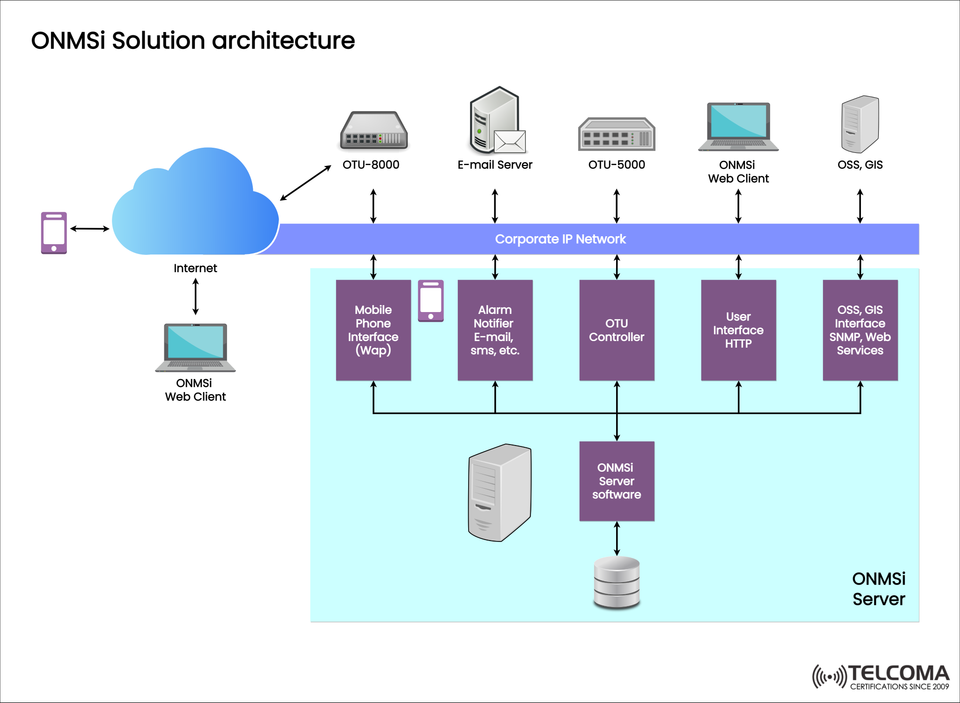

A Closer Look at the ONMSi Solution Architecture: Key Components, Functions, and Applications in Telecom
Telecom networks are evolving fast, which means they need sophisticated management systems to efficiently orchestrate, monitor, and control complex infrastructures. The traditional tools just can’t keep up with the next-gen optical networks where scalability, automation, and seamless integration are vital.
This is where the ONMSi (Optical Network Management System – intelligent) architecture steps in. It offers a centralized, smart framework for managing telecom networks, ensuring service quality, operational efficiency, and compatibility with existing IT ecosystems.
The diagram provided gives a clear picture of the ONMSi solution architecture, illustrating how the ONMSi server connects with various layers—mobile clients, web clients, controllers, and OSS/GIS systems—to offer comprehensive visibility and control.
In this blog post, we’ll dive into the ONMSi architecture, breaking down each part and showing how they work together to enable more intelligent telecom network operations.
What’s ONMSi?
ONMSi, or Optical Network Management System – intelligent, is a software-driven management platform designed to help telecom operators keep an eye on, configure, and optimize their optical transport and access networks.
Its main functions are:
Fault Management – Spotting and isolating issues in the optical transport network.
Configuration Management – Making it easier to set up and adjust devices.
Performance Monitoring – Tracking KPIs to ensure SLA compliance.
Integration with OSS/BSS – Supporting advanced tasks like billing, GIS mapping, and automation.
Scalability – Capable of handling multi-vendor, multi-technology optical infrastructures.
Breaking Down the ONMSi Solution Architecture
The ONMSi solution architecture diagram shows how ONMSi fits into the telecom environment. It connects various client interfaces, controllers, and network elements via a corporate IP network, with the ONMSi server at the center.
The Heart of the System: ONMSi Server
At the core of the architecture is the ONMSi Server, which includes:
ONMSi Server Software – This is the main application that manages data collection, analysis, and reporting.
Database – This stores network configurations, alarms, historical performance data, and user access logs.
Think of this server as the “brain” of the operation, enabling:
Centralized management of various network devices (like OTUs, switches, routers).
Alarm and event correlation for proactive fault management.
API-based integration with external OSS/BSS systems.
Connected Interfaces and Components
The ONMSi server works with several interfaces, controllers, and clients to operate efficiently:
- Mobile Phone Interface (WAP)
This allows for remote monitoring and control through mobile devices.
Perfect for field engineers who need real-time alerts and access.
Utilizes Wireless Application Protocol (WAP) for secure, lightweight communication.
- Alarm Notifier (Email, SMS, etc.)
Sends proactive alerts to administrators during alarms or failures.
Supports various notification channels:
Email alerts for detailed fault logs.
SMS for urgent updates that need quick attention.
This enhances responsiveness and helps reduce Mean Time to Repair (MTTR).
- OTU Controller
Manages Optical Transmission Units (OTU-5000, OTU-8000, etc.).
Provides provisioning, fault detection, and performance monitoring for optical transport layers.
Bridges the physical network elements and the ONMSi server.
- User Interface (HTTP)
A web-based GUI accessed through ONMSi web clients.
It includes dashboards, real-time alarms, topology views, and performance metrics.
Lets administrators set up policies, run diagnostics, and see network health.
- OSS/GIS Interface (SNMP, Web Services)
Connects ONMSi with higher-level systems like:
OSS (Operations Support Systems) – For automating workflows, service provisioning, and fault management.
GIS (Geographic Information Systems) – For visualizing network assets spatially.
Utilizes SNMP, RESTful APIs, and web services for communication.
External Components' Role
The corporate IP network ensures smooth communication between ONMSi and external systems. The connected components include:
OTU-8000 and OTU-5000 – These are the optical transport units managed by the OTU controller.
Email Server – Distributes alarm and fault notifications.
ONMSi Web Clients – Remote clients that access the ONMSi dashboard through IP or the internet.
OSS/GIS Servers – Advanced platforms that use ONMSi’s data for telecom functions.
Advantages of the ONMSi Architecture
The ONMSi architecture has a lot of benefits for telecom operators:
- Centralized Management
One platform to oversee and control various network elements.
- Real-Time Fault Handling
The built-in alarm notifier helps ensure quick responses to issues.
- Remote Accessibility
Mobile and web clients allow engineers to access the system from anywhere.
- Seamless OSS/GIS Integration
This supports enterprise-wide service assurance and inventory management.
- Vendor-Agnostic Design
Works with multiple OTU devices and external management systems.
Key Use Cases in Telecom
ONMSi is widely used in telecom operations for:
Optical Transport Network Monitoring – Keeping high-capacity backbones reliable.
FTTx Deployments – Managing large-scale fiber-to-the-home/business projects.
Enterprise Services – Offering SLA-based monitoring for corporate clients.
Smart Cities – Integrating with GIS for real-time asset tracking.
Disaster Recovery – Quick detection of outages and rerouting traffic.
ONMSi Versus Traditional Network Management Systems
Feature ONMSi Traditional NMS Mobility Support Mobile interface (WAP)Limited/none Alarm Notification Multi-channel (Email, SMS)Basic SNMP traps OSS/GIS Integration Native SNMP, web services Requires customization User Access Web clients, mobile, HTTP GUI Desktop-only clients Scalability Designed for large optical networks Limited to small/medium networks
Challenges in Deploying ONMSi
Even with its benefits, telecom operators might encounter:
Integration Complexity – Fitting ONMSi into existing OSS/BSS.
Training Needs – Engineers will need to learn the ONMSi GUI and workflows.
Cost Concerns – Initial setup and customization costs.
Security Management – Keeping mobile/WAP interfaces secure.
These issues can be tackled with good planning, support from vendors, and phased rollout strategies.
The Future of ONMSi in Telecom
As telecom networks move towards 5G and beyond, ONMSi is set to grow with:
AI-driven Automation – For predictive fault detection and self-repair.
Cloud-native Deployment – Making ONMSi services more flexible and scalable.
Deeper OSS/BSS Integration – Combining platforms for billing, orchestration, and assurance.
Enhanced Mobility Features – Real-time monitoring using 5G-enabled mobile dashboards.
Wrapping Up
The ONMSi solution architecture is crucial for modern telecom operations, allowing operators to manage optical transport networks smartly and effectively.
By combining server-based intelligence, real-time alarm notifications, OSS/GIS interfaces, and remote access, ONMSi equips telecom professionals to provide reliable services while minimizing downtime.
For both telecom operators and enterprises, ONMSi isn't just a network management tool; it’s a strategic asset for driving digital transformation in the era of high-speed fiber and 5G networks.