
Operational Flow of Cloud VR Game Service: A Deep Dive into Low-Latency Architectures

Exploring How Cloud VR Game Services Operate: A Look at Low-Latency Designs
Virtual Reality (VR) has quickly shifted from being a niche interest in gaming to becoming a part of mainstream entertainment, business training, healthcare, and education. A major game-changer in making VR widely accessible is Cloud VR, which allows for VR rendering and processing to be done in the cloud instead of requiring expensive local hardware.
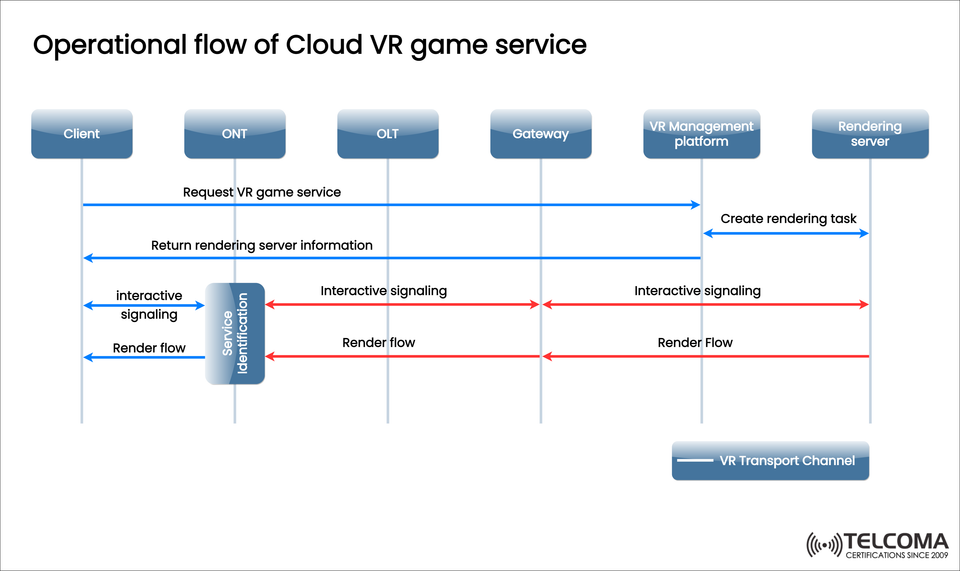
This transition hinges on a strong network flow to guarantee low latency, high bandwidth, and dependable connections—all things that are essential for an immersive VR experience. The accompanying diagram—Operational Flow of Cloud VR Game Service—illustrates this complex process.
In this post, we’ll break down the complete flow of a Cloud VR gaming session, clarify the function of each network component, and explain why this design is vital for telecom operators who want to excel in providing immersive services.
What is the Flow of Cloud VR Game Services?
The flow of a Cloud VR game service outlines how user interactions and rendering tasks travel between the VR client device (like a headset), network elements (ONT, OLT, Gateway), and the cloud setup (VR management platform and rendering server).
Unlike conventional VR systems that handle graphics locally, Cloud VR shifts computation to remote rendering servers, which then stream high-definition visuals back to the client device. This design lessens dependency on hardware while requiring super-fast, low-latency transport channels.
Main Components of the Operational Flow
The diagram shows a straightforward yet highly interactive series of steps. Here’s a rundown of each component and what it does:
- Client (VR Headset or Device)
This is where the service begins.
It sends a request for VR game service through the ONT.
It receives rendered VR streams and provides feedback like gestures or head movements.
- ONT (Optical Network Terminal)
This serves as the user’s entry point to the fiber optic network.
It converts optical signals into electrical signals for the VR client.
Responsible for service identification—it maps requests to the right rendering server.
- OLT (Optical Line Terminal)
This device gathers traffic from multiple ONTs.
It forwards interactive signals and render flows deeper into the network.
Works within the PON (Passive Optical Network) structure, which is essential for F5G fixed broadband.
- Gateway
Manages policy enforcement, QoS (Quality of Service), and traffic directing.
Makes sure VR traffic gets priority, keeping latency low for gaming experiences.
- VR Management Platform
Coordinates the service by creating rendering tasks.
Assigns the appropriate rendering server for each VR client.
Tracks user session performance to ensure QoE (Quality of Experience).
- Rendering Server
Functions as the “cloud GPU.”
Carries out rendering tasks, building VR environments live.
Streams results back through the network to the VR client.
The Operational Flow in Four Steps
The process can be divided into four main stages:
- Service Request & Identification
The client requests a VR game service via the ONT.
The ONT sends the request through the OLT and gateway to the VR management platform.
The management platform creates a rendering task and assigns a rendering server.
The rendering server’s details are sent back to the client.
- Interactive Signaling
After the connection is made, interactive signaling kicks off.
Client actions (like turning the head or pressing a button) are sent through ONT → OLT → Gateway → VR management → Rendering server.
These signals determine how the VR environment should adapt in real time.
Rendering & Delivery (Render Flow)
The rendering server produces frames based on the client’s actions.
These frames travel back along the same path and reach the client via the ONT.
This process is known as the render flow, and it needs to stay super fast to prevent lag.
VR Transport Channel Maintenance
Throughout the session, the VR Transport Channel works to ensure smooth signaling and render flow.
Latency is kept low through smart bandwidth management and prioritized traffic handling.
The Importance of Low Latency in Cloud VR
VR demands that motion-to-photon latency stays under 20 ms—ideally closer to 1 ms, in line with F5G standards. If latency is high, it can lead to:
Motion sickness from a delay between user actions and visual feedback.
Disrupted immersion, ruining the gaming or simulation experience.
Unfair advantages in competitive gaming situations.
The operational flow makes sure that latency-sensitive processes (like interactive signaling and rendering flows) are prioritized and handled in real time.
Cloud VR Game Service Workflow in a Table
Stage Actor Function Service Request Client → ONT → OLT → Gateway → VR Management Platform Starts the game session Rendering Task Creation VR Management Platform → Rendering Server Allocates cloud resources Interactive Signaling Client ↔ Rendering Server Sends input actions Render Flow Rendering Server → Client Streams real-time VR frames Transport Channel Network (ONT, OLT, Gateway)Keeps a low-latency path
Challenges Addressed by This Flow
Lower Hardware Costs * No need for local GPUs or top-of-the-line VR-ready PCs.
Scalable VR Access * Multiple users can tap into the same cloud rendering setup.
Dynamic Resource Management * The VR management platform ensures servers are used effectively.
Consistent Experience with F5G * Full-fiber connections provide reliable high bandwidth and low jitter.
Telecom Opportunities with Cloud VR
This operational flow also shows strategic benefits for telecom operators:
Service Differentiation: Providing Cloud VR packages over fiber broadband.
New Revenue Opportunities: Collaborations with gaming developers and VR content creators.
Quality of Experience Assurance: Offering premium services with service-level agreements (SLAs).
5G & F5G Integration: Seamlessly extending VR services across both fixed and mobile networks.
Wrapping Up
The operational flow of Cloud VR game services goes beyond just a technical diagram—it outlines the future of immersive entertainment and business applications. By coordinating service requests, interactive signaling, rendering tasks, and real-time render flows across a low-latency, fiber-based network, telecom operators can deliver VR experiences once thought to be only possible with high-end gaming setups.
For those in telecom, grasping this flow is crucial: it not only opens up new revenue avenues but also establishes the network as the backbone of next-gen immersive ecosystems.
As more people adopt Cloud VR, this operational model will likely set the standard for VR delivery, ensuring scalable, cost-effective, and deeply immersive experiences across the globe.