
Option 4 vs Option 4a in 5G Architecture: Key Differences Explained

Option 4 vs. Option 4a in 5G: A Guide for Telecom Professionals
As 5G networks keep progressing, there are various deployment options available to ensure smooth integration between LTE (4G), NR (New Radio), EPC (Evolved Packet Core), and 5GC (5G Core). Among these options, Option 4 and Option 4a are crucial in determining how user and control plane traffic moves between LTE and NR when 5GC is in play.
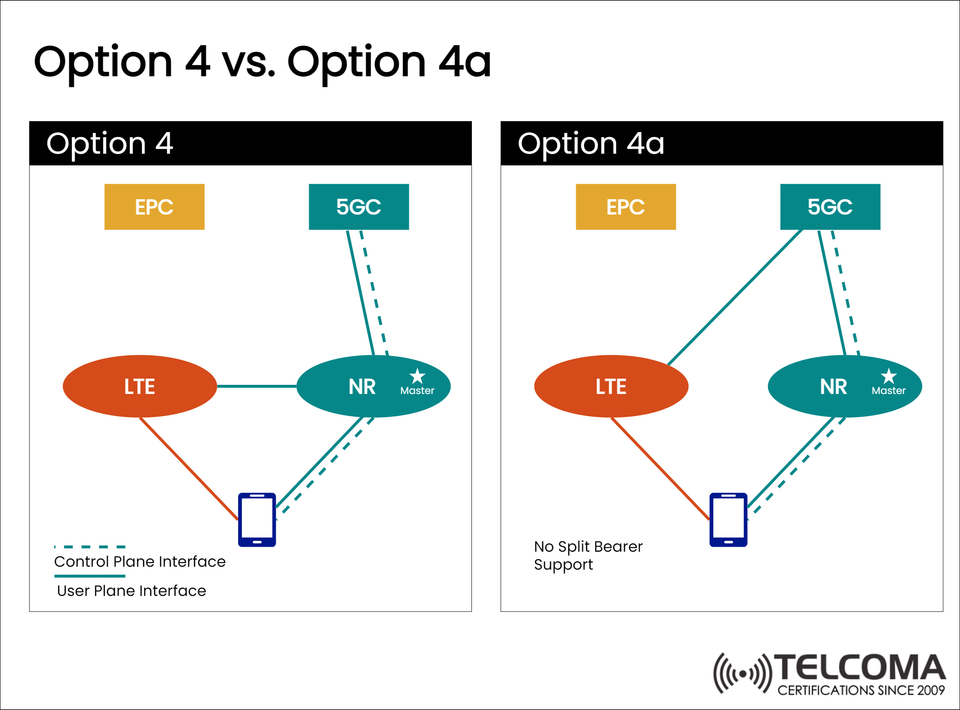
In this article, we’ll highlight the main differences between Option 4 and Option 4a, using 3GPP specifications and the accompanying image for reference. By the time we’re done, you’ll have a solid grasp of how these options influence network architecture, deployment considerations, and the overall experience for users.
Background: 5G Deployment Options
Deploying 5G isn’t a one-size-fits-all situation. Depending on the existing infrastructure and strategy of a telecom operator, networks can evolve through either Non-Standalone (NSA) or Standalone (SA) setups.
NSA: LTE serves as the anchor, while NR delivers added capacity and speed.
SA: NR connects straight to the 5G Core (5GC) without needing LTE.
To connect LTE and 5GC, dual connectivity options were introduced. These allow user equipment (like smartphones) to link up with both LTE and NR at the same time, each having distinct roles.
That’s where Option 4 and Option 4a come in. Both are part of the E-UTRA-NR Dual Connectivity (EN-DC) family, but they have different approaches when it comes to bearer management and EPC/5GC integration.
Understanding the Components
Before diving into the specifics of the options, let’s clarify what the entities in the diagram represent:
EPC (Evolved Packet Core): This is the core network for 4G LTE.
5GC (5G Core): The next-gen core designed for 5G SA, capable of supporting network slicing, ultra-low latency, and extensive IoT.
LTE (E-UTRA): The 4G radio access technology, often the anchor in NSA configurations.
NR (New Radio): The 5G air interface that offers higher bandwidth and lower latency.
UE (User Equipment): This refers to smartphones, IoT devices, or anything that users utilize.
Option 4: Master NR with Split Bearer Support
In Option 4, NR takes the lead as the master node, and LTE acts as the secondary.
Control Plane: Based in NR, connected to the 5G Core (5GC).
User Plane: Has the capability for split bearer support, allowing traffic to flow through both LTE and NR simultaneously for better throughput.
This setup means if NR is available, the UE can tap into both radio technologies to achieve higher data rates.
Key Characteristics of Option 4
NR connects directly to 5GC.
LTE connects through NR, not directly.
Split bearer means one bearer’s traffic can be shared between LTE and NR.
NR is the master while LTE plays the secondary role.
This option is ideal for operators fully moving to 5G Core while still relying on LTE for extended coverage.
Option 4a: Master NR Without Split Bearer Support
In Option 4a, NR remains the master node, but the approach to bearer architecture is different.
Control Plane: Anchored in NR and directly linked to 5GC.
User Plane: Lacks split bearer support, where LTE and NR connect independently to 5GC.
This removes the complexity of split bearers, though it might compromise some efficiency in managing traffic.
Key Characteristics of Option 4a
NR connects directly to 5GC as the master node.
LTE enjoys its own direct path to 5GC (bypassing NR).
No split bearer support: Each bearer is tied to either LTE or NR—never both.
Simplifies things, but it could mean lower peak throughput relative to Option 4.
Great for networks that value straightforward deployment over peak performance.
Side-by-Side Comparison: Option 4 vs Option 4a
Feature Option 4Option 4aMaster Node NR NR Control Plane Anchor NR → 5GCNR → 5GCUser Plane Path Split across LTE & NR Separate LTE and NR paths Split Bearer Support Yes No LTE’s Role Secondary node, routed via NR Independent path to 5GCComplexityHigherLowerPerformance (throughput)Higher Moderate Best Use Case Operators aiming for maximum efficiency Operators seeking simpler deployment
Why Do These Differences Matter?
For telecom operators and engineers alike, the choice between Option 4 and Option 4a hinges on network priorities:
Option 4 allows better spectrum utilization and peak speeds thanks to split bearers, but it demands more intricate coordination between LTE and NR.
Option 4a simplifies the structure by doing away with split bearers, though this could lead to slightly reduced performance.
From a deployment standpoint, Option 4 may appeal to operators heavily focusing on enhancing performance and throughput, while Option 4a might be more suitable for those looking for a more straightforward integration without extensive changes.
Real-World Deployment Considerations
Device Support: Not all UEs can handle split bearers. Operators need to check device compatibility before implementing Option 4.
Backhaul Requirements: Support for split bearers requires robust synchronization and backhaul capabilities, which can add cost and complexity.
Migration Strategy: Operators looking to transition to a full 5G SA model might prefer Option 4 for long-term gains, while those still in LTE-dominant phases could temporarily opt for Option 4a.
QoS (Quality of Service): In Option 4, QoS can be flexibly managed between LTE and NR, while with Option 4a, QoS remains linked to each bearer on its own.
Conclusion
Option 4 and Option 4a are both NR-focused dual connectivity solutions for 5G. The primary distinction is in split bearer support.
Option 4: NR serves as master, LTE as secondary, and user plane traffic can be divided between LTE and NR.
Option 4a: NR is the master, LTE connects separately, and split bearers aren’t supported.
Understanding these differences is vital for telecom professionals when planning network upgrades, making the most out of resources, and ensuring a smooth shift to 5G SA. In the end, the choice between Option 4 and Option 4a will depend on the operator’s objectives, resources, and device compatibility.