
Overall RAN Architecture: CU-CP and CU-UP Separation in 5G Networks
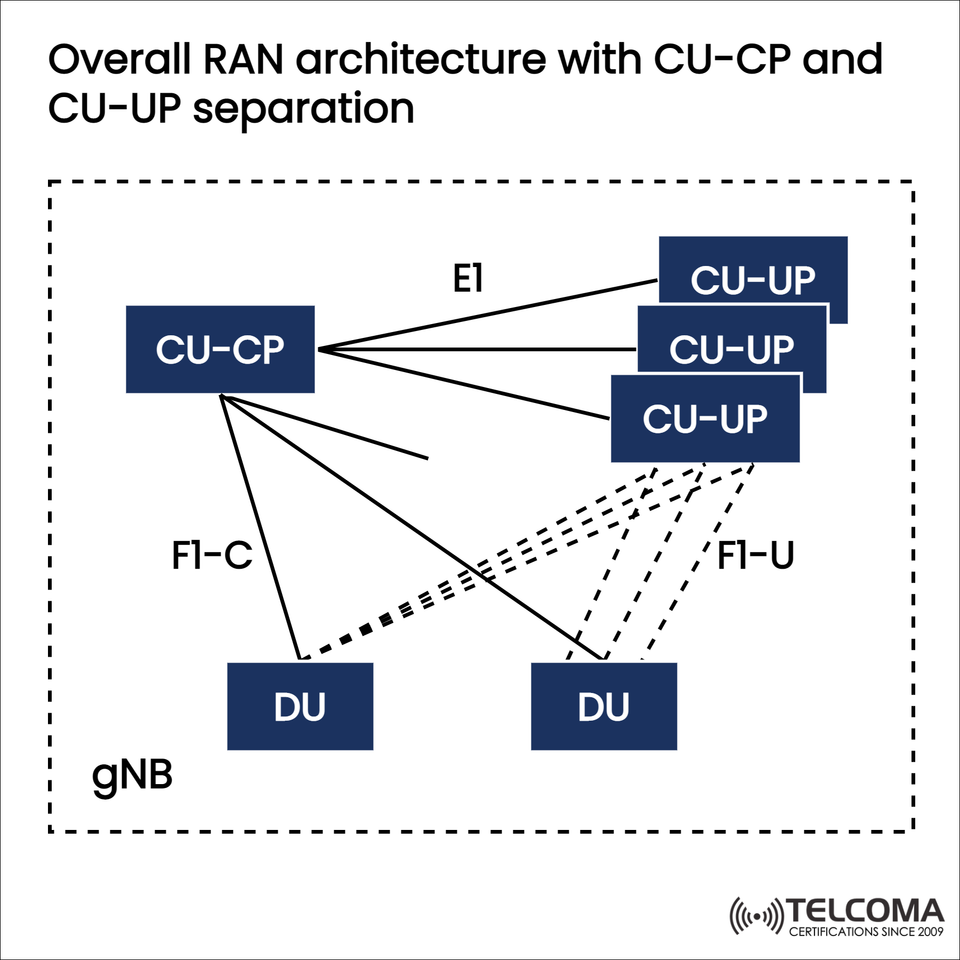

Overview of RAN Architecture with CU-CP and CU-UP Separation
The shift from 4G LTE to 5G New Radio (NR) isn't just about speed; it’s really changing the way the Radio Access Network (RAN) works, transforming it into a cloud-native, disaggregated system. A key part of this change is the separation of the Central Unit – Control Plane (CU-CP) and Central Unit – User Plane (CU-UP), along with the Distributed Unit (DU). This split gives operators more flexibility, scalability, and efficiency, and it also opens the door to new services like network slicing and ultra-reliable low-latency communication (URLLC).
The image uploaded illustrates this setup, detailing how the CU-CP connects with various CU-UPs and DUs through specific interfaces (E1, F1-C, F1-U). Let’s take a closer look.
Main Components of 5G RAN Architecture
- CU-CP (Central Unit – Control Plane)
Handles signaling, mobility, session setup, and RRC (Radio Resource Control).
Links to several DUs via the F1-C interface.
Works with CU-UPs over the E1 interface.
Allows for centralized control, yet is adaptable for deployment.
- CU-UP (Central Unit – User Plane)
Takes care of forwarding user data packets.
Can be located closer to the edge to support apps that need low latency.
Scales on its own to manage different data loads.
Connects with DUs using the F1-U interface.
- DU (Distributed Unit)
Manages the lower-layer RAN tasks (MAC, RLC, parts of PHY).
Positioned near radio antennas to ensure effective real-time processing.
Collaborates with CU-CP for signaling and with CU-UP for managing user traffic.
Interfaces in CU-CP and CU-UP Separation
This architecture relies on well-defined interfaces:
E1 Interface: Connects CU-CP to CU-UPs for control and coordination.
F1-C (Control Plane): Connects CU-CP with DUs for signaling and mobility management.
F1-U (User Plane): Links CU-UP with DUs for user data transport.
This clear separation of functions enhances flexibility in scaling and deployment.
Importance of CU-CP and CU-UP Separation
Separating the control and user planes within the gNB architecture provides a host of benefits:
Independent Scaling: Operators can increase CU-UPs to manage heavy data traffic without affecting CU-CP resources.
Edge Deployment: Position CU-UPs nearer to end users for ultra-low latency applications, such as autonomous vehicles and remote surgeries.
Enhanced Reliability: Keeping signaling separate from user traffic means one won't overwhelm the other.
Support for Network Slicing: Each slice of the network can be customized with specific CU-UP instances while sharing CU-CP control.
Energy Efficiency: Smarter scaling means less unnecessary processing, which saves network resources.
Deployment Scenarios
With the separation of CU-CP and CU-UP, a variety of deployment models are possible:
Centralized CU with Multiple DUs * Both CU-CP and CU-UP remain centralized in the cloud. * DUs are positioned at the edge to manage radio functions. * Ideal for macro coverage and large-scale setups.
Distributed CU-UP for Low Latency * CU-UP instances are placed closer to the edge. * Guarantees rapid packet forwarding for latency-critical applications. * Supports URLLC and edge computing scenarios.
Hybrid Deployments * A mix where some CU-UPs are centralized (to save costs), while others are edge-deployed (for lower latency). * Balances scalability with responsiveness.
Comparing 4G and 5G CP/UP Separation
Feature4G LTE EPC (CUPS)5G NR RAN (CU-CP & CU-UP Split)Scope Core network only Both RAN and Core Interfaces Sx interfaceE1, F1-C, F1-UDeploymentCentralized EPC Flexible – Centralized, distributed, hybrid Latency Optimization Limited Strong (with edge-deployed CU-UPs)Slicing Support Minimal Full support for network slicing Scalability Moderate High – independent scaling of CP and UP
This table shows how 5G expands CP/UP separation from just the core network to the RAN, offering much greater flexibility.
Advantages for Operators
By implementing the CU-CP and CU-UP separation, operators can enjoy:
Operational Flexibility: Deploy functions based on service demands (whether centralized or distributed).
Cost Efficiency: Scale resources as needed, avoiding over-provisioning.
Faster Innovation: New 5G applications can be launched without needing to redesign the entire network.
Better QoE (Quality of Experience): Provides stable signaling and high data throughput, even during congestion.
Implementation Challenges
Even with the advantages, operators have to tackle some challenges:
Interface Complexity: E1, F1-C, and F1-U add layers of coordination.
Synchronization Issues: Ensuring smooth mobility handovers with distributed units is crucial.
Increased OPEX (Initial Phase): More components might lead to higher operational costs at the start.
Skills Gap: Network engineers need a deeper understanding of virtualization and cloud-native designs.
These challenges are being addressed through industry initiatives like O-RAN Alliance, which promotes open interfaces and vendor compatibility.
Looking Ahead
As networks advance toward 6G, the separation of CU-CP and CU-UP will still be a key foundation for:
AI-Driven RAN Management: Intelligent automation will position CU-UPs nearer to high-demand areas.
Comprehensive Slicing: Each service slice will have its own tailored CP and UP functions.
Cloud-Native Microservices: CU and DU functions will be deployed as containerized workloads for maximum flexibility.
Integration with Non-Terrestrial Networks (NTN): CU-UP instances might reach out to satellites or HAPS for global coverage.
Summary
The separation of CU-CP and CU-UP in 5G RAN architecture is a significant advancement in network design. Unlike 4G’s centralized framework, 5G champions flexibility, scalability, and edge intelligence by decoupling signaling from user data.
For telecom pros, getting a handle on this architecture is vital for crafting efficient, future-ready networks.
For tech buffs, it highlights how 5G is designed not just for speed, but also for adaptability and innovation.
As 5G develops and 6G research gains momentum, the separation of CU-CP and CU-UP will stay at the heart of smart, cloud-native, and robust RANs.