
PCF Architecture in 5G: Layers, Components, and Functions Explained

Introduction: The Role of PCF in 5G Networks
The Policy Control Function (PCF) is a vital part of the 5G Core (5GC) architecture as outlined by 3GPP. It's essentially an upgrade from the older PCRF (Policy and Charging Rules Function) that was used in 4G.
PCF is key in managing policy decisions, ensuring quality of service (QoS), implementing charging rules, and working alongside other crucial network functions like the SMF (Session Management Function) and AMF (Access and Mobility Management Function).
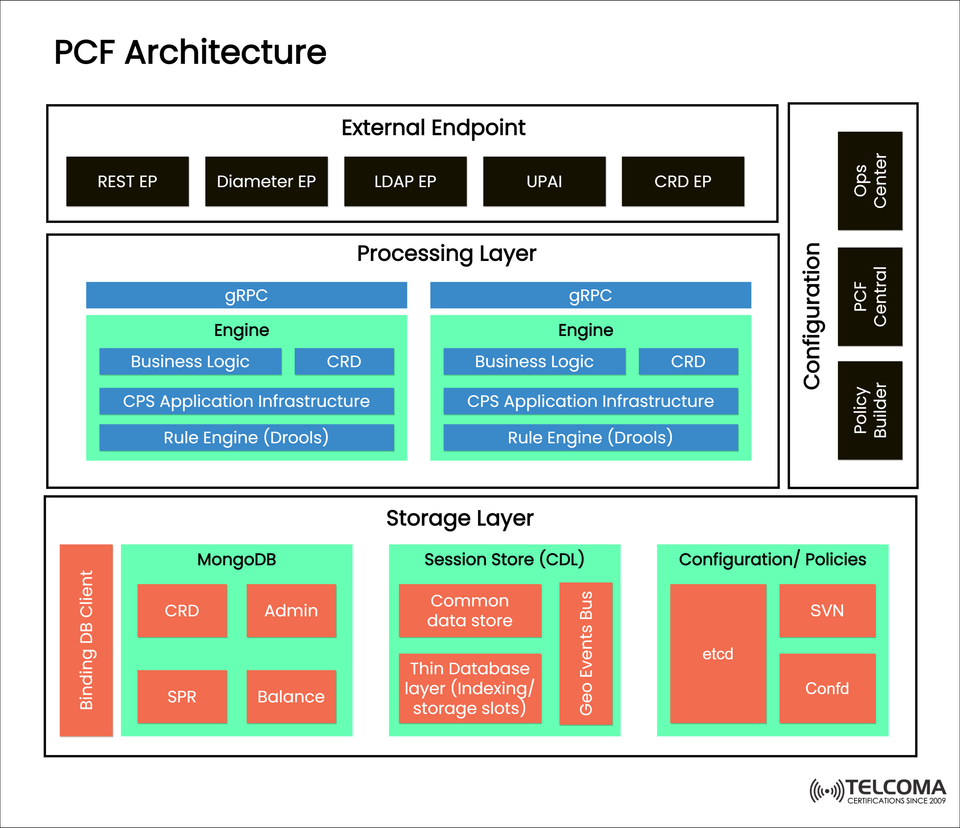
The diagram provided gives a clear view of the layered architecture of PCF, illustrating how various elements like external endpoints, processing, storage, and configuration modules come together to manage policies in the 5G environment.
Key Components of the PCF Architecture
PCF architecture can be divided into four main parts:
External Endpoints
Processing Layer
Storage Layer
Configuration & Control Modules
Each part has a specific role in managing policy requests, processing logic, and storing policy data.
- External Endpoints
PCF offers several endpoints for connecting with other network functions and applications:
REST EP: Implements RESTful APIs for external apps to interact with PCF.
Diameter EP: Maintains compatibility with older Diameter-based interfaces.
LDAP EP: Facilitates connections with Lightweight Directory Access Protocol systems.
UPAI EP: For exchanging user profile and authentication information.
CRD EP: Manages charging-related data.
Role: These endpoints serve as gateways, enabling effective communication between PCF and other 5G network components, OSS/BSS platforms, and external systems.
- Processing Layer
The processing layer is the intelligent core of PCF, handling policy requests, applying business logic, and interacting with storage for data retrieval.
Components of the Processing Layer
gRPC (gRPC Framework): A high-performance RPC framework that facilitates scalable and effective communication among internal components.
Engine:
Carries out the core functions of PCF.
This includes:
Business Logic: Determines how policies are applied based on service type, QoS, or user subscriptions.
CRD (Charging and Rating Data): Links with charging systems to enforce the rules for policy-based charging.
CPS Application Infrastructure: Supplies the necessary platform services for PCF operations.
Rule Engine (Drools): A framework for making decisions and applying complex policy rules in real time.
Importance: This layer makes sure that every policy decision is context-aware, optimized for performance, and in line with business guidelines.
- Storage Layer
The storage layer takes care of all the persistent and session-related data that PCF needs.
Storage Components
MongoDB:
Manages subscriber and policy-related data, including:
CRD: Charging data.
Admin: Administrative settings.
SPR (Subscriber Profile Repository): Holds subscriber profiles and entitlements.
Balance: Information on subscriber balances for both prepaid and postpaid systems.
Session Store (CDL – Common Data Layer):
Stores ongoing session information.
Includes:
Common Data Store: Centralized storage for session details.
Thin Database Layer: Provides efficient storage with indexing.
Geo Events Bus: Deals with geo-distributed event management.
Configuration/Policies:
Keeps PCF configuration files and policy definitions.
Components include:
SVN: Manages policy versions.
etcd: A distributed key-value store for availability.
Confd: Oversees dynamic configurations.
Role: This layer guarantees quick access, scalability, and redundancy for important policy data.
- Configuration and Control
This block allows PCF operators to set up, manage, and monitor policy functions.
Ops Center: Offers operational monitoring and management for PCF functions.
PCF Central: The main control hub for all PCF activities.
Policy Builder: Lets operators define, test, and deploy new policies in real time.
Function: A centralized interface for administrators, making sure policy updates are consistently applied throughout the system.
How PCF Works in a 5G Context
When a subscriber or a network function needs a session, here’s the process:
Request: The SMF (Session Management Function) sends a policy request to PCF using REST or the N7 interface.
Processing: PCF pulls subscriber data from the SPR in the storage layer.
Policy Decision: Using the rule engine (Drools), business logic, and CRD, PCF makes a decision.
Response: PCF provides QoS rules, charging parameters, or other directives.
Enforcement: The SMF enforces these rules on the user session.
This guarantees that every session conforms to operator policies, user subscription profiles, and network conditions.
Benefits of PCF in 5G Networks
Dynamic Policy Control: Allows for real-time decision-making based on user and network context.
Subscriber-Centric Services: Ensures policies are in line with user subscriptions and entitlements.
Optimized QoS: Facilitates detailed Quality of Service differentiation.
Efficient Resource Usage: Smartly allocates network resources.
Charging Integration: Works with billing systems for immediate charging.
Flexibility: Offers APIs and multiple endpoints for integration with various systems.
PCF Architecture vs. Legacy PCRF
Feature PCRF (4G)PCF (5G)Protocol Support Diameter only REST, gRPC, Diameter, LDAP, etc. Data Handling Subscriber-centric only Subscriber + session + application data Rule Engine Limited Dynamic with Drools Storage Basic DB Mongo DB + CDL + distributed stores Scalability Moderate Cloud-native, highly scalable Integration Limited APIs Full API-driven integration
Real-World Use Cases of PCF
QoS Differentiation: Guaranteeing priority bandwidth for autonomous vehicles or telemedicine applications.
Charging Flexibility: Enabling innovative 5G billing models, like pay-per-service.
Network Slicing: Setting policies specific to different slices for IoT, URLLC, and eMBB services.
Subscriber Management: Enforcing policies based on user profiles, balances, or enterprise agreements.
Enterprise 5G: Crafting tailored policies for private networks in industrial settings.
Challenges in PCF Implementation
Complex Policy Rules: Crafting dynamic policies that span various slices and services.
Scalability Pressure: Managing the influx of numerous IoT device connections.
Latency Requirements: Making sure that policy enforcement is real-time.
Integration Efforts: Seamlessly connecting with OSS/BSS and external APIs.
To tackle these challenges, operators can use cloud-native deployments, AI-driven policy automation, and Kubernetes-based orchestration.
Conclusion
The PCF Architecture serves as the policy brain of 5G networks, enabling real-time decision-making, subscriber-centered control, and smart resource allocation.
Its layered design—External Endpoints, Processing Layer, Storage Layer, and Configuration Modules—equips PCF to manage the intricate needs of today's 5G networks.
By utilizing technologies like gRPC, Drools, MongoDB, and distributed data stores, PCF ensures that operators can provide customized services, consistent QoS, and innovative monetization strategies.
As we move from 5G towards 6G, the flexibility, scalability, and smart features of PCF will remain crucial in building the connected digital ecosystem.