
PCF Functional Architecture in 5G: Components, Interfaces, and Role in Telecom

In today’s world of 5G networks, managing policy and charging control is essential for maintaining quality of service (QoS), subscriber-specific regulations, and making the most of advanced services. That’s where the Policy Control Function (PCF) comes in, replacing the older Policy and Charging Rules Function (PCRF) that was used in 4G networks.
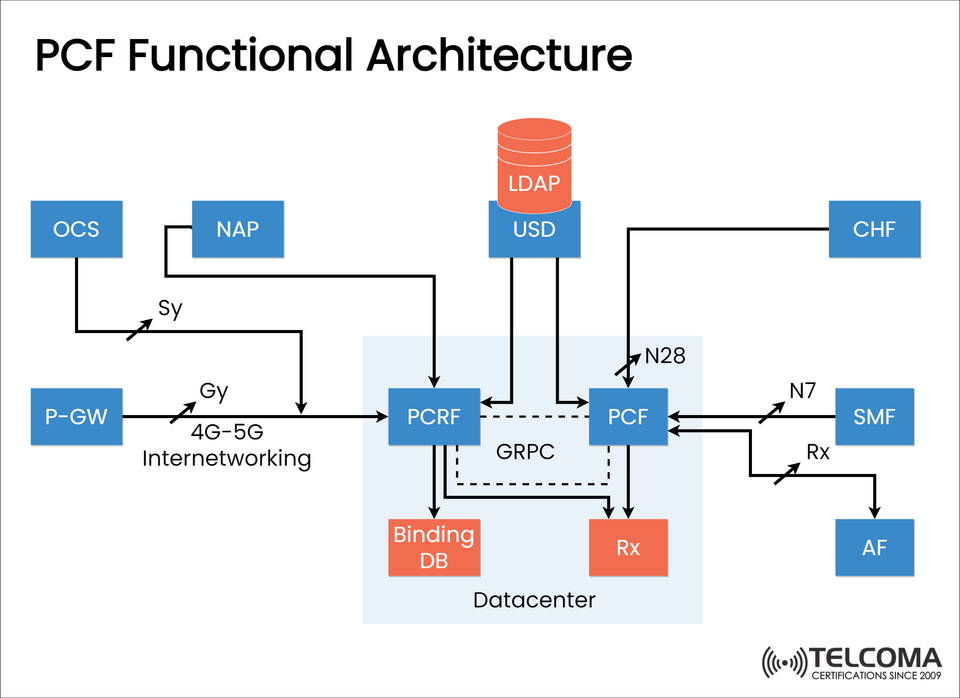
The diagram included gives a detailed look at PCF's functional architecture, illustrating how it works with PCRF, CHF, SMF, AF, and other external systems like LDAP/UDR databases. This setup is vital for 5G core network operations, allowing for dynamic policy enforcement and smooth 4G-5G interworking.
In this blog, we’ll dive into the components, interfaces, and workflow of PCF, how it integrates with PCRF, and its role in providing flexible, cloud-native telecom services.
What is PCF in 5G?
The Policy Control Function (PCF) is a crucial component in the 5G Core (5GC) that handles policy decisions. It oversees rules concerning:
Quality of Service (QoS) enforcement
Access control and network slicing policies
Charging rules alongside CHF
Interworking with PCRF for smooth transitions from 4G to 5G
In simple terms, PCF makes sure each subscriber session adheres to the operator’s business policies while optimizing network resources.
PCF vs PCRF: The Evolution
Feature PCRF (4G)PCF (5G)Standard3GPP in EPC3GPP in 5GCScopePolicy + charging rules Policy control + AI/analytics + slicing Interfaces Gx, RxN7, Rx, N28ArchitectureCentralized, limited cloud adoption Cloud-native, service-based Interworking Legacy EPC Supports 4G-5G interworking
The diagram shows the PCF-PCRF interaction, making sure that both 4G and 5G networks can function together during migration phases.
Components of PCF Functional Architecture (Explained from Diagram)
The uploaded diagram outlines the interaction of PCF with other entities. Let’s break that down:
- PCRF (Policy and Charging Rules Function)
It's the legacy function from 4G/EPC.
Still valuable in interworking scenarios.
Connects with PCF using a gRPC interface to keep rules in sync.
- PCF (Policy Control Function)
The core of 5G policy management.
Interacts with SMF (Session Management Function), AF (Application Function), and CHF (Charging Function).
Guarantees real-time policy enforcement for user sessions.
- SMF (Session Management Function)
Communicates with PCF through the N7 interface.
PCF provides session-related policies, including QoS parameters, data routing, and charging triggers.
- AF (Application Function)
Requests policy rules from PCF via the Rx interface.
A typical example would be a video streaming service that needs guaranteed bandwidth.
- CHF (Charging Function)
Works with PCF for policy-based charging rules.
Ensures accurate billing based on data sessions, app types, or slice usage.
- LDAP / UDR (Unified Data Repository)
Represented as USD and LDAP in the diagram.
Supplies subscriber profile data and policy rules.
PCF pulls user-specific info to enforce accurate policies.
- NAP (Network Access Point)
Collaborates with PCRF in 4G-5G interworking situations.
Assures backward compatibility and continuity of sessions.
- OCS (Online Charging System)
Connected through the Sy interface.
Works with PCRF in 4G but indirectly affects PCF operations during interworking.
- P-GW (Packet Gateway)
Mentioned under 4G-5G interworking.
Partners with PCRF and indirectly with PCF for backward compatibility.
- Datacenter Components (Binding DB & Rx)
Binding DB: Monitors session bindings between user identities and services.
Rx entity: Facilitates Application Function (AF) requests using the Rx interface.
Both are fundamental for effective session management.
Interfaces in PCF Functional Architecture
From the diagram, several 3GPP-defined interfaces are significant:
N7 → Between PCF and SMF (policy decisions for session management).
Rx → Between PCF and AF (application-driven policy requests).
N28 → Between PCF and CHF (charging policy exchange).
gRPC → Between PCF and PCRF (interworking across 4G/5G).
Sy / Gy → Older PCRF interfaces with OCS and P-GW.
These interfaces guarantee smooth communication between policy control, charging, and session management functions.
Workflow of PCF in 5G
Here’s how PCF usually functions in a 5G setting:
Session Establishment
The user kicks off a session through SMF.
SMF checks with PCF via the N7 interface for relevant policies.
Policy Retrieval
PCF looks into subscriber data from UDR/LDAP.
It pulls applicable service rules, QoS profiles, and charging needs.
Policy Decision
Based on inputs from SMF, AF, and CHF, PCF creates a policy decision.
For instance, higher QoS might be assigned to enterprise IoT devices compared to regular users.
Policy Enforcement
PCF relays decisions back to SMF.
SMF applies the QoS, routing, and charging rules.
Charging Coordination
PCF communicates with CHF to ensure policy-based charging.
4G-5G Interworking
If the user switches networks, PCF and PCRF share info via gRPC.
Benefits of PCF in Telecom
Seamless 4G-5G Migration → Guarantees continuity with PCRF.
Cloud-Native Design → Functions efficiently in Kubernetes/containerized environments.
Dynamic Policy Control → Adjusts policies in real time based on service, slice, or user.
Support for Network Slicing → Allows different policies for each slice.
Enhanced Charging Flexibility → Collaborates with CHF for real-time, event-based billing.
Subscriber-Centric QoS → Tailors services based on user data.
Challenges of PCF Deployment
Interworking Complexity → Coexisting with PCRF needs careful alignment.
Security Risks → Policy decisions need to be handled sensitively; identity/access control is crucial.
Performance Bottlenecks → Database policy lookups can introduce delays.
Scalability Management → Requires orchestration tools like Kubernetes for dynamic scaling.
Vendor Interoperability → Must ensure standard compliance across multiple vendor setups.
Real-World Applications of PCF
Enterprise 5G Slices
PCF implements enterprise-specific QoS and charging regulations.
IoT Policy Management
Differentiates between critical IoT (like healthcare) and non-critical IoT (like smart home).
Video Streaming Optimization
AF requests guaranteed bandwidth, and PCF enforces policies through SMF.
Roaming Policy Control
Guarantees seamless policy enforcement across various operator networks.
Future of PCF in 5G and Beyond
AI/ML Integration → More intelligent, predictive policy enforcement.
Edge-based PCF → Positioning PCF closer to users for ultra-low latency.
6G Evolution → PCF is expected to transition into intent-driven policy engines.
Open API Ecosystem → Integration with external applications for real-time policy customization.
Conclusion
The PCF functional architecture is a foundation of the 5G Core network, allowing operators to provide personalized, policy-driven, and monetized services.
As illustrated in the diagram, PCF collaborates with SMF, AF, CHF, databases, and traditional PCRF to ensure effective policy control and billing. It bridges the gap between 4G and 5G networks, maintaining smooth interworking while offering the flexibility inherent in a cloud-native design.
For telecom operators, setting up a solid PCF architecture goes beyond compliance; it’s a strategic step to tap into the full potential of 5G.
In summary, PCF enables smarter, faster, and more profitable networks, setting the stage for advanced applications in IoT, enterprise slicing, and beyond 5G.