
PCI Conflict in LTE/5G Networks: Causes, Impact & Solutions

📡 What is PCI in LTE and 5G?
Physical Cell Identity (PCI) is very important in providing a unique identifier primarily for User Equipment (UE) to have a unique point of reference to differentiate various cells in the mobile network. Each cell broadcasts an PCI from a set of 504 possible PCI identity values.
Range: 0 to 503 (per 3GPP specification)
Purpose: Allow the UE to identify and discriminate between geographic neighbor cells that are nearby.
Usage: In cell search, synchronization, and hand-overs decisions.
⚠️ What is PCI Conflict?
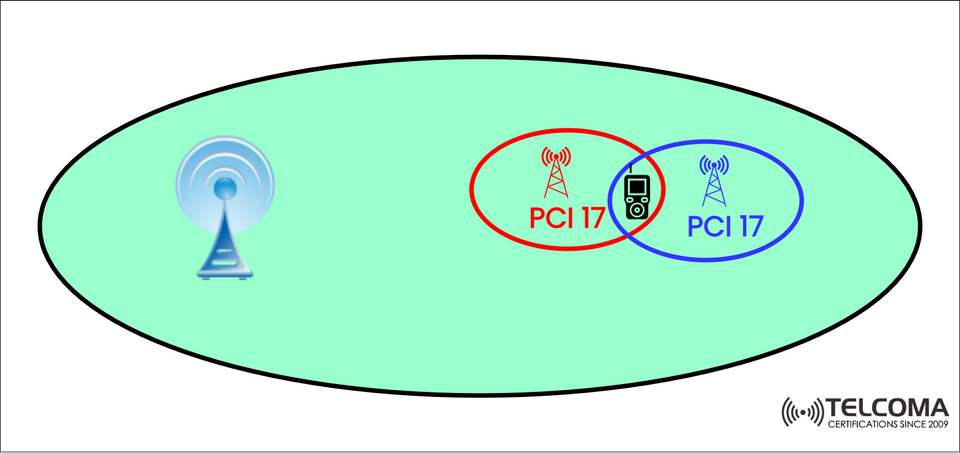
The uploaded image is an illustration of a PCI conflict; both of these cells (in different physical locations) are separately broadcasting PCI 17 in overlapping coverage areas. This generates a blue and red cell, and causes ambiguity for the UE so that it cannot distinguish both cells reliably.
PCI Issues:
Type Description
PCI Collision Two neighboring cells use the same PCI and their signals overlap; if the UE attempts to hand-over or decode information from the same PCI Cells it will experience a failure or degradation.
PCI Confusion Two cells that are remote using the same PCI will appear as neighbors due to reflections or mobility of the UE; however, hand-over will fail or degrade.
📉 Impact of PCI Conflicts on Network Performance
The network has one or more impending PCI conflicts; the network as a whole might experience:
❌ Call drops due to failed or incorrect handover
📶 Synchronization issues during cell selection
🔁 Re-selection loop as the UE is trying to lock onto a stable Cell
🔍 Ambiguous neighbor relations in the ANR
🛠️ Finding and Fixing PCI Conflicts
Detection Techniques:
📈 Drive Testing: Using TEMS, Nemo or Rohde & Schwarz, etc.
🗺️ PCI Planning Tools: Analyze the predicted coverage and predicted signal overlap
📊 SON/OMC Reports: Included as a module for automatic conflict detection
Resolution Techniques:
🔁 Reassign PCI values to accommodate planning constraints
📏 Use reuse distance planning (i.e. keep the same PCIs at least 3-5 cells apart)
⚙️ Use SON functionality to identify, assign PCIs, and optimize
🔄 After you have resolved conflicts, update neighbor relations and handover parameters
🧭 PCI Planning Best Practices
When deploying LTE or 5G, avoid PCI conflicts by adhering to the following PCI planning practices:
PCI Planning Guidelines:
Avoid reusing PCIs in the same three tier ring of neighbors
Reserve PCI ranges for certain indoor small cell usage
Consider physical layer interference when determining PCI reuse
In high density urban deployments, periodically audit PCI assignments
🤖 The Role of SON in PCI Conflict Management
As the LTE and 5G landscape continues to densify, manual PCI (Physical Cell Identity) planning process becomes less pristine, less accurate and error prone. In this regard, SON (Self-Organizing Networks) enables network operators to manage PCI conflicts in a dynamic and efficient way.
Top SON Capabilities Associated with PCI:
Automatic PCI Assignment (A-PCI):
This feature assigns non-conflicting PCI values to newly added cells in real-time based on current network topology.
Conflict Detection And Resolution:
Detects overlap or reuse of PCI values in neighbouring lists.
Automatic Reassignment:
Initiates the process of cell PCI reassignment when a PCI conflict, or less than ideal PCI, is detected in real-time.
Advantages of SON in PCI Management:
💡 Reduces human error in dense deployments
🔄 Adapts dynamically to new cells being added, or when there are changes in network topology
⚡ Speeds up roll outs of small cells and 5G NR
📉 Reduces outage during PCI correction, and the zero-touch automation yields little if any outage
🌍 Real World Scenario: PCI Conflict In Urban Microcells
In dense urban deployments, and heterogeneous networks (macro + micro + femto), the likelihood of a PCI conflict occurring increases due to:
-Limited PCI pool (504 values)
-Irregular cell geometries
-Multipath and signal reflections
-Fluid UE mobility behaviour
Case Study: A user equipment (UE) detects two cells with PCI 17 from different eNodeBs, as the same PCI is erroneously used due to overlapping coverage. The UE tries to decode SIB1 using the first PCI 17 it saw when it arrived in the area, however the other eNodeB with the same PCI 17 had a better signal quality and the UE could not separate the cells in the overlapping coverage. Therefore, the UE does not run the cell discovery properly for the second eNodeB, and the UE fails to decode SIB1 properly. This is the effect of not being able to separate the overlapping PCI.
✅ Conclusion
But what about PCI conflicts? They seem like a simple oversight in planning, when in fact, they can noticeably impact the stability and quality of LTE and 5G radio access networks. Fortunately, by using the detection technique, planning methods, and SON approaches outlined above, PCI conflicts can be detected, solved, and avoided.
If you have PCI planning down pat, you have mobility down pat, you will have reliable connections for end users, and you will have the best possible end user experience.
🔁 Planning for PCI vs. Optimizing PCI: A Big Picture Overview
Factor PCI Planning PCI Optimization (via SON)
Performed During network rollout Continuously during network operation
Scope Static and based on RF prediction Dynamic and based on real-time data
Tools Used RF Planning tools (e.g. Atoll) SON tools (e.g. Nokia EdenNet, Ericsson ENM)
Risk of Conflict Medium to High in dense areas Low - able to adjust to changes
Efficiency Manual and time-intensive Automated and scalable
Above are some of the key differences when looking at Planning and Optimization, especially when it comes to PCI (Physical Cell Identification). Moving forward, let’s take a look at the tips for performing a PCI deployment with little or no conflicts.
🧠 Pro Tips to Avoid PCI Conflicts
🔄 Always perform periodic PCI audits when optimizing
🧩 Include PCI planning in your RF planning models
📶 Look at inter-frequency assignments to create better reuse patterns
📡 For 5G, consider the beam-level PCI implications and sectorization
PCI assignment is critical in achieving:
✅ Seamless mobility and handovers
✅ Lower interference and retransmits
✅ Improved Quality of Experience (QoE) for users
✅ Reduced OPEX due to reduced troubleshooting
📌 Suggested Tags (for WordPress SEO)
PCI conflict resolution, LTE PCI planning, 5G SON optimization, PCI confusion in networks, self-organizing networks, PCI reuse strategy