
Pioneering 5G NR Technologies: Key Innovations Driving the Next-Gen Network
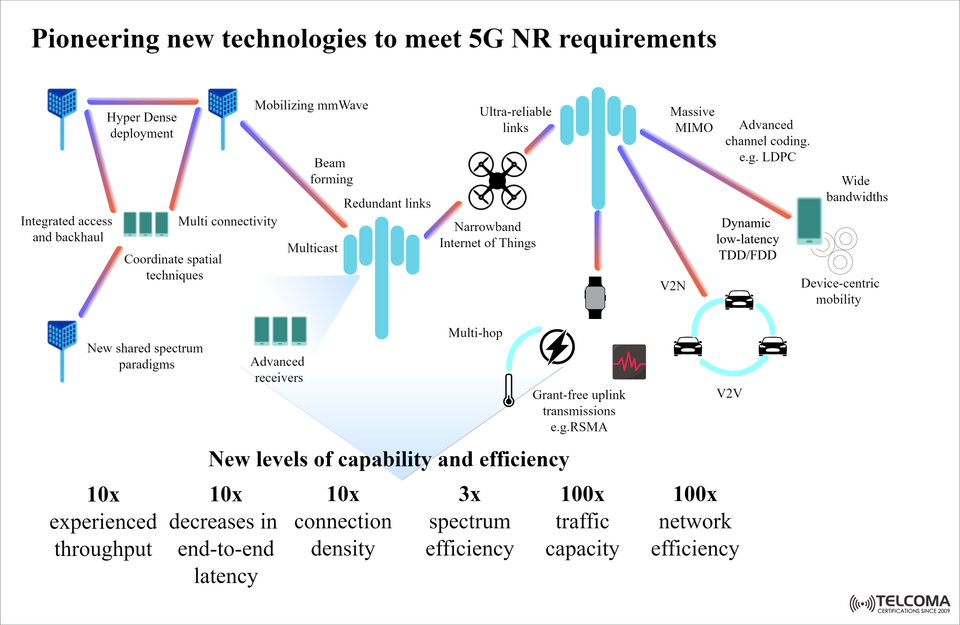

Innovative Techniques for Achieving 5G NR Goals
5G New Radio (NR) is not just faster mobile internet—it's a fundamental advancement in wireless communication. To meet its ambitious performance goals, advanced technologies must work together as an integrated ecosystem; each technology addresses a different performance goal such as throughput, latency, connection density, spectrum efficiency, and network reliability.
Next, we describe the core enabling innovations for 5G NR that were depicted in the above image:
- Hyper-Dense Deployment
Small Cells & Distributed Antenna Systems: Increases capacity in high-traffic areas.
Integrated Access and Backhaul: Using the same wireless infrastructure for user access and interconnectivity between sites.
New Shared Spectrum Paradigms: Dynamic sharing using the same spectrum during the same time period—both unlicensed and licensed spectrum are used.
Impacts:
10× experienced throughput through reduced cell sizes and increased frequency reuse.
- Mobilizing mmWave
Beamforming: Directing radio waves towards the user so that they get the best possible signal quality.
Redundant Links: Ensuring that users can maintain connectivity even if one link fails.
Multicast: Transmitting the exact same data stream to multiple users.
Impacts:
10× drop in end-to-end latency and improved bandwidth availability.
- Advanced IoT & Ultra-Reliable Links
Narrowband IoT: Low power wide area networks allow for connections to a massive number of devices.
Multi-Hop Networking: Coverage can be extended by relaying information through multiple nodes.
- Massive MIMO and advanced channel coding
Massive MIMO: Takes advantage of dozens or hundreds of antennas for spatial multiplexing.
LDPC and Polar Codes: Make error correction more efficient across changing conditions.
Dynamic Low-Latency TDD/FDD: Changes the uplink/downlink split based on traffic.
Implications:
triples spectrum efficiency and allows traffic capacity to increase 100-fold.
- Device-centric mobility
V2V (vehicle-to-vehicle) and V2N (vehicle-to-network): Allows for autonomous-driving communications
Wide bandwidths: Gives ultra-high data rates for rich media and AR/VR.
Implications:
100-fold network efficiency through allocative intelligence of resources.
Performance Targets at a Glance
Metric 5G NR Target Enabling Technologies
Experienced Throughput 10x increase Hyper-dense deployment, mmWave
Latency Reduction 10x decrease Beamforming, grant-free UL
Connection Density 10x increase NB-IoT, multi-hop, redundant links
Spectrum Efficiency 3x increase Massive MIMO, LDPC
Traffic Capacity 100x increase Massive MIMO, shared spectrum
Network Efficiency 100x increase Device-centric mobility, V2X
Conclusion
Achieving the demanding 5G NR performance requirements is not due to one break-through technology; it is the combination of numerous advanced technologies: hyper-dense deployment, mmWave activation, ultra-reliable IoT links, and massive MIMO, which then lead to extreme speed, ultra-low latency, and massive scalability.
From LTE Advanced to 5G NR: What are they capable of?
Prior to 5G NR, LTE Advanced and LTE Advanced Pro enhanced mobile networks performance by introducing higher downlink categories, advanced carrier aggregation, and enlarging MIMO capabilities. These enhancements were an extension from LTE to 5G, and fully prepared networks and devices for ultra performance.
LTE Advanced CMDA Categories (Release 12 and beyond)
LTE-A (R12) offered several major enhancements:
Larger Throughput Categories: Categories 10-15 achieved peak rates of greater than 3 Gbps under perfect conditions.
Carrier Aggregation: Combination of several carriers is presented, maintaining the same effective bandwidth.
MIMO: Increased number of antenna streams allowing for increased data parallelism.
256 QAM (quadrature amplitude modulation): Higher-order modulation yielding better spectural eficiency.
Category Max DL data rate Max CA Bandwidth MIMO Layers
Cat 10 450 Mbps 60 MHz 2x2 / 4x4
Cat 12 600 Mpbs+ 60 MHz 2x2 / 4x4
Cat 16 979 Mbps 80 MHz 4x4
Cat 18-20 1.2-2.0 Gbps+ 100-160 MHz 4x4 / 8x8
Summary: LTE Advanced built the foundation that defined high-capacity, multi-carriers, and multi-antenna procedures. 5G NR expands this foundation by using more spectrum resources and includes massive MIMO arrays.
NR Protocol Architecture: The 5G Layering approach
5G NR builds upon the protocol principles from LTE, as well as enhance to allow for more flexibility, lower latency, and increased service orientated optimizations.
Key Protocol Layers:
PHY (phy layer)
Provides a wiring interface in connectivity, modulation, coding and signalling of bits of information on the air interface.
Provides mutiple numerologies and scalable numerologies for diverse frequency bands of usage (FR1 and FR2).
MAC (media access control layer)
Provides allocation of resources to users with a goal of low latency and high reliability
Provides opportunity for grant free transmission utilizing URLLC.
RLC (radio link control layer)
Reliability with ARQ and verification of reliable data transmission
Designed efficiently for varied QoS flows, e.g. IoT data vs eMBB data for a video stream.
PDCP (packet data convergence protocol)
Header compression, ciphering and integrity protection.
SDAP (service data adaptation protocol)
Service data adaptation layer, for QoS flow mapping to data bearer.
RRC (radio resource control)
Radio resource control layer, provides control for connection setup, handovers between different radio access technologies, and security configuration.
5G has a protocol stack that is service aware, meaning it provides one set of infrastructure and protocol stack use for eMBB (enhanced Mobile Broadband) and URLLC (Ultra-reliable Low-Latency Communication) and mMTC (massive Machine Type Communication).
"
Bringing It All Together! LTE-A Foundations + 5G NR Innovations
Feature LTE Advanced 5G NR
Carrier Aggregation Up to 5 carriers (100 MHz) Up to 16 carriers (800 MHz+)
MIMO Up to 8×8 DL Massive MIMO (64T64R, etc.)
Modulation Up to 256-QAM 256-QAM and scalable OFDM numerology.
Latency ~10ms <1ms (actual URLLC mode in test used <3ms)
Frequency Range <6GHz <6GHz in addition, mmWave (FR2)
Service Types Primarily eMBB Includes eMBB and also URLLC and mMTC
Conclusion
The distance from LTE Advanced to 5G NR is not merely a generational shift, but rather a multi-layered evolution of technologies over the course of a decade. The multi-carrier aggregation, high order modulation schemes and early model MIMO that LTE-A was able to deliver were stepping stones to 5G NR's ultra-flexible spectrum use, massive MIMO, and service-aware architecture. Together they form a new era of mobile networks, capable of delivering unprecedented performance for applications ranging from autonomous vehicles to industrial IoT.