
POL All-Optical Campus Solution vs Traditional Campus Networks: A Complete Guide

POL All-Optical Campus Solution vs Traditional Campus Networks: A Complete Guide
Today's rapid digital evolution is pushing businesses, universities, and smart campuses to need a high-speed, scalable, and budget-friendly network infrastructure. Traditional campus networks typically use a three-layer switch setup (core, convergence, and access), but now we have Passive Optical LAN (POL) that offers a more streamlined, eco-friendly, and powerful option.
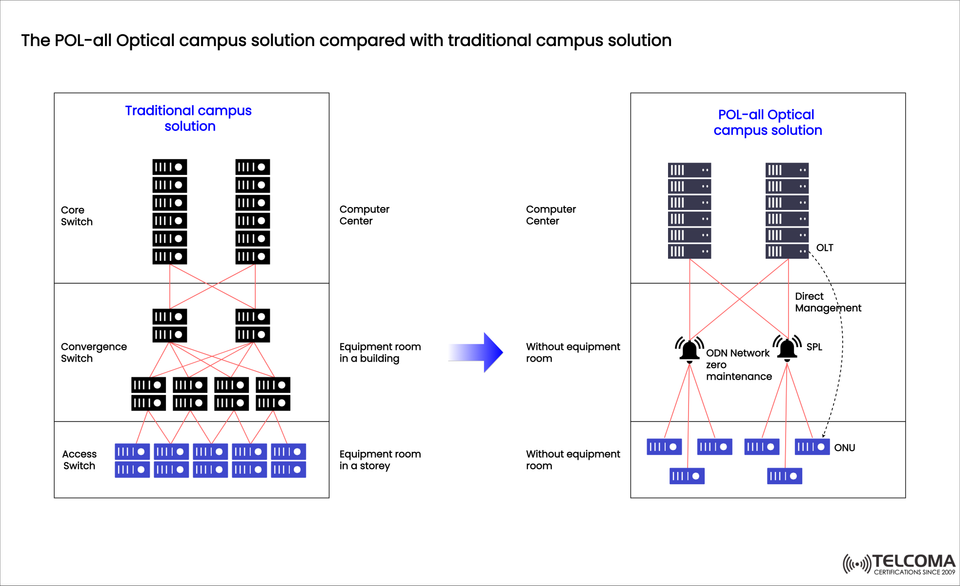
The diagram uploaded shows this change clearly: on the left, there’s a traditional campus setup filled with switches and equipment rooms; on the right, a POL all-optical campus solution powered by OLTs, ONUs, and an ODN that requires far less gear.
In this blog, we’ll dive into how these two solutions stack up against each other, why POL is becoming more popular, and what it means for the future of telecom and enterprise networking.
What is a Traditional Campus Network?
Traditional campus networks are built on a layered Ethernet switching model:
Core Switches: They provide high-speed backbone connectivity.
Convergence (Distribution) Switches: These gather traffic from several access switches.
Access Switches: They connect end devices like computers, printers, and Wi-Fi access points.
Challenges with Traditional Campus Architecture:
Need for multiple equipment rooms throughout buildings and floors.
Significant power and cooling costs because of active switching hardware.
Complicated cabling and maintenance requirements.
Scaling up for modern needs such as IoT, cloud applications, and high-definition video streaming can be tough.
What is a POL (Passive Optical LAN) Campus Solution?
A POL campus network takes advantage of Passive Optical Network (PON) technology, which is commonly used for Fiber to the Home (FTTH), and adapts it for campuses and enterprises.
Key POL Components:
OLT (Optical Line Terminal): Located in the computer center, it manages the optical network.
ODN (Optical Distribution Network): This includes passive optical splitters and fibers that distribute signals.
ONU (Optical Network Unit): Positioned close to end devices, it converts optical signals to electrical ones.
Benefits of POL:
It cuts out the need for intermediate convergence and access switches.
There’s no need for equipment rooms on each floor or in every building.
It lowers power, cooling, and space needs.
Makes network management simpler with direct OLT-to-ONU connections.
Can support a longer reach (up to 20 km as opposed to just 100 m for copper Ethernet).
POL vs Traditional Campus Network: Architecture Comparison
Feature Traditional Campus Network POL All-Optical Campus Network Core Layer Core switches in computer center OLT in computer center Distribution Layer Convergence switches in equipment rooms Eliminated (handled by ODN splitters)Access Layer Access switches at floor levels ONUs near user endpoints Cabling Copper (CAT5/6) + fiber backbone End-to-end fiber Equipment Rooms Needed at building and floor levels Not needed Power Consumption High (active switches)Low (passive splitters, fewer devices)Scalability Limited by switch capacity Scales easily with OLT ports and splitters Maintenance Frequent, with multiple active devices Minimal, with zero-maintenance ODNReach~100 meters (Ethernet)Up to 20 km (fiber)
Technical Highlights from the Diagram
The diagram shows several key differences:
Traditional Solution (Left Side):
Uses a multi-layer structure with core, convergence, and access switches.
Has equipment rooms in buildings and floors.
Complex due to inter-switch connections.
POL All-Optical Solution (Right Side):
OLT replaces the core switch in the computer center.
ODN (zero-maintenance optical distribution network) substitutes for convergence switches.
ONUs take the place of access switches, close to end devices.
No equipment rooms required, making deployment simpler and cutting costs.
Why POL is the Future of Campus Networking
- Simplified Architecture
POL cuts the network down from three layers to two (OLT + ONU).
It gets rid of convergence and access switches, lowering hardware reliance.
- Reduced Operational Costs
With fewer active devices, you see lower power and cooling expenses.
No need for equipment rooms also frees up space.
- High Bandwidth & Low Latency
POL can handle 10 Gbps (XGS-PON) or higher for equal upload/download speeds.
Perfect for video calls, VR/AR, and cloud services.
- Scalability and Flexibility
A single OLT port can cater to up to 128 ONUs through splitters.
Easy to grow by adding more OLT line cards or splitters.
- Future-Proof with Fiber Infrastructure
Optical fiber can support 25G/50G PON developments without needing to re-cable.
This ensures longevity and flexibility for evolving digital needs.
Key Use Cases of POL Campus Networks
✅ Universities & Educational Campuses
Supports e-learning, VR labs, IoT devices, and extensive Wi-Fi access point installations.
✅ Enterprises & Office Parks
Delivers high bandwidth for cloud computing, collaboration, and unified communications.
✅ Smart Cities & Government Campuses
Fuels IoT integration, surveillance, and smart services with minimal upkeep.
✅ Healthcare & Hospitals
Provides reliable low-latency connections for telemedicine, PACS imaging, and connected medical devices.
Challenges in POL Adoption
Though POL brings many advantages, there are a few challenges:
Initial Investment: The upfront costs for fiber cabling and OLT gear can be higher.
Technical Expertise: You need staff skilled in fiber optics and PON technologies.
Compatibility: Older Ethernet devices may require ONUs with Ethernet ports.
Standardization: Making sure different vendors’ OLTs and ONUs work well together is crucial.
The Telecom Operator’s Perspective
For service providers and network integrators, POL presents new prospects:
Simplified Service Delivery: It's easier to offer services that need a lot of bandwidth (like cloud, VR, and streaming).
Revenue Streams: There’s potential for premium all-optical campus packages aimed at enterprises and universities.
Operational Efficiency: Reduces the need for service calls, maintenance, and downtime.
Sustainability: Energy-efficient fiber helps lower the carbon footprint, aligning with ESG goals.
Conclusion
The POL all-optical campus solution signifies a major change from the traditional three-layer Ethernet model. By swapping out multiple switches and equipment rooms for a simpler OLT–ODN–ONU architecture, campuses can benefit from lower costs, enhanced performance, and ready scalability.
For telecom experts, choosing between traditional campus solutions and POL isn’t solely a tech decision; it’s about creating sustainable, scalable, and efficient digital infrastructure.
As businesses, educational institutions, and smart campuses continue their digital transformation journey, POL emerges as a future-proof foundation for providing fast, reliable, and low-latency connectivity.