
PON in Home: How Passive Optical Networks Power Next-Generation Smart Living

PON in Home: How Passive Optical Networks Power Next-Generation Smart Living
The need for super-fast, dependable, and low-latency home internet is at an all-time high. With the growing popularity of 4K video streaming, online gaming, VR/AR, IoT, and smart homes, traditional copper broadband is having a tough time keeping up. This is where Passive Optical Networks (PON) come in.
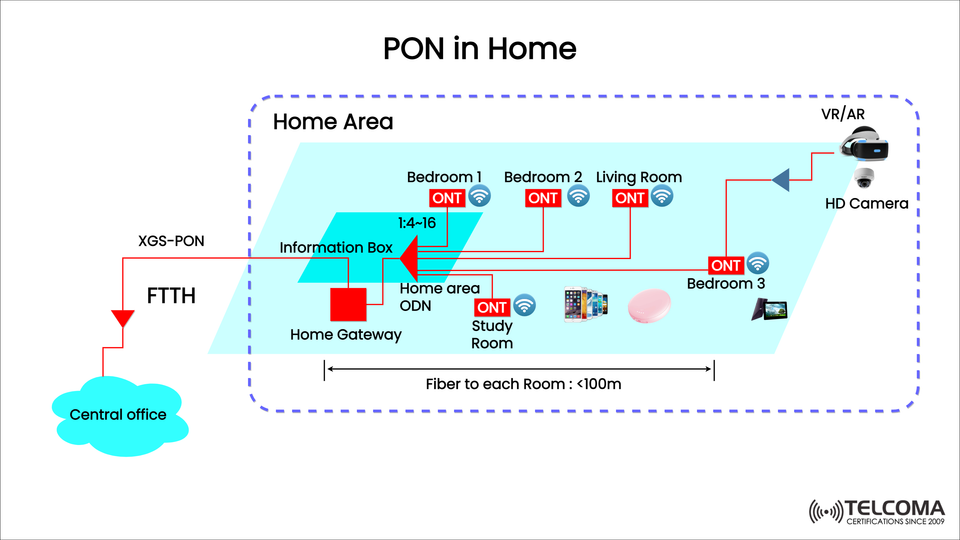
The diagram uploaded illustrates PON in a home setup, showing how Fiber-to-the-Home (FTTH), powered by XGS-PON technology, spreads high-speed internet across various rooms and devices. Let’s break down how it works, why it's essential, and how it changes modern digital living.
What is PON (Passive Optical Network)?
A Passive Optical Network (PON) is a point-to-multipoint fiber access network that utilizes optical splitters to distribute broadband from a central office to several end-users. Unlike active networks, PONs don’t need powered switching gear between the provider and the customer, which makes them:
Cost-effective – No active components in the distribution area.
Energy-efficient – Passive parts don’t need any electricity.
Scalable – One optical fiber can accommodate multiple households or devices.
Key PON Standards Relevant to Home Use:
GPON (Gigabit PON) – Offers up to 2.5 Gbps downstream.
XGS-PON – Provides symmetrical 10 Gbps speeds, perfect for households with many devices.
NG-PON2 – A next-gen evolution supporting up to 40 Gbps capacity.
How PON Works in a Home Environment
The uploaded diagram outlines the pathway of the fiber from the central office to individual devices in a home.
- Central Office → FTTH
The service provider connects fiber from the central office directly to the home gateway through FTTH (Fiber to the Home).
The XGS-PON technology allows for symmetrical 10 Gbps speeds, providing ample bandwidth for VR/AR, HD cameras, and multiple devices.
- Home Gateway & Information Box
The home gateway serves as the bridge between the external network and the internal home distribution network.
An information box (with 1:4–1:16 splitters) sends the optical signals to several ONTs inside the house.
- Home Area ODN (Optical Distribution Network)
Fiber cables run from the splitter to each room (less than 100 meters long).
This setup assures dedicated optical paths for every room, cutting down on signal loss and latency.
- ONTs in Each Room
Each room, including bedrooms, the living room, and the study, has an ONT (Optical Network Terminal).
The ONT changes optical signals into electrical signals and gives Wi-Fi or Ethernet connections to devices.
Devices like VR/AR headsets, HD cameras, laptops, and smart gadgets connect smoothly to the ONTs.
Benefits of PON in Home Networks
Implementing PON at home comes with several advantages:
- Gigabit-to-Multi-Gigabit Speeds
The XGS-PON guarantees 10 Gbps symmetrical speeds.
This enables 4K/8K streaming, VR gaming, AR collaboration, and HD surveillance without any delay.
- Low Latency Performance
Crucial for Cloud VR, AR applications, online gaming, and telehealth.
Handles latency-sensitive tasks like remote learning and cloud computing effectively.
- Full Coverage with Fiber-to-the-Room (FTTR)
Every room has exclusive fiber, ensuring no Wi-Fi dead zones.
Ideal for smart homes, where IoT devices need reliable connectivity.
- Scalability & Future-Proofing
PON can easily adapt as household devices grow in number.
Supports future enhancements (NG-PON2, 25G PON) without major rewiring.
- Energy and Cost Efficiency
Passive components help lower power usage and operating costs.
ONTs are lightweight, compact, and easy to install.
Applications Enabled by PON in Home
Let’s take a look at how various real-world applications benefit from PON in a home:
✅ High-Definition (HD) Surveillance Cameras
Smooth real-time video streaming without lag.
Supports AI-driven video analytics at the edge or in the cloud.
✅ VR/AR Entertainment
These experiences demand low-latency and high throughput.
Cloud-based VR gaming becomes feasible with 1–10 ms latency goals.
✅ Smart Home Devices
IoT devices (like thermostats, smart locks, lighting, appliances) operate without a hitch.
PON guarantees stable connections even with multiple devices in use.
✅ Remote Work & Online Learning
Symmetrical speeds ensure high-quality video calls.
Reduces jitter and packet loss for business-grade remote work.
✅ Multi-Device Streaming
Each ONT can support multiple 4K/8K streams at the same time.
Great for families with varied streaming and gaming needs.
Technical Highlights from the Diagram
Component | Function
FTTH (Fiber to the Home)|Direct fiber connection from central office to home
XGS-PON | Symmetrical 10 Gbps speeds for upload/download
Home Gateway | Central access point for all in-home connections
Information Box (1:4–1:16 Splitter) | Splits optical signals to multiple ONTs
Home Area ODN | Fiber cabling under 100m to each room
ONT (Optical Network Terminal) | Converts optical to electrical signals, provides Wi-Fi/Ethernet
Applications | VR/AR, HD Cameras, Smart Devices, Multi-device connectivity
Challenges in PON Home Deployments
Despite the advantages, there are still some hurdles to overcome:
Installation Costs – Running fiber to each room can be pricey, especially in older homes.
Device Interoperability – Standardization of ONTs and gateways from different vendors is needed.
Maintenance Complexity – Skilled technicians are essential for managing home area optical networks.
Upgrade Path – Transitioning from GPON to XGS-PON or NG-PON2 requires careful planning.
Telecom Operator Opportunities
For service providers, PON in Home isn’t just a technical installation—it opens up business opportunities:
Premium Broadband Packages: FTTR-enabled offers tailored for VR/AR and gamers.
Smart Home Bundles: Combine fiber with IoT products.
Value-Added Services: Like cloud VR gaming, remote health services, and surveillance as a service.
Customer Experience Differentiation: Delivering guaranteed bandwidth to each room.
Conclusion
The PON in Home model is paving the way for the future of residential broadband. With XGS-PON offering 10 Gbps symmetrical speeds, FTTR guaranteeing smooth room-level connectivity, and ONTs powering every device, homes can become high-speed digital ecosystems.
From VR/AR entertainment to smart security and multiple-device streaming, PON provides the bandwidth, reliability, and performance that next-gen applications demand. For telecom operators, it’s not only about connectivity—it’s about creating a smarter, immersive, and future-ready digital lifestyle.
By adopting PON widely, homes can transform into genuine fiber-driven smart hubs, opening up possibilities for immersive living experiences and more.