
Potential Applications of 6G: AI, Networking, Data Analytics, and Beyond

Possible Uses for 6G: AI, Networking, Data Analysis, and More
Even though we're still in the process of rolling out 5G, the telecom industry is already gearing up for 6G, which is expected to hit the scene around 2030. 5G has paved the way for better mobile internet, reliable low-latency communication (uRLLC), and a lot more IoT devices, but 6G aims to take things even further. It's not just about improving connectivity; it's about creating brand-new applications that seamlessly combine AI, sensing, and human experience in a fully integrated digital ecosystem.
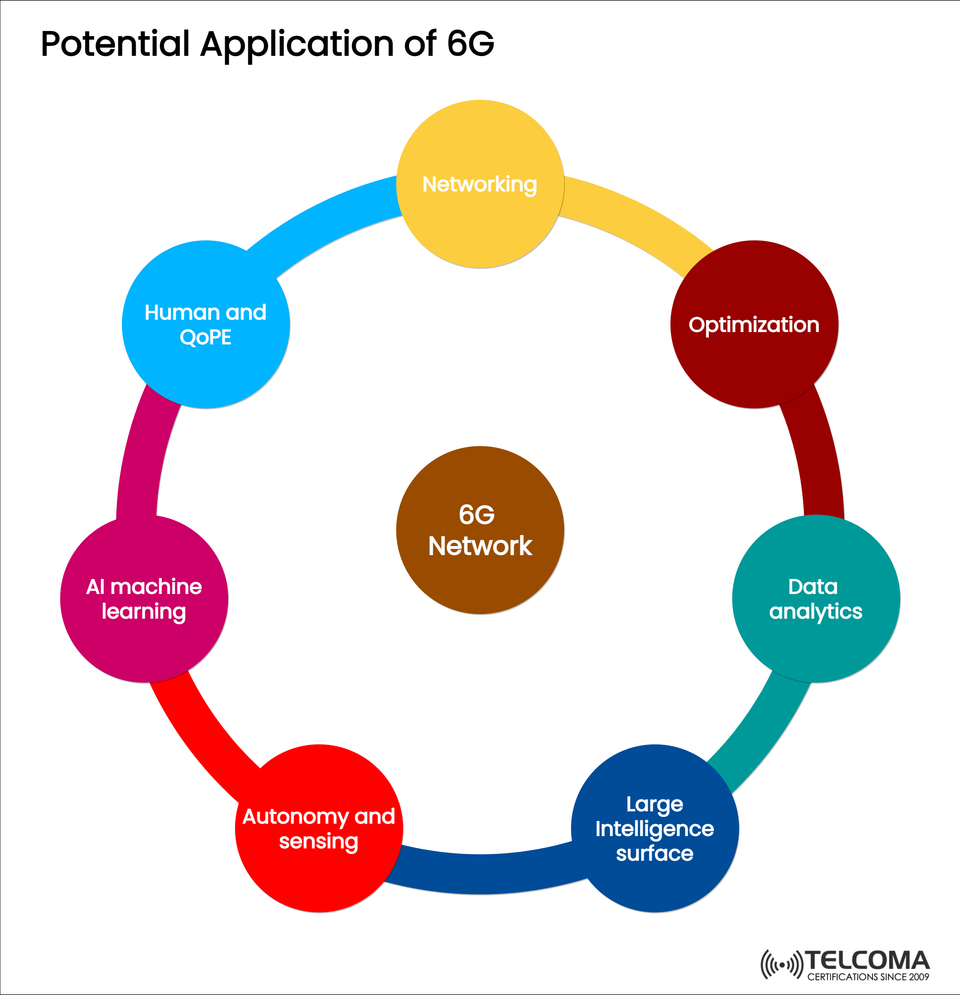
The following diagram illustrates the potential application areas of 6G:
Networking
Optimization
Data Analysis
Large Intelligent Surfaces
Autonomy and Sensing
AI & Machine Learning
Human and QoPE
Let’s dive into these areas, what they mean, and how they'll influence the future of connectivity.
- Networking in 6G
At its heart, 6G will function as a network-of-networks, seamlessly bringing together terrestrial, satellite, underwater, and aerial systems.
Key Features of 6G Networking:
Global Coverage: Merging low Earth orbit (LEO) satellites with ground-based infrastructure.
Holographic Communications: Almost zero latency for real-time 3D interactions.
Terahertz Spectrum Use: Expanding bandwidth for lightning-fast connections.
Seamless Roaming: Providing unified connectivity across various platforms and regions.
For telecom providers, 6G networking offers the promise of uninterrupted global mobility, allowing industries to tap into new services like monitoring supply chains worldwide and creating planet-wide IoT ecosystems.
- Optimization in 6G
The future networks will require self-optimizing capabilities, adjusting to real-time needs with little to no human input.
Applications of Optimization:
Dynamic Spectrum Allocation: Tweaking spectrum use for maximum efficiency.
Network Slicing on Demand: Customizing bandwidth for specific sectors like healthcare, gaming, or defense.
Energy Efficiency: Fine-tuning energy consumption for a greener infrastructure.
QoS and QoE Enhancements: Focusing on both service quality and user-perceived quality.
Optimization will shift networks from being constrained by resources to being driven by user experience, all thanks to AI-powered automation.
- Data Analytics in 6G
With trillions of IoT devices, 6G is set to produce an unprecedented amount of data. Advanced data analytics will play a key role in turning raw data into actionable insights.
Potential Applications:
Smart Healthcare: Using predictive analytics for real-time monitoring of patients.
Urban Analytics: Planning smart cities based on traffic, pollution, and energy consumption data.
Telecom Network Insights: Predictive maintenance and balancing network load.
Consumer Behavior Analysis: Crafting ultra-personalized digital services.
By embedding analytics right at the edge, 6G ensures quicker decision-making and context-aware services.
- Large Intelligent Surfaces (LIS)
One of the most groundbreaking applications of 6G is Large Intelligent Surfaces (LIS). These are advanced materials that can manipulate electromagnetic waves to boost wireless communication.
How LIS Will Change Connectivity:
Signal Enhancement: Surfaces that can be reconfigured to improve signal strength.
Energy Harvesting: Surfaces that collect ambient energy for sustainable IoT use.
Smart Environments: Buildings, vehicles, and public spaces equipped with LIS for better coverage.
Reduced Dead Zones: Clearing out weak signal areas in crowded urban settings.
For telecom professionals, LIS signals a hardware revolution, changing how radio signals interact with the environment.
- Autonomy and Sensing
6G networks will integrate native sensing capabilities, making the line between communication and sensing blur.
Applications in Autonomy and Sensing:
Autonomous Vehicles: Real-time sensing for navigation and collision avoidance.
Industry 5.0: Smart factories filled with sensors that enhance robotic collaboration.
Environmental Monitoring: Networks that can sense temperature, pollution, or disaster risks.
Defense Applications: Radar-like capabilities embedded into communication signals.
By fostering autonomy, 6G goes beyond just data transfer—it evolves into a perceptive network that can grasp its surroundings.
- AI and Machine Learning
Unlike 5G where AI is an additional layer, 6G will be AI-native. Machine learning will be built right into the core of the network.
AI-Driven Applications:
Self-Healing Networks: Automatic detection of faults and recovery.
Predictive Traffic Routing: Smart data flow based on predictive models.
Personalized User Experiences: Networks that adapt to individual user preferences.
AI-Driven Edge Computing: Quicker decision-making at the edge of the network.
AI makes sure that 6G networks are not just faster—they're also smarter and adaptable, evolving with new needs.
- Human and QoPE (Quality of Physical Experience)
A standout feature of 6G is its focus on QoPE—Quality of Physical Experience. Unlike QoS (technical quality) or QoE (user perception), QoPE directly weighs in on human sensory and cognitive experiences.
Human-Centric Applications:
Immersive XR (Extended Reality): Full-body holographic experiences.
Brain-Computer Interfaces (BCIs): Directly linking neural activity with digital systems.
Healthcare and Well-being: Monitoring physical and cognitive states in real-time.
Digital Twins: Mirroring human interactions in virtual settings for training and collaboration.
By prioritizing human experiences, 6G ensures technology becomes integrated into our everyday lives, boosting productivity, safety, and entertainment.
Comparison Table: Potential Applications of 5G vs 6G
Domain 5G Application 6G Potential
Networking eMBB, IoT, uRLLC Global coverage with satellite-terrestrial Optimization Static resource allocation AI-driven, dynamic, self-optimizing Data Analysis Limited edge data insights Massive real-time analytics across devices Intelligent Surfaces Not applicable Reconfigurable, energy-efficient LIS Autonomy & Sensing IoT + limited automation Native sensing, autonomous vehicle networks AI & ML Network optimization AI-native, self-learning, self-healing Human & QoPE QoS/QoE QoPE: human-centered, immersive integration
Conclusion
The potential uses of 6G—covering networking, optimization, data analytics, intelligent surfaces, autonomy, AI, and human-centric QoPE—showcase a transformative leap forward from 5G. More than just enhancing connectivity, 6G will fuse communication, intelligence, and human experience into one cohesive framework.
For telecom experts, these applications will reshape business models, infrastructure planning, and how services are delivered. For tech enthusiasts, 6G symbolizes a forward-thinking leap into immersive digital realms, autonomous systems, and smart environments.
As we edge toward 2030, the excitement about 6G is building—not just as a minor upgrade, but as a major shift in how humanity connects, senses, and interacts with technology.