
Potential Spectrum Regions for 6G: Sub-6 GHz to Visible Light
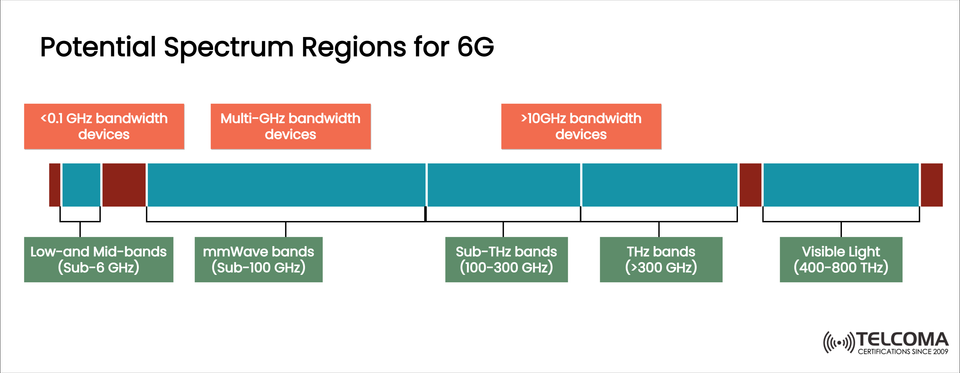

Exploring the Spectrum Regions for 6G
As the telecom sector gears up for 6G, figuring out how to allocate spectrum effectively is becoming a key focus in research and development. Unlike 5G, which mostly uses sub-6 GHz and millimeter-wave (mmWave) bands, 6G plans to dive into sub-THz, THz, and even the visible light spectrum.
The illustration we've included shows how various spectrum bands—ranging from lower and mid-bands to 400–800 THz visible light frequencies—will help shape the next generation of wireless communication.
In this blog, we’ll take a closer look at these spectrum areas, their features, uses, and the hurdles we face in creating a 6G ecosystem that's ready for the future.
The Importance of Spectrum for 6G
Spectrum is really the lifeblood of wireless communication. Each new generation of mobile tech counts on fresh frequency bands for better performance:
2G/3G → Mostly used sub-2 GHz bands for basic voice and data.
4G → Moved into higher mid-bands to enhance mobile broadband.
5G → Introduced mmWave for super high capacity.
6G → Is set to go even further, tapping into sub-THz, THz, and visible light for incredible data speeds and brand-new applications.
6G’s goal is to achieve Tbps-level speeds, ultra-low latency (<1 ms), and global connectivity for exciting things like holographic communication, digital twins, and the tactile internet.
Spectrum Areas for 6G
- Low and Mid-Bands (Sub-6 GHz)
Frequency Range: Below 6 GHz
Bandwidth Support: <0.1 GHz devices
Advantages:
Great for coverage and penetration.
Reliable, especially in rural and suburban areas.
Applications:
Nationwide coverage.
IoT and low-power devices.
Compatible with 4G/5G systems.
- Millimeter-Wave Bands (Sub-100 GHz)
Frequency Range: 24 GHz – 100 GHz
Bandwidth Support: Multi-GHz devices
Advantages:
Higher capacity than sub-6 GHz.
Perfect for dense urban environments.
Supports ultra-reliable low-latency communication (URLLC).
Applications:
Enhancements for 5G and early 6G implementations.
Connectivity for smart cities and businesses.
Edge computing and real-time services.
- Sub-Terahertz Bands (100–300 GHz)
Frequency Range: 100 GHz – 300 GHz
Bandwidth Support: Multi-GHz devices
Advantages:
Extremely high data rates.
Paves the way for new applications like holographic telepresence.
Challenges:
Limited coverage.
Prone to atmospheric absorption.
Applications:
Short-range ultra-high-speed communication.
Data centers and industrial automation.
High-density indoor settings.
- Terahertz (THz) Bands (>300 GHz)
Frequency Range: Above 300 GHz
Bandwidth Support: >10 GHz devices
Advantages:
Enables Tbps-level speeds.
Sets the stage for future tactile internet and immersive extended reality (XR).
Challenges:
Significant propagation loss.
Requires advanced antennas and beamforming technology.
Applications:
Holographic communications.
Digital twins in manufacturing and smart grids.
Wireless backhaul in urban areas.
- Visible Light Spectrum (400–800 THz)
Frequency Range: 400–800 THz
Technology: LiFi (Light Fidelity) and visible light communications (VLC)
Advantages:
Massive bandwidth potential.
No interference with traditional RF spectrum.
Secure communication in a direct line of sight.
Challenges:
Requires direct visibility.
Can be affected by obstacles and lighting conditions.
Applications:
Indoor ultra-high-speed internet.
Smart homes, offices, and hospitals.
Underwater communication.
Device Bandwidth Categories
We’ve classified devices based on their bandwidth support in these spectrum areas:
<0.1 GHz Bandwidth Devices: Operates in the sub-6 GHz range (low data speed, high coverage).
Multi-GHz Bandwidth Devices: Operate in mmWave and sub-THz bands (high speed, shorter distances).
10 GHz Bandwidth Devices: Work in THz and visible light bands (extreme speeds, very limited range).
This tiered approach ensures that various spectrum bands cater to specific use cases, creating a well-rounded ecosystem.
Advantages of Exploring New Spectrum Regions
Lightning Fast Speeds: Reaching 1 Tbps data rates.
Ultra-Low Latency: Essential for the tactile internet and critical mission services.
Widespread Connectivity: Accommodating billions of IoT devices.
Abundant Spectrum: Eases congestion in existing bands.
Future Innovations: Opens doors to new services like holograms, digital twins, and brain-computer interfaces.
Challenges in Utilizing Spectrum
Even though the future of 6G spectrum looks bright, we have some challenges to tackle:
Propagation Losses: High-frequency bands (THz, visible light) can fade quickly.
Hardware Constraints: We need advanced antennas, RF circuits, and photonic gear.
Energy Efficiency: Communication at high frequencies usually demands more power.
Spectrum Regulation: We need global coordination for rules across different regions.
Deployment Costs: Building dense infrastructure for THz and LiFi can be pricey.
Comparing Spectrum Regions for 6G
Spectrum Region Frequency Range Bandwidth Potential Coverage Key ApplicationsSub-6 GHz<6 GHz<0.1 GHz Wide Rural coverage, IoTmmWave24–100 GHzMulti-GHzUrban5G/6G densificationSub-THz100–300 GHz Multi-GHz Limited Indoor, industry THz>300 GHz>10 GHz Very short XR, holograms, digital twins Visible Light (LiFi)400–800 THz>10 GHz Line-of-sight Indoor ultra-broadband, healthcare.
🚀 6G Spectrum: From Sub-6 GHz to Visible Light 🌐
As 6G develops, its success hinges on branching out into new spectrum regions that go beyond what 5G currently offers.
📡 Potential 6G Spectrum Regions:
Sub-6 GHz → Great for wide coverage, rural areas, and IoT applications.
mmWave (24–100 GHz) → Provides high capacity for crowded urban environments.
Sub-THz (100–300 GHz) → Designed for ultra-high-speed connections in indoor and industrial settings.
THz (>300 GHz) → Achieves Tbps speeds, powering XR and holographic communications.
Visible Light (400–800 THz) → Enables secure indoor broadband through LiFi technology.
💡 Device Bandwidth Classes:
<0.1 GHz → Devices with low frequency and extensive coverage.
Multi-GHz → mmWave and sub-THz devices meant for high-speed urban use.
10 GHz → THz and LiFi devices, delivering extreme-speed for short distances.
📈 Why This Matters:
6G aims to provide 1 Tbps data rates, ultra-low latency (<1 ms), and extensive IoT connectivity. The variety in spectrum will pave the way for new applications like digital twins, holograms, brain-computer interfaces, and the tactile internet.
Understanding 6G Spectrum Regions
1/ 🚀 With 6G on the horizon, its foundation will be based on new spectrum ranges that exceed what we have with 5G. Let's dive into the key spectrum areas for 6G and their significance for the telecom industry. 👇 #6G #Telecom
2/ 📡 Sub-6 GHz
Reliable coverage with a long range, focusing on rural areas.
Serves as a massive connectivity backbone for IoT. ✅ Perfect for enhancing 5G-like coverage in 6G.
3/ ⚡ mmWave (24–100 GHz)
Already in use with 5G.
Offers ultra-fast speeds but has a shorter range.
Best for densely populated urban areas, smart cities, and stadiums.
4/ 🔬 Sub-THz (100–300 GHz)
Huge bandwidth capabilities at over 100 Gbps.
Ideal for indoor spaces and industrial automation.
Supports XR technologies, robotics, and holographic meetings.
5/ 🌐 THz bands (>300 GHz)
Achieves Tbps speeds ⚡.
Features an extremely short range.
Fuels digital twins, tactile internet, and brain-computer interfaces.
6/ 💡 Visible Light (400–800 THz)
Think of LiFi!
Provides ultra-secure, interference-free indoor broadband.
Perfect for environments like hospitals, aircraft, and other high-density setups.
7/ 📊 Device Classes in the 6G Spectrum:
<0.1 GHz → Long-range devices.
Multi-GHz → mmWave and sub-THz devices.
10 GHz → Devices leveraging THz and LiFi technology.
Each class meets varying needs for coverage, speed, and usage.
Final Thoughts
The potential spectrum regions for 6G extend far beyond what we see with 5G today. By integrating sub-6 GHz, mmWave, sub-THz, THz, and visible light bands, 6G is aiming to deliver unmatched performance.
Each spectrum area has its own role—balancing coverage, capacity, and latency. The real strength of 6G comes from its spectrum diversity, allowing applications that range from massive IoT and rural coverage to holographic telepresence and immersive XR.
For those in the telecom field, grasping these spectrum areas is key to planning strategies for allocating spectrum, investing in infrastructure, and driving innovation in the 6G landscape.