
Private 5G Networks Deployed in Public Infrastructure: Architecture and Benefits

Private 5G Networks in Public Infrastructure
The emergence of 5G technology has opened up a ton of opportunities for businesses needing secure and high-performance connections. One of the most intriguing options is setting up private 5G networks within public networks. This hybrid setup lets organizations take advantage of the reach and efficiency of public infrastructure, while also gaining the control and customization that private networks provide.
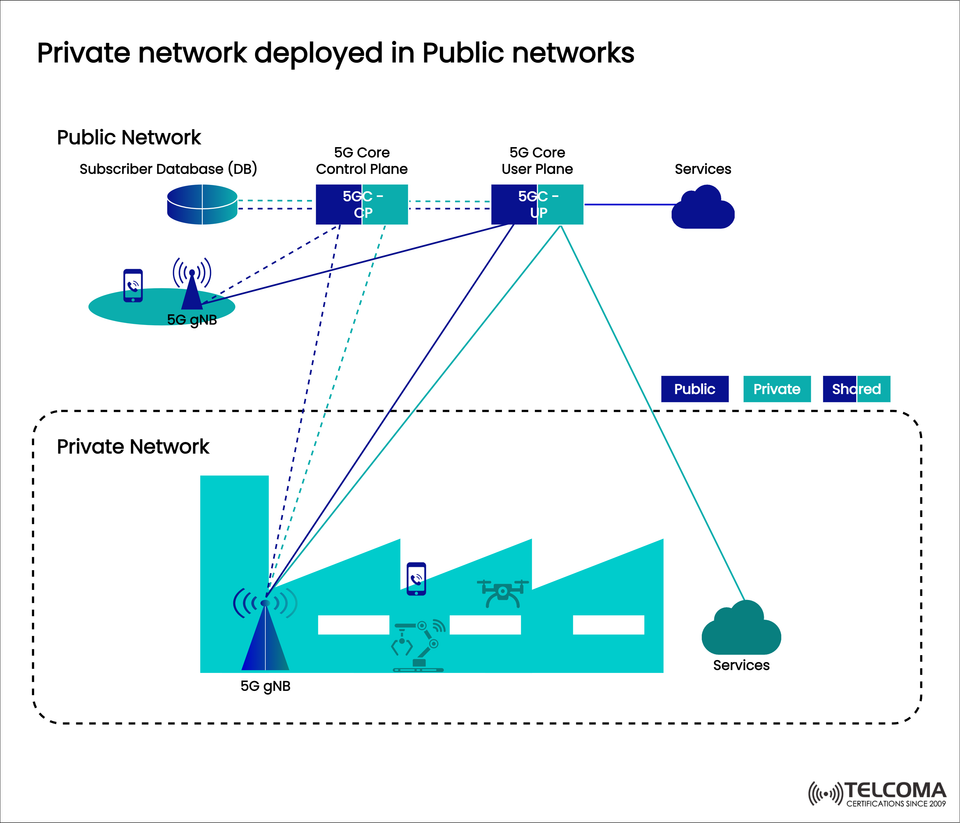
The diagram provided here illustrates how public 5G core elements (covering control and user planes) link up with customized private network setups for enterprises. Let’s break down how this operates, why it’s important, and how various industries can benefit from it.
Understanding Private Networks in Public 5G
In the past, companies in need of secure and reliable wireless connections would typically lean on dedicated private 5G networks, completely isolated from public networks. But this approach can get pretty expensive and resource-heavy.
To tackle this, telecom companies now offer shared deployments, where private networks are hosted on existing public infrastructure. Here’s what that looks like:
Enterprises can tap into dedicated resources like a private gNB (base station) and tailored services.
Core network functions, such as 5G Control Plane (5GC-CP) and User Plane (5GC-UP), might be housed in the operator’s public data centers.
Depending on what’s needed, services can be accessed from both public clouds and private enterprise clouds.
This hybrid approach blends flexibility with cost-effectiveness, allowing businesses to embrace 5G without the hefty investment of a stand-alone network.
Architecture of Private Networks in Public Deployments
The diagram you uploaded gives a clear view of how this architecture is laid out. Let’s walk through its parts:
Public Network * Subscriber Database (DB): Manages user authentication, identity, and mobility management. * 5GC – Control Plane (CP): Handles session management, mobility, and policy control. * 5GC – User Plane (UP): Takes care of data forwarding and routing to services. * Services (Cloud): Includes consumer applications like internet access, streaming, or business SaaS tools.
Private Network * Dedicated 5G gNB: Delivers enterprise-level radio access tailored for local coverage (think inside a factory or office complex). * Services (Private Cloud): Can include internal apps like robotics control, real-time analytics, or secure company communications.
Shared Integration * Some resources stay public (like the subscriber database, core network). * Others are private (enterprise services hosted on a private cloud). * Some are shared (gNBs that cater to both enterprise and public subscribers based on how they’re set up).
This combination of public, private, and shared resources maximizes infrastructure use while ensuring the enterprise's security and performance needs are met.
Benefits of Deploying Private 5G in Public Networks
- Cost Efficiency
There's no need for companies to invest in a full standalone core.
Shared infrastructure helps cut down on CAPEX and OPEX.
- Faster Deployment
Making use of existing public infrastructure speeds up time-to-market.
In many cases, there's no need to acquire separate spectrum.
- Flexibility
Hybrid resources can scale according to what the business needs.
Private services mix seamlessly with public connectivity.
- Enhanced Security and Control
Enterprise traffic can be segmented and routed to private services.
Sensitive applications (like IoT control and robotics) can remain isolated.
- Operational Simplification
Telecom providers manage core functions.
Companies can focus on their applications without needing deep telecom know-how.
Use Cases of Private Networks in Public Deployments
Industry Application Benefits Manufacturing Robotics, automation, predictive maintenance Low latency, secure factory connectivity Healthcare Connected devices, telemedicine, patient monitoring Secure data handling, reliable connections Smart Cities Surveillance, traffic management, public safety Efficient shared public/private infrastructure Offices & Campuses Collaboration tools, IoT sensors, secure access Flexible scaling, reliable enterprise services
Challenges in Deploying Private Networks on Public Infrastructure
Though this hybrid model is valuable, it comes with its fair share of challenges:
Security Management: Keeping a clear divide between public and private traffic requires rigorous policies.
Performance Guarantees: Some resources may still depend on the conditions of the public network.
Regulatory Compliance: Spectrum licensing and data sovereignty laws can differ from one country to another.
Service-Level Agreements (SLAs): Businesses must trust operators to uphold the agreed performance standards.
Future of Hybrid Private-Public 5G Networks
The path forward for 5G leans towards convergence: merging public and private setups with edge computing and cloud-native architectures. Here are some key trends to look out for:
On-demand private slices within public infrastructure, thanks to network slicing.
Edge-based deployments where enterprise applications operate closer to the production floor or office space.
AI-driven orchestration for dynamic resource allocation between public and private networks.
Pay-as-you-go enterprise connectivity models aimed at making 5G more accessible for smaller businesses.
Comparing Deployment Models: Network Slicing vs. Private Networks in Public Infrastructure
Both options utilize 5G technology to provide secure and customized connectivity for businesses, but they have distinct differences in their architecture, resource management, and level of control. Here’s a quick overview:
Aspect Network Slicing for Private 5GPrivate Network Deployed in Public Infrastructure Core Concept Logical “slices” are created on a shared physical 5G network Enterprises use dedicated g NBs/services while tapping into the operator’s public 5G core Control & User Planes Different slices for each business or service (like Smart Factory, Smart Office)Control/User Planes generally hosted in the public operator core Isolation Level Strong logical separation; businesses share physical infrastructure but get unique slices Physical RAN might be private, but control depends on the public core — less isolation compared to slicing Deployment Complexity Needs advanced orchestration and slice management Easier for businesses, since the operator handles most functions Cost Model Higher initial setup cost for slices, but efficient for multiple enterprises Lower cost, as businesses reuse public infrastructure Customization Highly customizable for each business or application (URLLC, e MBB, m MTC)Limited customization, based on the operator’s policies and SLAs Best Suited For Large businesses with varied, mission-critical needs (factories, logistics, healthcare)Medium businesses or offices wanting private connectivity without hefty infrastructure costs Scalability High — new slices can be added on the fly Moderate — scalability depends on the public network's capacity Security Traffic is isolated within slices Enterprise traffic is separated, but some reliance on public security policies remains
Which Model Should Enterprises Choose?
The best option really hinges on enterprise needs, budget, and use case priorities:
Go for Network Slicing in Private 5G if:
You’re a large enterprise with mission-critical applications.
You require ultra-low latency for robotics, automation, or AR/VR.
You seek maximum customization and independent control over services.
Opt for Private Network in Public Infrastructure if:
You’re a mid-sized business looking for private 5G at a more budget-friendly price.
You can manage with some reliance on operator cores.
You need faster deployment without the need for a standalone core.
Strategic Perspective for Telecom Operators
For service providers, offering both models is crucial for tapping into the enterprise 5G market:
Network slicing attracts Tier-1 clients (like automotive factories, healthcare facilities, and airports).
Private-in-Public deployments create opportunities with mid-market businesses (think smart offices, logistics SMEs, and retail chains).
By accommodating both options, operators can develop a tiered service portfolio, increasing their revenue while optimizing infrastructure efficiency.
Conclusion
Setting up private networks within public 5G infrastructure offers a practical and cost-effective way for businesses to get on board with next-gen connectivity. This architecture combines shared, private, and public resources, ensuring that companies can access secure, scalable, and flexible 5G services without the heavy financial load of standalone networks.
As the diagram shows, businesses can utilize the 5G control and user planes of the public network while rolling out their private gNBs and service environments. This hybrid approach is poised to speed up enterprise 5G adoption, driving innovation across sectors like smart factories, healthcare, and smart cities.
For telecom pros, this deployment model presents a key opportunity to provide unique services to businesses. For tech fans, it highlights how 5G is more than just speed—it’s about flexibility, efficiency, and digital transformation.