
Private 5G vs Wi-Fi 6: Key Differences, Benefits, and Enterprise Use Cases

Private 4G/5G vs Wi-Fi 6: The Future of Enterprise Connectivity
In our fast-evolving digital world, businesses need secure, high-performance, and flexible wireless networks to keep up with Industry 4.0, IoT, automation, and critical services. Two key technologies leading the way are Private 4G/5G networks and Wi-Fi 6 (and 6E).
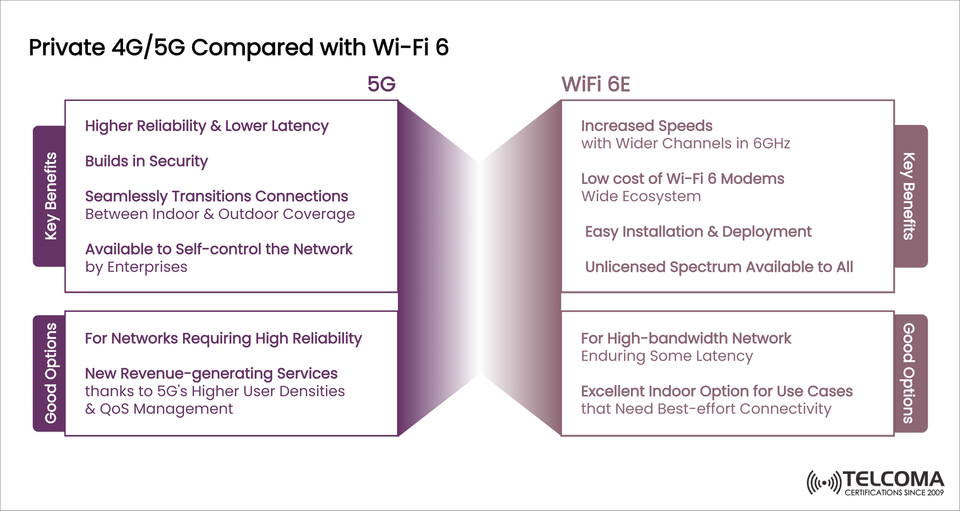
The image provided lays out the main benefits and viable options of each technology side by side, making it straightforward for network planners, IT heads, and telecom engineers to see where each one shines.
Now, let’s dive into this comparison and figure out which solution could be the right fit for your enterprise.
Overview: Why Enterprises Need Next-Gen Connectivity
Older Wi-Fi setups and public cellular networks often don’t meet the enterprise needs for low latency, reliability, and control. As companies push toward smart factories, autonomous operations, and hybrid work setups, the need for private, secure, and dependable wireless systems has really taken off.
Private 4G/5G Networks
These private cellular networks (using LTE or 5G NR) let businesses set up their own mobile networks, giving them complete control over coverage, security, and quality of service (QoS).
Wi-Fi 6 and 6E
Wi-Fi 6 (IEEE 802.11ax) and Wi-Fi 6E (which adds a 6 GHz extension) bring improvements in speed, efficiency, and capacity, making Wi-Fi even more useful in dense and high-demand environments.
Both technologies offer great value — but they fit best in different scenarios.
Private 4G/5G: Key Benefits
On the left side of the image, it’s clear that 4G/5G networks deliver several enterprise-grade benefits that go beyond what consumer Wi-Fi typically offers.
Higher Reliability and Lower Latency
Private 5G networks are built for mission-critical operations, providing consistent performance.
Latency: Often under 5 ms with URLLC (Ultra-Reliable Low Latency Communication).
Reliability: Uptime over 99.999%, making them perfect for industrial automation and robotics.
Built-in Security
5G stands out from traditional Wi-Fi thanks to SIM-based authentication and encryption (like 256-bit key management), ensuring strong protection against unauthorized access and potential intrusions.
Seamless Transition Between Indoor and Outdoor Coverage
5G supports continuous connectivity, allowing users and devices to move from indoors to outdoors without needing to re-authenticate manually or face handoff issues.
Enterprise Self-Control
Businesses can own and manage their private 5G networks — deciding access policies, prioritizing traffic, and maintaining full control over data location, which is especially important for compliance-driven sectors.
Good Use Cases for Private 4G/5G
The image also points out where private 5G really shines:
For Networks Requiring High Reliability
Here are some examples:
Industrial automation and robotics.
Smart manufacturing and supply chain operations.
Autonomous guided vehicles (AGVs) and drones.
Energy and mining sectors.
New Revenue-Generating Services
Private 5G can handle high device densities (up to 1M devices/km²) and end-to-end QoS control, paving the way for innovative enterprise applications like:
Predictive maintenance using IoT sensors.
AR/VR-based training and remote assistance.
Real-time video analytics and surveillance.
These features position 5G as a key driver for digital transformation and Industry 4.0 innovations.
Wi-Fi 6/6E: Key Benefits
On the right side of the image, Wi-Fi 6 and its extended version, Wi-Fi 6E, provide cost-effective and accessible connectivity for businesses.
Increased Speeds with Wider Channels
Wi-Fi 6E adds access to the 6 GHz spectrum, which enables:
Wider 160 MHz channels for multi-gigabit throughput.
Less interference compared to the crowded 2.4 and 5 GHz bands.
This makes Wi-Fi 6E a great option for high-bandwidth, non-critical applications like HD video streaming, AR, and general connectivity.
Low Cost of Deployment
Thanks to the global Wi-Fi ecosystem, equipment for Wi-Fi 6/6E (like routers and access points) is affordable and easy to find, making it a simple upgrade for businesses.
Easy Installation and Deployment
Setting up Wi-Fi networks is plug-and-play, especially compared to cellular networks that can require spectrum licensing and specialized infrastructure. This ease enables quick deployment across offices, campuses, and retail spaces.
Unlicensed Spectrum
Wi-Fi works in unlicensed frequency bands, which means no spectrum fees or regulatory hassles. This opens the door for even smaller organizations to establish strong wireless connections.
Good Use Cases for Wi-Fi 6/6E
From the comparison, Wi-Fi 6/6E is best suited for high-bandwidth applications that can handle a bit of latency.
For High-Bandwidth Networks
Wi-Fi 6 offers:
Speeds up to 9.6 Gbps (theoretical).
Efficient multi-user scheduling with OFDMA and MU-MIMO, making it a solid choice for video collaboration, cloud computing, and general office tasks.
Best-Effort Indoor Connectivity
Wi-Fi 6E is particularly effective in indoor settings such as:
Corporate campuses and meeting spaces.
Universities, malls, and public venues.
Homes and co working spaces.
Even though Wi-Fi 6 can’t compete with 5G in terms of latency or reliability, it offers excellent coverage for budget-sensitive, non-critical applications.
Private 5G vs Wi-Fi 6: Feature Comparison
Feature Private 4G/5GWi-Fi 6/6ESpectrumLicensed / Shared (CBRS, local licenses)Unlicensed (2.4, 5, 6 GHz)
Latency Ultra-low (<5 ms)Moderate (~10–30 ms)
Reliability Carrier-grade (99.999%)Best-effort
Mobility Seamless handover between cells Limited; session drops possible
Security SIM-based, carrier-grade encryptionWPA3 encryption
Coverage Wide-area (campus, industrial)Local (indoor)
Deployment Cost Moderate-high Low
Control Fully enterprise-managed Shared / decentralized
Use Case Examples Smart factories, logistics, autonomous systems Offices, education, retail, hospitality
This comparison shows that Private 5G is geared for mission-critical, large-scale deployments, while Wi-Fi 6 is perfect for cost-effective, high-throughput indoor networks.
Choosing Between Private 5G and Wi-Fi 6
Picking the right technology comes down to the enterprise’s connectivity needs — it’s not just about performance stats.
Choose Private 5G If You Need:
Ultra-low latency and dependable performance.
Secure, managed connectivity for critical operations.
Wide coverage across indoor and outdoor spaces.
Integration with IoT, robotics, or AI tech.
Choose Wi-Fi 6/6E If You Need:
Affordable, fast wireless for non-vital use.
Quick setup and flexibility for short-term projects.
Indoor coverage for staff and visitors.
Best-effort performance with high throughput.
In many settings, a hybrid approach — using private 5G for essential operations and Wi-Fi 6 for general access — might just be the best of both worlds.
The Future: Convergence of 5G and Wi-Fi 6
Both technologies are rapidly advancing and are not in competition but rather complementary. The industry is shifting toward seamless interoperability between 5G and Wi-Fi networks via unified management frameworks and collaboration between 3GPP and IEEE.
Emerging Trends
Private 5G slicing integrated with Wi-Fi 6 access points.
Converged network orchestration using SD-WAN and edge computing.
5G-Wi-Fi roaming and authentication interoperability (e.g., EAP-SIM).
In the future, enterprises won't have to choose between 5G and Wi-Fi — they'll use both to provide unified, intelligent connectivity.
Conclusion: Complementary Technologies for a Connected Enterprise
The comparison of Private 4G/5G vs Wi-Fi 6 showcases two powerful yet distinct wireless ecosystems.
Private 5G excels in reliability, security, and large-scale industrial automation.
Wi-Fi 6/6E stands out for cost efficiency, ease of use, and high-speed indoor coverage.
Businesses looking to achieve digital transformation, automation, and future-ready infrastructure should look closely at both technologies — often deploying them together in complementary roles.
In short, 5G provides the control and reliability of telecom, while Wi-Fi 6 brings the flexibility and affordability of IT. Together, they lay the foundation for next-gen enterprise connectivity.