
Protocol Architecture of the 5G NR Interface: Layers, Channels & Functions
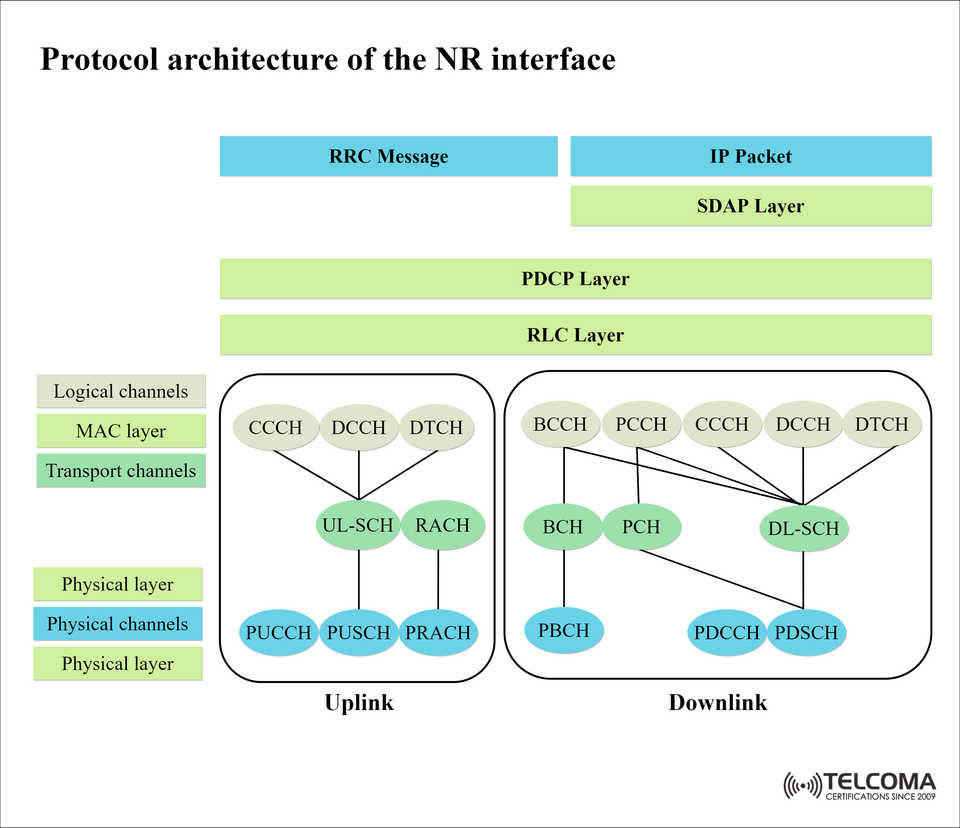

Protocol Architecture of the 5G NR Interface
Definition of the 5G New Radio (NR) protocol architecture to facilitate all the data movement between the user equipment (UE) and the 5G gNB base station. The NR protocol architecture organizes this communication into layers and types of channels to guarantee high speed, low latency, and reliable connectivity.
The following diagram breaks down how the the NR interface organizes the data flow into logical, transport, and physical channels. The diagram depicts the relationship of the channels for uplink (UL) and downlink (DL) data flow separately.
- NR Protocol Stack Upper Layers
RRC Message Layer
Responsible for control signaling between UE and gNB.
Responsible for establishing, modifying, and releasing radio bearers.
IP Packet Layer
User data is carried between the UE and the RAN (radio access network) over the radio interface (voice, video, internet traffic, etc.).
SDAP Layer (Service Data Adaptation Protocol)
Allows the mapping of Quality of Service (QoS) flows to data radio bearers to ensure that QoS compliance is maintained for each specific service type.
- PDCP & RLC Layers
PDCP (Packet Data Convergence Protocol)
Functions: header compression; ciphering; integrity protection; in-sequence delivery
Although a layer in both the user and control planes, PDCP operates for control plane signaling, as well as for general end-user communication.
RLC (Radio Link Control)
Modes: Transparent Mode (TM), Unacknowledged Mode (UM), Acknowledged Mode (AM)
Functions: segmentation, reassembly, error correction through ARQ (automatic repeat requests)
3. NR Logical Channels
Logical channels are defined by the type of information being transmitted.
Channel Direction Purpose
BCCH (Broadcast Control Channel) DL System information transmitted by broadcast.
PCCH (Paging Channel) Table 1: Downlink logical channel mapping.
- Transport Channels
The transport channels provide for information transmission through the air.
DL-SCH (Downlink Shared Channel). The primary data channel downlink.
UL-SCH (Uplink Shared Channel). The primary data channel uplink.
BCH (Broadcast Channel). Contains system information.
PCH (Paging Channel). Contains paging messages.
RACH (Random Access Channel). Initial access requests.
- Physical Channels
The physical channels are the transmitted signals over the air.
Uplink Physical Channels
PUCCH (Physical Uplink Control Channel). Contains control information.
PUSCH (Physical Uplink Shared Channel). Uplink user and control data.
PRACH (Physical Random Access Channel). Random access preambles.
Downlink Physical Channels
PBCH(Physical Broadcast Channel). Contains the contents of the BCH.
PDCCH (Physical Downlink Control Channel). Scheduling and control information.
PDSCH (Physical Downlink Shared Channel). The uplink's primary data channel.
- How uplink connects and how downlink connects
In uplink:
Logical channels (CCCH, DCCH, DTCH) transmit the data to the transport channels (UL-SCH, RACH).
Transport channels are mapped to the physical channels (PUSCH, PUCCH, PRACH).
In downlink:
Logical channels (BCCH, PCCH, CCCH, DCCH, DTCH) transmit the data to the transport channels (BCH, PCH, DL-SCH).
Transport channels are mapped to the physical channels (PBCH, PDCCH, PDSCH).
Conclusion
The NR protocol architecture provides the framework for low latency and high performance in 5G. Each type of channel serves a unique purpose with how devices communicate over air interface. Be it to provide user information, send user data, provide paging messages, or connect devices, it is important that we have a full understanding the basic relationship between logical, transport, and physical channels. This basic relationship is able to support why low latency can be achieved for users.
- How NR Protocol Architecture Differs from LTE
While the layers of LTE and 5G NR protocols contain the same seven layers or logical entities (logical → transport → physical), in 5G NR there are several optimizations that improve enhanced Mobile Broadband (eMBB), Ultra-Reliable Low Latency Communications (URLLC), and massive Machine Type Communications (mMTC):
SDAP Layer: NR includes an SDAP layer for handling Quality of Service (QoS)- there is no SDAP layer in LTE.
Flexibility in Numerology: NR supports multiple subcarrier spacings (15 kHz to 240 kHz) which allows for flexible deployment.
Integrated Beamforming: NR has a much higher level of integrated deep stack functionality between physical Layer and the MAC Layer, especially with regards to beam management.
Low Latency Support: Dedicated resources, fewer processing cycles, low latency slots for TX/RX enable less than 1 ms air interface latency.
- Example of End-to-End Data Flows in 5G NR
Uplink Example (from UE to gNB)
The Application Layer sends app data packets, the IP Layer encodes and groups the packets, the SDAP Layer maps the QoS flows to bearers, the PDCP header compresses and encrypts, RLC segments/reassembles the packets, the MAC Layer schedules and maps the data to transport channels (UL-SCH), and the Physical Layer transmits over either PUSCH or PUCCH.
Downlink Example (from gNB to UE)
The core network sends data to the gNB (to provide downlink data), while the PDPC ensures it is sent in a timely fashion and security and delivery conditions are met. It may be that some physical layer processing is handled in conjunction with the gNB now to reduce possible obstacles within the radio environment.
The RLC and MAC handle the scheduling and reliability of the delivery to the UE. Meanwhile, the gNB sends user data using the DL-SCH over PDSCH, which the UE needs to decode before passing into the application layer.
- Significant Advantages of NR Protocol Structure
Scalable: Can support IoT devices, smartphones, and high bandwidth fixed wireless concurrently.
Reliable: There are redundancy and integrity checks built into the protocol structure.
Efficient: It minimizes overhead for small packets (important in mMTC).
Future-Proof: It is designed to evolve to future 6G technology and beyond.
- Quick Reference Table of NR Interface Layers & Functions
Layer Function Examples
Application User services & applications Video, VoIP
RRC Connection & mobility mgmt. Bearer setup
SDAP QoS mapping eMBB, URLLC flows
PDCP Compression, encryption Integrity check
RLC Segmentation & reassembly AM, UM modes
MAC Scheduling, multiplexing UL-SCH, DL-SCH
PHY Transmitting air interface PUSCH, PDSCH
Conclusion:
Why all telecom professionals should know
The protocol architecture of the NR interface is not merely abstract— it is the foundation for all 5G communications. In other words, if you are working on optimising network performance, creating new services or troubleshooting challenging connectivity situations, you must understand how logical, transport and physical channels connect.