
Public Safety and Commercial Use Cases in 5G: Enhancing Connectivity Through Sidelink and RTT-Based Communication

Public Safety and Other Uses for 5G
The emergence of 5G is really changing the game in various fields. While it offers super-fast internet, the true strength of 5G is in mission-critical communication and low-latency connections, particularly for public safety and commercial IoT applications.
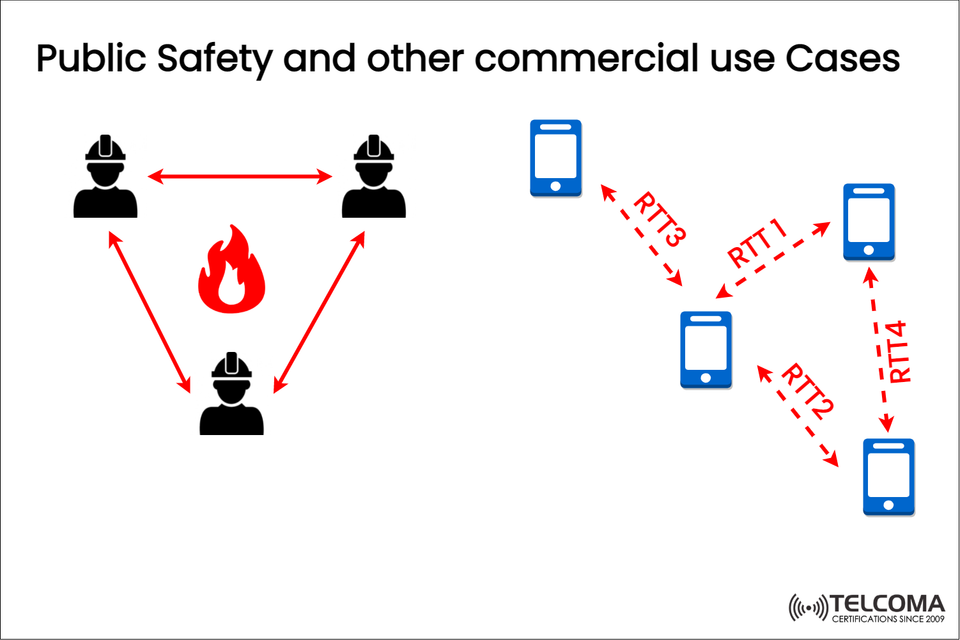
The image uploaded shows two major clusters of 5G use cases:
Public safety networks that utilize direct device-to-device (D2D) communication for coordinating emergencies.
Commercial applications that use Round Trip Time (RTT)-based signaling between devices for accurate positioning and real-time reactions.
Both of these rely on the 5G sidelink interface (PC5), which plays a crucial role in ensuring dependable communication even when there's no network coverage.
Public Safety Communication: Always Ready, Direct, and Essential
Communications for public safety must stay operational under any circumstances—whether it’s a disaster, in remote areas, or when the cellular network is down.
Here’s where 5G sidelink communication becomes essential. It enables user equipment (UEs)—like radios for firefighters, helmets for rescue workers, or field sensors—to talk directly to each other without relying on the network infrastructure (gNB).
Key Concept: 5G Sidelink (PC5 Interface)
Sidelink creates a direct communication pathway between UEs, skipping the base station altogether.
Initially developed in LTE for V2X communications, 5G has improved it for public safety, industrial applications, and commercial IoT.
It can work in both in-coverage (with network assistance) and out-of-coverage (independently) modes.
A Public Safety Use Case Example
On the left side of the diagram:
Imagine three rescue workers (depicted by helmet icons) forming a triangular communication network.
The red arrows illustrate direct communication links between them, creating a sidelink mesh network.
The fire icon represents a hazardous situation where network infrastructure might be unavailable.
This setup shows how 5G makes device-to-device communication possible for:
Sharing real-time voice and video among emergency responders.
Exchanging sensor data (like temperature, location, gas levels).
Coordinating efforts without delay, even if the network goes down.
Technical Features for Public Safety:
Feature Description Device-to-Device (D2D)Enables direct links between UEs for quick, independent communication. ProSe (Proximity Services)Allows nearby UEs to discover and exchange data. Relay Mode One UE can function as a relay node to extend coverage for others. Low Latency Supports real-time data sharing, crucial for mission responses. Network Slicing Ensures public safety has a dedicated logical network with guaranteed QoS.
Benefits for Public Safety Agencies
Reliability: Functions in areas with weak coverage and during emergencies.
Resilience: Enables independent communication when base stations are down.
Security: 5G provides encrypted D2D communication, keeping mission data safe.
Efficiency: Real-time situational awareness helps improve coordination and cut response times.
This D2D mesh model aligns with 3GPP Release 17 and future updates, which focus on enhancing sidelink features for public safety and industrial usage.
Commercial Use Cases: RTT-Based Communication and Positioning
On the right side of the image, another 5G application is highlighted: commercial scenarios using Round Trip Time (RTT).
Multiple devices like smartphones or IoT nodes share RTT measurements, represented by dashed red lines labeled RTT1, RTT2, RTT3, and RTT4. This setup showcases RTT-based ranging and synchronization used for positioning, detecting proximity, or time-sensitive networking.
What is RTT (Round Trip Time)?
RTT refers to the time it takes for a signal to go from one device, hit another, and then return.
In 5G, RTT can be applied to:
Estimate the distance between devices.
Support indoor positioning and location-based services (LBS).
Synchronize devices for collaborative tasks.
Technical Overview
5G NR (New Radio) allows RTT-based measurements to achieve centimeter-level accuracy, which is especially beneficial for:
Industrial automation
Smart manufacturing
Autonomous drones
Connected vehicles
Smartphones used for indoor navigation
The RTT values (RTT1 to RTT4) shown in the diagram illustrate bi-directional timing exchanges between devices for:
Estimating distances
Monitoring signal quality
Synchronizing tasks precisely
RTT in 5G Positioning
Parameter Typical Range / Function Measurement Type Uplink/Downlink RTT Accuracy<30 cm (in ideal conditions)Frequency RangeSub-6 GHz and mmWave Use Cases Indoor navigation, asset tracking, industrial robots Standardization Defined in 3GPP Release 16, with enhancements in Release 17
RTT-based positioning forms a part of 5G’s advanced location services, which are essential for industrial IoT and commercial innovation.
Contrasting Public Safety and Commercial Use Cases
Aspect Public Safety Commercial Use Cases Communication TypeD2D via Sidelink (PC5)RTT-based data/positioning Primary Objective Mission-critical, low latency Precision positioning, data exchange Coverage Mode Often out-of-coverage In-coverage or semi-autonomous Devices First responder UEs, sensors Smartphones, IoT nodes, machines Reliability Needs Ultra-reliable (URLLC)High accuracy and synchronization Standards Base3GPP Rel-16/17 Pro Se Enhancements3GPP Rel-16 RTT and NR positioning Example Use Case Firefighter coordination Indoor navigation, industrial tracking
Integration Through 5G Sidelink Evolution
Both public safety and commercial RTT uses share the same key framework—the 5G sidelink (PC5) interface.
In Release 18, 3GPP is set to enhance sidelink further with:
NR Sidelink Relays to improve coverage.
Enhanced Positioning Assistance using RTT and AoA (Angle of Arrival).
Energy-efficient communication for battery-friendly IoT devices.
This evolution promises scalable, interoperable solutions across mission-critical and commercial sectors.
The Importance of Network Slicing and Edge Computing
To make these applications work seamlessly, 5G network slicing and edge computing (MEC) are key:
Network Slicing: Ensures public safety networks have a dedicated, isolated logical slice, guaranteeing QoS and priority traffic management during emergencies.
Edge Computing: RTT-based services along with D2D communication gain from ultra-low latency by processing data closer to where it originates.
Dynamic Resource Allocation: Ensures bandwidth and latency are assigned based on the urgency of the situation.
Challenges and Future Prospects
Even though 5G offers a robust framework, there are some hurdles to tackle:
Interoperability: Making sure D2D works smoothly across different vendors’ systems.
Security: Enhancing encryption for both device-to-device and RTT signaling.
Spectrum Management: Balancing the needs of public safety and commercial spectrum usage.
Energy Efficiency: Keeping power usage low for devices that are always active in mesh networks.
Future research into 6G aims to explore AI-driven network optimization, zero-touch service assurance, and sub-centimeter 3D positioning for cutting-edge public safety and industrial IoT frameworks.
Final Thoughts: A Unified 5G Framework for Safety and Innovation
The image does a great job highlighting the dual strength of 5G IoT—facilitating both public safety communications and commercial applications within one unified framework.
Public safety gains from direct sidelink communications, ensuring reliable coordination even when networks go down.
Commercial sectors benefit from RTT-based precision and low latency, paving the way for smarter, location-aware services.