
RACH Optimization in 5G and LTE: Two-Step vs Four-Step Random Access Procedures Explained

⚡ RACH Optimization in 5G versus LTE: Moving from 4-Step to 2-Step Access
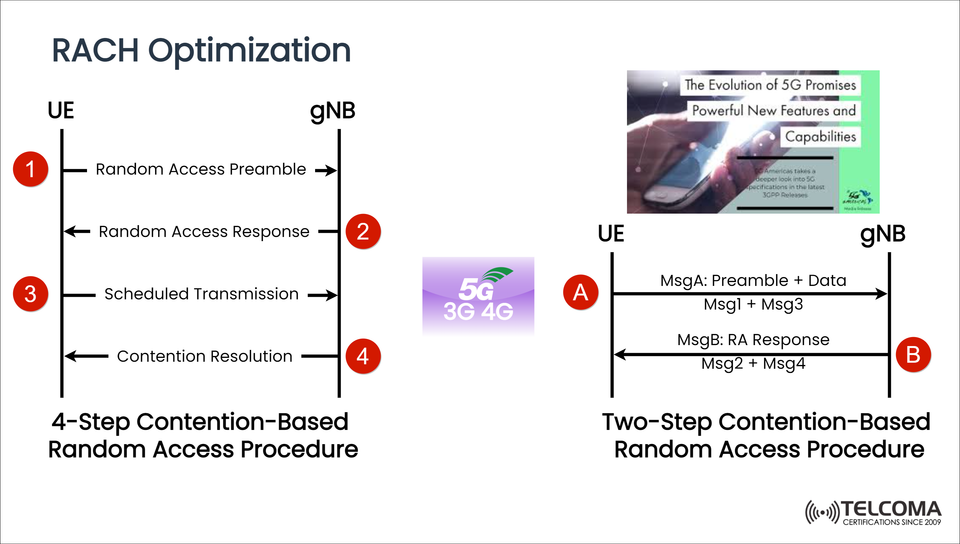
For mobile networks, the Random Access Channel (RACH) procedures are fundamental for the initial connection of the UE, during a handover, and for uplink synchronization. The diagram above illustrates the difference between the traditional RACH procedure used in 4G/LTE with 4 steps, and the optimized 2-step access used in 5G, and how 5G allows for faster access for devices and users.
As we enter more complex mobile networks, RACH optimization is important to decrease latency, reduce collisions, and also the signaling overhead, especially in dense UE environments such as IoT, smart cities, and for use cases involving high-speed mobility.
📶 Understanding RACH in LTE: 4-Step Contention-Based Procedure
Used for 4G LTE, it involves four messages separating the User Equipment (UE) and the gNB (eNodeB in LTE).
📋 The Steps:
Random Access Preamble (Msg1): UE randomly selects a preamble and sends.
Random Access Response (Msg2): The gNB sends the timing alignment and the uplink grant.
Scheduled Transmission (Msg3): The UE sends its identity and request.
Contention Resolution (Msg4): The gNB shall resolve if there were multiple UEs that sent the same preamble.
🔍 Key Features:
High signaling overhead
More likely to have a collision and delays
When UE is sparse, this procedure is acceptable.
⚙️ 5G Enhancement: Two-Step RACH Optimization
To meet 5G use cases requiring ultra-low latency and high device density, 3GPP defined a two-step, or two message, contention-based RACH optimization procedure.
📋 Process
Msg A (Msg 1+ Msg 3) - The UE sends both a preamble plus user data at the same time.
Msg B (Msg 2 + Msg 4) - The gNB replies with a resource grant plus contention resolution.
✅ Benefits
Significantly reduces access time by 50%
Reduces latency due to fewer message exchanges.
Use cases ideal for URLLC (Ultra-Reliable Low Latency Communication) support as well as massive IoT
Reduces signaling overhead, which is especially useful in dense 5G applications
📊 Comparative Table of 4-Step versus 2-Step RACH
4-Step RACH (from LTE) 2-Step RACH (from 5G)
Message Exchanged 4 2
Latency higher lower
Contention Resolutions is a separate resolution step is combined with Msg B
Ideal Use Case General use for mobile broadband URLLC specifically an mMTC or areas with high UE density
Signaling Overhead more less
📡 Real-World Use Cases of 2-Step RACH
Smart Factory. Sensor onboarding should take time. 1ms boot-
Autonomous Vehicles. Handovers from one cell to another in an instant.
Crowded Venues, Events. The initial access when the venue is crowded, is expected to be quick.
Massive IoT. Battery powered devices require energy efficient access.
🏁 Conclusion: Why RACH Optimization Matters for 5G
Moving from the existing 4-step shared RACH procedure to the newly defined
2-step RACH procedure is an important step to optimizing initial access for 5G networks. Reducing overall signaling interaction and access latency allows ultra-fast, high-reliable communications—exactly what 5G is built for and justified.
🔍Deployment Aspects of RACH Enhancements
The use of 2-step RACH is not simply a configuration setting, it's a consideration that includes layers of the Radio Access Network (RAN), core network innovation, and UE innovation.
✔️ Prerequisites:
Both gNB and UE must support 5G Standalone (SA)
gNB software must support a 3GPP Release 15 version or later
RRC parameters must be re-tuned to enable 2-step RACH procedures in selected cells
⚠️ Constraints:
Not all UEs support 2-step RACH; it's a fallback to a 4-step process
The efficiency gain is very sensitive to the configuration of timing for MsgA and the MsgA detection algorithms that were designed.
There is risk to missing a detection if MsgA decoding is incorrect.
🧠 2-Step RACH Enables Different Use Cases
The 2-step RACH process enables a lot of different next generation use cases - especially for low-latency and high-reliability:
Network Slicing: tagging slices with different RACH configurations (i.e. URLLC versus eMBB)
Massive IoT: billions of devices benefiting from shorter access opportunities and much less signaling
Emergency services: ultra-fast radio-access for mission-critical push-to-talk or video transmission
Autonomous drones and vehicles: instantaneous access to gNBs in fast handover conditions.
📘 Network Engineering Best Practice
Ideally, apply 2-Step RACH strategically to cell(s) that exhibit:
High user density
High-speed mobility
Latency-sensitive services
Track key KPIs including
Random Access Success Rate
RACH Collisions
MsgA decode success
Communicate with UE vendors to make sure devices are optimized and serviced properly
Have tight gNB firmware release dates to reflect 3GPP fixes and features
📈 Final Thoughts: RACH in 5G-Advanced and 6G
As 5G advances to 5G-Advanced, and then 6G, we can expect even more sophisticated access methods through:
AI/ML assisted access decisioning
Ultra-fast applications utilizing Grant-free RACH methods
RACH with priority based on Network Slicing for QoS-class differentiation
The transition to smart, predictive access will be paramount in supporting trillions of connections across devices, vehicles, sensors, and infrastructure.
✨ Summary
Aspect 4-Step RACH (LTE) 2-Step RACH (5G)
Message Count 4 2
Latency Higher Lower
Use Case Traditional LTE access URLLC, IOT, 5G SA
Complexity Lower Slightly higher
Efficiency of Dense Networks Limited Greatly improved
📣 Call to Action for telecom professionals
Whether you are deploying or planning to deploy 5G SA networks you should:
✅ Review your existing RACH configuration
✅ Upgrade your gNB code, so it can support the 3GPP Release 15+
✅ Monitor UE behavior and optimize your contention parameters
✅ Refresh your RF team with 2-step RACH trouble shooting and KPI education
🧩 Conclusion
RACH optimization is the first step in fully realising the capabilities of 5G. By moving to 2-step contention-based RACH, operators can not only improve latency, and throughput but also overall user experience especially in the case of dense and heavily loaded deployments.