
Radio Network Planning Outline for 5G: Capacity, Coverage, and Deployment

As the telecom industry shifts towards 5G and beyond, the complexity of network planning is growing, but it's more important than ever. A solid radio network planning outline forms the basis for designing networks that meet coverage, capacity, and performance goals without breaking the bank.
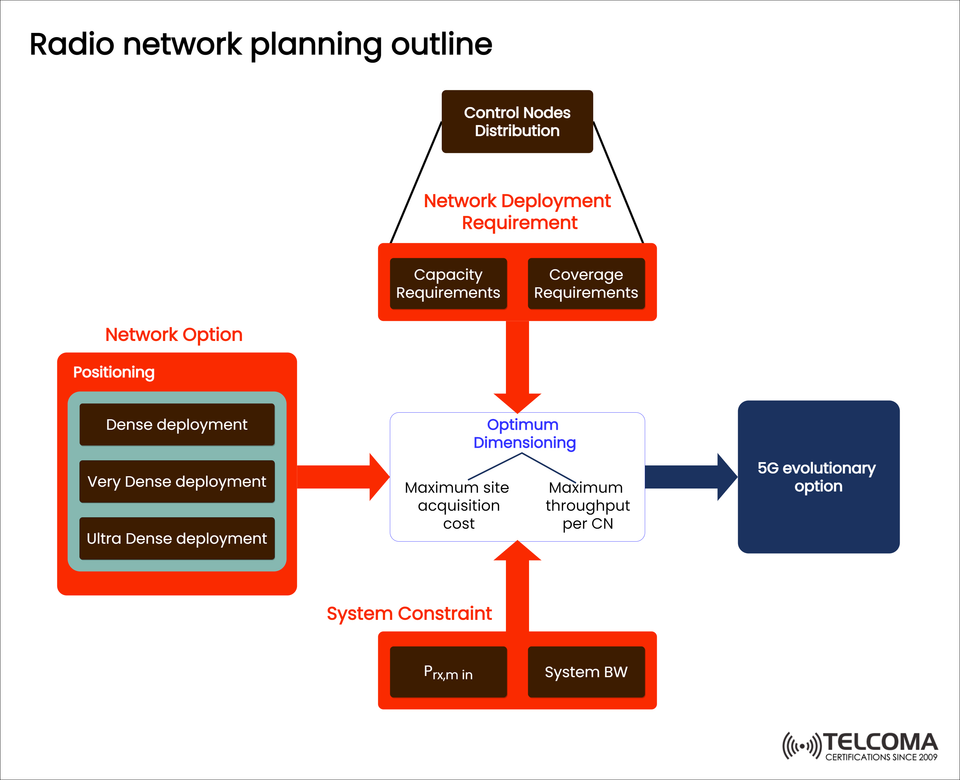
The diagram included shows the planning framework that balances deployment needs, system limitations, and smart dimensioning to create efficient 5G options. This blog breaks down each part in detail, giving telecom professionals and tech fans a clearer picture of how 5G networks come together during the planning phase.
Why Radio Network Planning Matters in 5G
The 5G era isn’t just about making small improvements to 4G. It brings a whole new level of bandwidth, ultra-reliable low-latency communications (URLLC), and massive machine-type communications (mMTC). To tackle all these different service needs, network planning must:
Ensure seamless coverage in urban, suburban, and rural areas.
Provide capacity scaling for heavy user loads.
Find a balance between site acquisition costs and throughput efficiency.
Support flexible deployment models that range from dense to ultra-dense.
Without a solid plan, operators could end up overspending on infrastructure or not delivering the performance users expect.
Key Elements of the Radio Network Planning Outline
The diagram points out four main aspects of network planning:
Network Deployment Requirement
Network Option (Deployment Density)
System Constraint
Optimum Dimensioning
Each of these plays a role in shaping the 5G evolutionary option, making sure the network is ready for the future. Let's dig into these elements.
- Network Deployment Requirement
The deployment requirements center on capacity and coverage, which are essential for radio network planning.
Capacity Requirements: This refers to how well the network can handle more users and increased data traffic. Key factors include spectrum availability, user density, and types of services (like video streaming and IoT).
Coverage Requirements: This ensures users have reliable connectivity all over the area. In 5G, it covers both macro coverage for larger regions and small cells for specific hotspots.
Control Nodes Distribution: This is crucial for determining where control elements (like gNodeBs) should be placed to optimize signaling efficiency and cut down on latency.
Takeaway: Effective planning is about balancing high user capacity with extensive and reliable coverage.
- Network Option: Positioning Strategy
Deployment strategies differ based on urban density and how users behave. The image shows three deployment models:
Dense Deployment * This is for suburban areas or medium-density cities. * It balances cost and performance by deploying a suitable number of sites.
Very Dense Deployment * Aimed at urban areas with lots of users. * This involves deploying many small cells to boost throughput and reduce interference.
Ultra-Dense Deployment * Found in megacities, stadiums, or industrial areas. * Requires a very high density of sites to support massive user connections and ultra-low latency needs.
Tip: Operators should pick the deployment density that fits their business objectives and user demand forecasts.
- System Constraint
Even the best laid plans come with technical and financial limits. Two big constraints stand out:
Maximum Received Power (P_Rx,m in): This determines the minimum power levels acceptable at the receiver, ensuring reliable communication right at the edge of cells.
System Bandwidth (BW): Spectrum is a limited resource. How bandwidth is allocated affects capacity and the quality of service we can deliver.
Insight: Good planning acknowledges these constraints and seeks inventive solutions like spectrum sharing, carrier aggregation, and advanced antenna systems (e.g., Massive MIMO).
- Optimum Dimensioning
Optimum dimensioning connects all the planning components. It’s about finding the right balance between site costs and network performance.
Maximum Site Acquisition Cost: Each new base station site adds to operational and capital costs. Planning has to keep costs in check while still providing the necessary coverage.
Maximum Throughput per Control Node (CN): This is the highest data capacity a single node can manage. It’s key to ensuring scalability without overwhelming parts of the infrastructure.
By optimizing dimensioning, operators can strike a balance between being cost-effective and delivering a good user experience.
Integrating Optimum Dimensioning with 5G Evolution
The result of all this is a 5G evolutionary option. Different from 4G, where the focus was mostly on coverage, 5G planning incorporates more complex factors like:
Beamforming for better coverage.
Network slicing to customize services for specific sectors (IoT, AR/VR, automotive, etc.).
Dense small-cell deployment to handle capacity hotspots.
Cloud-native core integration for better scalability and automation.
This ensures that the network transitions smoothly while supporting new business models and use cases.
Radio Network Planning Workflow
Here’s a straightforward workflow for the planning process based on the diagram:
Define Deployment Requirements * Capacity demands * Coverage needs * Control node distribution
Select Deployment Option * Dense / Very Dense / Ultra Dense
Factor in System Constraints * Power reception levels * Bandwidth availability
Perform Optimum Dimensioning * Balance site acquisition costs against throughput per CN
Choose the 5G Evolutionary Path * Implement scalable and future-ready solutions
Benefits of Effective Radio Network Planning
A well-organized planning process brings a number of benefits:
Cost Efficiency: Helps avoid unnecessary site deployments and cuts down on OPEX/CAPEX costs.
Performance Optimization: Ensures high throughput and low latency for users.
Future-Proofing: Prepares networks for evolving 5G services and beyond.
Seamless User Experience: Provides reliable coverage across different areas and service types.
Conclusion
The radio network planning outline serves as a roadmap for creating efficient, cost-effective, and future-ready 5G networks. By weighing deployment needs, system limits, and optimum dimensioning, operators can offer top-notch performance while keeping costs manageable.
As 5G moves towards 6G, planning is set to become even more dynamic, incorporating AI automation, green energy solutions, and tighter links with cloud-native architectures. For now, mastering this planning process is key for any operator wanting to stay competitive in the telecom field.