
Radio Unit (RU) Hardware Architecture Explained: Components & Functions for 5G & Beyond
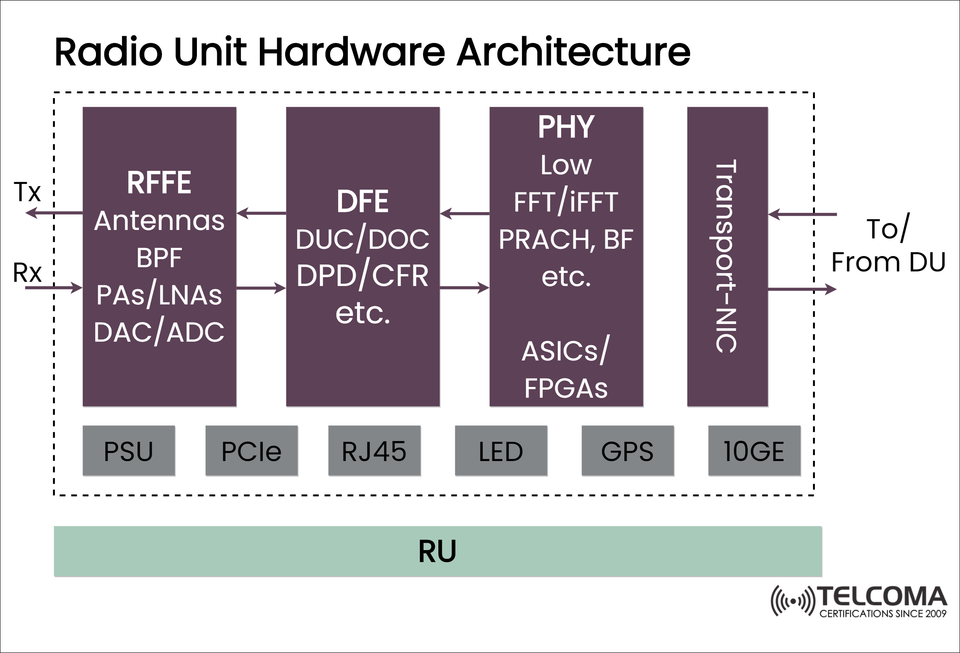

Radio Unit Hardware Architecture: an Overview for 5G Professionals
As 5G Networks scale quickly, understanding the radio unit (RU) hardware architecture is important knowledge for engineers working in telecommunications and tech-savvy enthusiasts. This article breaks down the components of a modern RU, using the diagram above to illustrate each component and explain how they process the wireless wireless signal as it travels through Radio Access Network (RAN) from when it’s transmitted to when it’s received.
🔍 What is a radio unit (RU)?
A RU is a function of the Open RAN architecture and includes the analog to digital and digital to analog conversion of signals, radio frequency amplification and low-level processing. The RU is situated near the antennas and operates using a high-speed transport interface to communicate with the Distributed Unit (DU). The RU communicates with the DU using Open Fronthaul, such as eCPRI.
🧠 RU HARDCWARE ARCHITECTURE: a block-by-block breakdown
The above diagram illustrates the physical distribution of blocks of any RU. Each block runs a critical function:
- RFFE (radio frequency front-end)
Functions:
- antennas
- bandpass filters (BPF)
- power amplifiers (PA)
- Low-noise amplifiers (LNA)
- Digital-to-Analog converters (DAC)
- Analog-to-Digital converters (ADC)
Role:
It converts signals between analog and digital formats, filters frequencies, and amplifies. The RFFE interfaces directly to antennas to transmit UDP packets in the up-link (Tx) and down-link (Rx).
- DFE (Digital Front End)
Functions:
Digital Up/Down Conversion (DUC/DOC)
Digital Pre-Distortion (DPD)
Crest Factor Reduction ( CFR)
Role:
Prepares signals to be modulated or converted to RF signals. DPD reconciles the distortions introduced by power amplifiers resulting in better efficiency and linearity.
- PHY (Physical Layer Processing)
Functions:
Low-PHY layer functions such as FFT/iFFT
PRACH (Physical Random Acces Channel)
Beamforming (BF)
It is implemented using ASICs or FPGAs.
Role:
Performs the low-level signal processing necessary to perform communications, synchronization, and channel estimation.
- Transport-NIC (Network Interface Card)
Functions:
Manages high-speed data transport between the RU and DU.
Primarily can be 10GE (10 Gigabit Ethernet) or higher.
Role:
When situated in the DU, the Transport NIC manages the interface with the RU using protocols such as eCPRI to achieve the lowest latency potential while providing the best reliability.
⚙️ Supporting Components
Below the core blocks, the following subsystems support the RU:
📡 The Importance of RU Architecture in 5G
Performance Efficiency: The RU makes the operation of the Distributed Unit (DU) faster when it reduces latency by taking over part of the function of the physical layer
Flexibility: The RU allows for modular design and development of equipment from even different manufacturers and can enable different configurations of frequencies used and antenna
Scalability - The RU a useable form factor for massive radio densification as the network introduces many smaller distributed RUs in its urban deployments
Open RAN Compatibility: The RU has standard interfaces to enable multi-vendor integration and the ability to develop and include open innovation.
✅ In Closing
To achieve maximum deployment and operational efficiencies for 5G networks it is important to develop an understanding of RU hardware architecture. Each part of the RU (RFFE to Transport-NIC) are components to maintain signal integrity, latency, and to maximize network performance. Understanding the RU's architecture in context of the move towards Open RAN and disaggregated architecture, can allow future telecom professional's to better develop more agile and resilient networks.
🔄 wHOW are RU Hardware Architectures Implemented
The RU hardware architecture depicted is not an experimental example and is operating in a real 5G network environment all over the world. Here's how telecom operators utilizing RUs in their real deployments:
📍 Urban Small Cells
Use Case: Correct small cell densification efforts in municipalities experiencing very high user density.
🌐 Massive MIMO Deployments
Use Case: Additional capacity at Macro cell towers.
🛰️ Private 5G Networks
Use Case: Enterprise or campus networks for industries like manufacturing or logistics.
RU Role: Typically deployed with ruggedized hardware and optional GPS based synchronization.
Key Focus: Low power consumption, integrates easily with DUs/CUs, and provides a flexible interface option.
🛠 Best Approaches to Use RU Hardware
When designing or working with RUs, telecom engineers and integrators would benefit from considering the following items:
✅ Synchronizing and Timing
Use GPS or IEEE 1588v2 (PTP) to synchronize clocks, particularly for TDD systems.
Keep clocks accurate to continue synchronizing DU and the RU.
✅ Thermal Management
RUs generate a lot of heat especially when using power amplifiers.
Use advanced cooling techniques such as heat sinks, fans, or even in some cases liquid cooling (on high power units).
✅ Transport Efficiency
On the transport side, use eCPRI or RoE (Radio over Ethernet) to transport fronthaul data as efficiently as possible.
Consider using Time Sensitive Networking (TSN) to improve QoS and minimize latency.
✅ Ability to Evolve Hardware
When it comes to a RU's hardware, use FPGAs to enable PD layer evolution.
Use ASICs for better performance and power savings for larger deployments.
🔄 Future Trends in RU Architecture
As networks progress toward 6G and Open RAN, the RU Hardware is evolving.
- Integrated AI Accelerators
For real time adaptive beamforming and power control. - Software-Defined Radios (SDR)
Allow for dynamic configuration of frequency bands and protocols using software. - mmWave and Sub-THz Support
RUs are in the process of being redesigned to operate at higher frequencies to provide ultra-high throughput and ultra-low latency. - Cloud Native Support
Adding support for containerized functions while increasing tight integration with cloud-native DUS and CUS.
🧾 Glossary of Key Terms
DUC/DOC: Digital Up/Down Conversion — The process of frequency translation of a baseband signal.
DPD: Digital Pre-Distortion — A digital method of improving the linearity of amplifiers.
CFR: Crest Factor Reduction — The process of reducing the peaks of a signal to maximize efficiency of amplification in RF.
PRACH: Physical Random Access Channel — The means where UEs have a reference for signalling a communication wish.
BF (Beamforming): A process which directs signals toward specific locations for improve performance.
eCPRI: Enhanced Common Public Radio Interface — The modern fronthaul protocol.
🧠 Final Thoughts
It's essential to understand the Radio Unit Hardware Architecture whether you are deploying 5G RAN infrastructure or optimizing an existing network. The RU acts as the physical bridge connecting a digital world of translating, amplifying, processing, and transmitting a network of high speed data. Understanding the RFFE, DFE, PHY, and multiple Transport interfaces will help you make strategic decisions and ultimately deliver a seamless experience for the customers of your networks.