
RAN Processing Pipeline: User and Control Plane Components Explained

Introduction: The Importance of the RAN Processing Pipeline
The Radio Access Network (RAN) serves as the link between mobile devices and the core network. How well it operates significantly affects the network's performance, latency, and user satisfaction. To handle both signaling (control plane) and data traffic (user plane), the RAN employs a processing pipeline made up of various functional components.
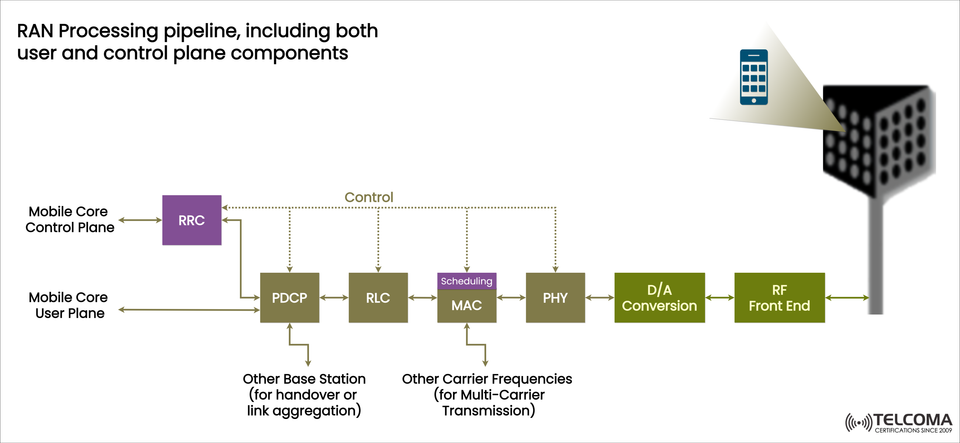
In the accompanying diagram, you can see how data and signaling flow from the mobile core through the RRC, PDCP, RLC, MAC, PHY, and finally reach the RF front end before connecting to user equipment (UE). Each part is crucial for ensuring reliable wireless communication.
Control Plane vs. User Plane in the RAN
The RAN pipeline deals with two types of traffic:
Control Plane (C-Plane): * Oversees signaling, mobility, and establishing connections. * Guarantees smooth session management and handovers.
User Plane (U-Plane): * Takes care of actual data traffic (voice, video, browsing, etc.). * Aims for high throughput and low latency.
This separation began with LTE and has been enhanced in 5G, allowing for independent scaling of signaling and data paths.
Step-by-Step Breakdown of the RAN Processing Pipeline
- Radio Resource Control (RRC)
Located in the control plane.
Interfaces with the mobile core control plane for signaling.
Functions: * Sets up, reconfigures, and disconnects connections. * Manages mobility (handover signaling). * Oversees security key management.
RRC is like the brain of the control plane, coordinating UE connections with the core network.
- Packet Data Convergence Protocol (PDCP)
Functions in both control (signaling) and user (data) planes.
Functions: * Header compression (ROHC) to cut down on overhead. * Security – ciphering and integrity protection. * Handover support – keeps data flowing.
PDCP also shares information with other base stations to aid link aggregation and inter-cell mobility.
- Radio Link Control (RLC)
Operates mainly in the user plane, but has some control functions.
Functions: * Error correction using ARQ (Automatic Repeat reQuest). * Segmentation and reassembly of PDCP packets. * Ensures reliable data transfer, even in poor radio conditions.
RLC is key for QoS assurance, especially for services like VoLTE and video streaming.
- Medium Access Control (MAC)
Connects the RLC and physical layers.
Functions: * Scheduling: Dynamically allocates radio resources among UEs. * Multiplexing: Combines data from different bearers. * Hybrid ARQ (HARQ): Quick retransmission for error correction.
The MAC layer also works with other carrier frequencies for multi-carrier transmissions, which is vital in 5G NR’s carrier aggregation.
- Physical Layer (PHY)
Turns MAC data into signals ready for transmission.
Functions: * Channel coding and decoding. * Modulation/demodulation (like QPSK, QAM, etc.). * MIMO processing for spatial multiplexing.
PHY is all about providing high throughput and reliability, adjusting modulation and coding schemes based on radio conditions.
- D/A Conversion (Digital-to-Analog Conversion)
Converts processed digital signals into analog waveforms.
Prepares signals for actual radio transmission.
- RF Front End
This is the final stage in the RAN pipeline.
Functions: * Boosts analog signals. * Filters and sends signals through the air. * Receives incoming signals from UEs.
The RF front end connects the RAN to real-world radio frequencies, completing the pipeline.
Control Flow Across the Pipeline
Across the pipeline, control signals move through various layers:
RRC manages direct communication with the mobile core control plane.
PDCP, RLC, MAC, and PHY implement control mechanisms (like error handling, scheduling, modulation) to ensure reliability.
This layered approach helps maintain robustness even in challenging wireless environments.
Interactions Beyond the Pipeline
The pipeline isn't just standalone — it connects with external components:
Other Base Stations: PDCP supports communication between base stations for handover and dual connectivity.
Other Carrier Frequencies: MAC manages multi-carrier transmission in carrier aggregation scenarios.
These interactions allow the pipeline to be adaptable and scalable, especially in 5G heterogeneous networks.
Advantages of a Structured RAN Processing Pipeline
Efficiency: Optimized handling of user and control traffic.
Scalability: Can support a massive number of device connections in 5G.
Flexibility: Allows for advanced features like carrier aggregation and MIMO.
Reliability: Incorporates error correction and retransmission mechanisms.
Security: PDCP ensures encryption and data integrity.
RAN Pipeline in 5G vs. LTE
Aspect LTE RAN Pipeline5G RAN Pipeline Control/User Separation Present, but less modular Enhanced with flexible split options Carrier Aggregation Limited to fewer bands Multi-carrier, wider spectrum usage Scheduling Centralized MAC scheduler Distributed, AI-assisted scheduling Mobility Handover-based Dual connectivity, seamless mobility Intelligence Static resource allocation Dynamic via Near-RT RIC (in O-RAN)
Future Outlook of RAN Processing Pipelines
AI-Driven Scheduling: MAC scheduling will use machine learning for proactive resource allocation.
Cloud-RAN (C-RAN): Virtualization will further separate pipeline components into centralized and distributed units.
6G Evolution: PHY and RF will adapt for terahertz frequencies, needing even more efficient processing.
Open RAN: Vendor interoperability will boost flexibility and lower costs.
Overview of the RAN Processing Pipeline
Mobile Core Control Plane ──► RRC ──► PDCP ──► RLC ──► MAC ──► PHY ──► D/A Conversion ──► RF Front End ──► UE ▲ ▲ ▲ ▲ │ │ │ │ Control Control Control Control Mobile Core User Plane ─────► PDCP ──► RLC ──► MAC ──► PHY ──► D/A Conversion ──► RF Front End ──►
The Control Plane is in charge of signaling, handling mobility, and keeping things secure.
On the other hand, the User Plane focuses on the actual transmission of user data.
There are also interconnections that support handovers, allow for multi-carrier aggregation, and manage scheduling to improve overall flexibility.
This diagram really shows how the RAN pipeline is structured in layers, making it easier to manage and optimize both signaling and data.
Conclusion
The RAN processing pipeline is the backbone of modern mobile communication, ensuring smooth interactions between the control plane (RRC, PDCP, control signaling) and the user plane (data transmission via RLC, MAC, PHY, and RF front end).
By breaking down functions into modules, the pipeline ensures reliability, scalability, and adaptability, making it a fundamental part of LTE, 5G, and even future 6G networks.
For professionals in the telecom sector, understanding these layers is essential for developing and optimizing next-gen wireless systems.