
RAN Sharing Architectures for Private 5G Networks: MORAN vs MOCN Explained
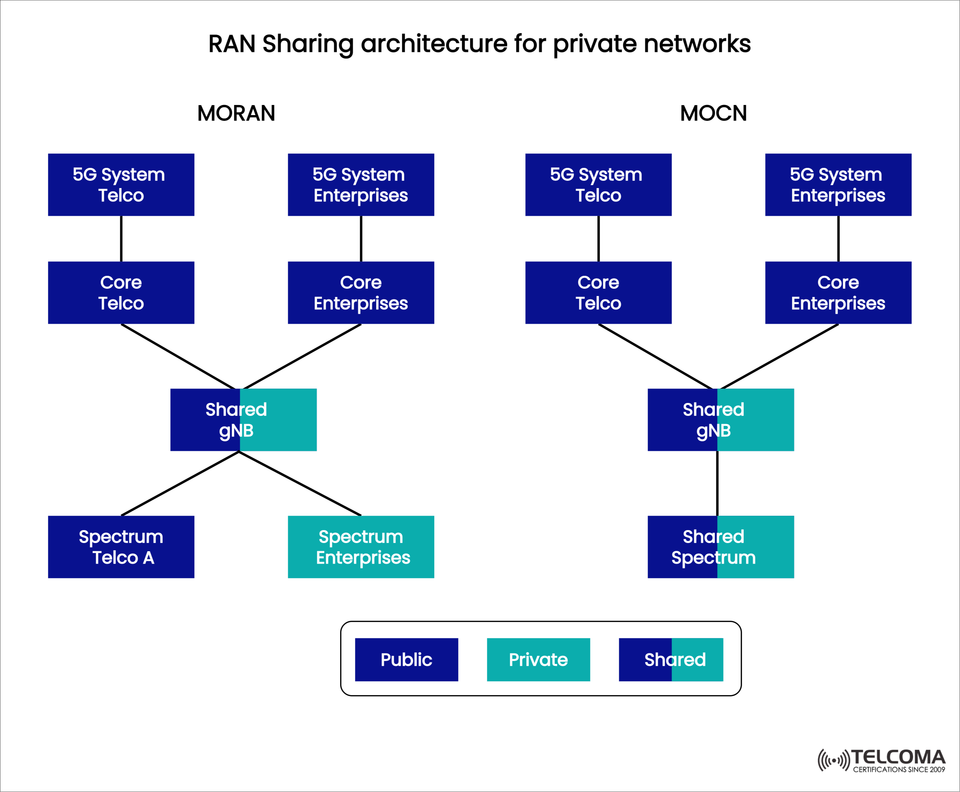

RAN Sharing Architectures for Private Networks: MORAN vs MOCN
Private 5G networks are shaking things up in various industries by providing secure, low-latency, and highly reliable connectivity. Companies in manufacturing, logistics, healthcare, and energy are jumping on board to boost automation, IoT, and essential applications.
That said, setting up a fully standalone 5G network can get pricey and complicated. To strike a balance between cost, efficiency, and flexibility, many enterprises turn to RAN sharing architectures in partnership with telecom operators. The two main approaches in play are MORAN (Multi-Operator RAN) and MOCN (Multi-Operator Core Network).
In this article, we’re going to break down how each architecture functions, highlight the key differences, and take a look at which might be more suitable for various enterprise applications.
What is RAN Sharing?
Radio Access Network (RAN) sharing allows multiple operators, both public and private, to share the same radio access infrastructure, notably the gNB (5G base station), to connect their users.
Here are some key reasons why RAN sharing is a smart move:
It cuts down on CAPEX and OPEX by avoiding duplicate infrastructures.
It supports enterprise-private and telco-public networks at the same time.
It speeds up the deployment of private 5G networks.
It optimizes spectrum usage for more efficient operations.
The two main models for RAN sharing are MORAN and MOCN.
MORAN: Multi-Operator RAN
Architecture Overview
In the MORAN model:
Both the telco and the enterprise run their own 5G cores.
A shared gNB serves as the common radio access point.
Each operator has its own spectrum — so Telco A’s spectrum and Enterprise's spectrum stay independent.
The diagram illustrates MORAN with:
Unique 5G systems for both telco and enterprises.
Separate cores (Core Telco and Core Enterprise).
Independent spectrums, but a common gNB that connects to both.
Benefits of MORAN
Spectrum Independence: Enterprises have full control over their licensed or local spectrum.
Simpler Policy Enforcement: Operators can independently apply their own policies via their respective cores.
Operational Control: Enterprises maintain autonomy over their network traffic flow.
Limitations of MORAN
Higher Spectrum Cost: Enterprises have to acquire and manage their own spectrum license.
Duplication in Spectrum Resources: Each network operates separately without pooling resources.
Limited Efficiency Gains compared to MOCN.
MOCN: Multi-Operator Core Network
Architecture Overview
In the MOCN model:
Both operators still use their own 5G cores.
The gNB is shared, just like in MORAN.
But unlike MORAN, the spectrum is also shared between the telco and enterprise.
The diagram illustrates MOCN with:
Separate 5G systems and cores.
A shared gNB and a shared spectrum pool.
Benefits of MOCN
Spectrum Efficiency: Both operators use the same spectrum, optimizing resource use.
Cost Savings: Enterprises avoid needing their own dedicated spectrum license, lowering expenses.
Simpler Deployment: Faster rollouts thanks to the shared spectrum setup.
Limitations of MOCN
Less Autonomy: Enterprises depend on the telco's spectrum and might have restricted independence.
Complex SLAs: Agreements between telco and enterprises need to clearly define spectrum usage and priorities.
Potential Policy Conflicts: Sharing spectrum could make managing traffic and ensuring quality of service more complicated.
MORAN vs MOCN: A Technical Comparison
Here’s a quick side-by-side comparison:
Feature MORAN (Multi-Operator RAN)MOCN (Multi-Operator Core Network)Shared Elements g NB (RAN hardware)g NB + Spectrum Spectrum Usage Independent (separate licenses)Shared spectrum Core Network Separate for telco and enterprise Separate for telco and enterprise Spectrum Cost for Enterprise High (must acquire spectrum)Lower (can rely on telco spectrum)Operational Control High (full autonomy with spectrum)Medium (shared control with telco)Deployment Speed Moderate Faster Efficiency Lower (no pooling of spectrum)Higher (pooled resources)
When to Choose MORAN vs. MOCN
MORAN is Best For:
Enterprises that own or have access to spectrum licenses.
Use cases needing strict data sovereignty and independence.
Industries with mission-critical control like defense, government, or energy.
MOCN is Best For:
Enterprises looking for quicker deployments without the hassle of acquiring spectrum.
Cost-sensitive sectors aiming for shared infrastructure and spectrum efficiency.
Collaborative projects where enterprises and telcos work together on resources (e.g., smart cities, logistics hubs).
Real-World Use Cases
MORAN Use Cases
Automotive Industry: Car manufacturers have private 5G networks inside production facilities with their independent spectrum.
Airports: Enterprises manage their spectrum for secure operations while also sharing RAN hardware with public operators.
Defense Facilities: Sovereignty and control over spectrum are crucial here.
MOCN Use Cases
Smart Cities: Shared gNBs and spectrum help speed up deployment and save costs.
Healthcare: Hospitals utilizing operator spectrum for swift deployment of private 5G for connected medical devices.
Warehouses and Logistics: Enterprises share spectrum to keep track of goods, drones, and autonomous vehicles.
Key Advantages of RAN Sharing in Private Networks
No matter if it’s MORAN or MOCN, both enterprises and telcos see significant benefits from RAN sharing:
Reduced Costs: Shared infrastructure lowers CAPEX and OPEX.
Faster Time-to-Market: Quicker deployments help speed up the adoption of enterprise 5G.
Flexibility: Enterprises can scale according to their needs without completely duplicating networks.
Enhanced Collaboration: Telcos can monetize enterprise needs while companies get improved connectivity.
Challenges of RAN Sharing
Despite the benefits, RAN sharing does come with some challenges:
Complex Agreements: Detailed SLAs are essential for managing responsibilities, costs, and quality of service requirements.
Interference Management: Especially in MOCN, sharing spectrum requires strong interference management.
Security Considerations: Shared RAN can open new avenues for cyber threats, necessitating strict isolating measures.
Regulatory Constraints: Spectrum usage and sharing agreements must adhere to local telecom regulations.
Future Outlook: MORAN and MOCN in the 6G Era
As 5G evolves and we look towards 6G, RAN sharing is expected to become even more dynamic and software-driven. With network slicing, these models will evolve, allowing enterprises to create dedicated virtual networks on shared infrastructure.
MORAN will likely continue to be important for heavily regulated industries that require strict independence.
MOCN will probably lead in commercial enterprise deployments for its cost efficiency and flexibility.
The shift towards “5G-as-a-Service” will also speed up, enabling telcos to offer turnkey private networks powered by RAN sharing.
Conclusion
MORAN and MOCN represent two essential RAN sharing architectures that make private 5G networks possible.
MORAN highlights autonomy and independence regarding spectrum, but it comes with higher costs.
MOCN prioritizes efficiency and cost savings via shared spectrum, but enterprises might sacrifice some control.
Both models empower businesses to tap into the benefits of private 5G without having to completely overhaul their infrastructure. Choosing the right architecture based on specific business requirements helps firms find the right balance between control, cost, and performance while speeding up their digital transformation journey.
As the telecom landscape changes, RAN sharing will remain central to private 5G deployment strategies, bridging the gap between public networks and the unique connectivity needs of enterprises.