
RAN Sharing Between Private and Public 5G Networks: Architecture and Benefits

RAN Sharing Between Private and Public 5G Networks
The quick growth of private 5G networks is creating fresh possibilities for businesses in sectors like manufacturing, logistics, healthcare, and energy. These networks offer secure, ultra-reliable, and low-latency connections that are crucial for applications such as robotics, drones, and IoT systems.
Meanwhile, public 5G networks run by mobile carriers provide extensive coverage, subscriber management, and smooth mobility. For companies, setting up a standalone private 5G system can be both expensive and complicated. That’s where RAN (Radio Access Network) sharing between private and public networks comes into play.
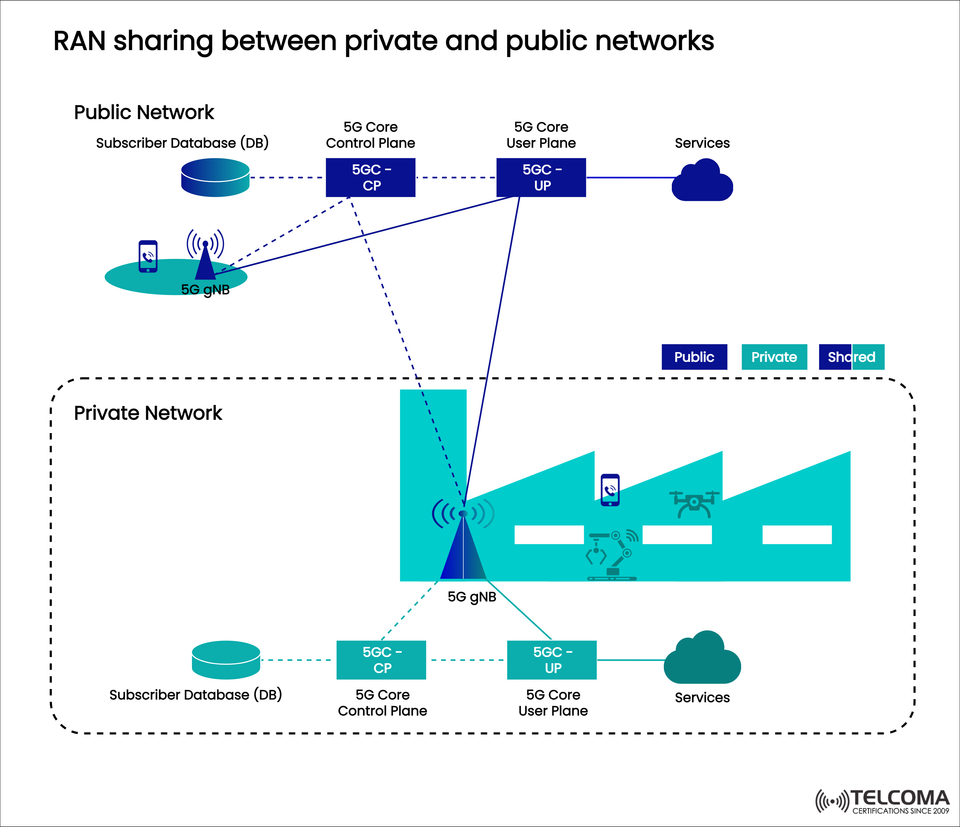
The diagram above illustrates how RAN sharing connects these two realms, allowing companies to take advantage of the benefits from both private and public 5G networks.
What is RAN Sharing?
RAN sharing is a method of deployment where both private and public 5G networks utilize the same 5G gNB (base station) infrastructure. Although the RAN is shared, the core networks (control and user planes) can either stay separate or be partially integrated, based on the arrangement.
By sharing RAN resources:
Companies can cut down on deployment costs.
Operators can broaden their service offerings.
End-users enjoy seamless mobility and coverage.
Architecture of RAN Sharing Between Private and Public Networks
The image depicts two linked domains:
Public Network Components
Subscriber Database (DB): Holds user credentials for authentication and authorization.
5G Core Control Plane (5GC-CP): Manages mobility, session control, and signaling.
5G Core User Plane (5GC-UP): Takes care of user traffic, routing data to public services.
5G gNB: A shared base station connecting both public users and private devices.
Private Network Components
Subscriber Database (DB): Keeps enterprise user profiles to ensure secure access.
5G Core Control Plane (5GC-CP): Oversees signaling and mobility for enterprise devices.
5G Core User Plane (5GC-UP): Handles local data traffic securely within the enterprise.
Services: Includes enterprise applications such as robotics, drones, and AI systems.
Shared Component
5G gNB (Base Station): Serves as the common RAN element for public and private users.
How RAN Sharing Works
Device Connection: A user device connects to the shared 5G gNB.
Network Selection: Based on subscriber info, the gNB directs the connection to either the public or private core.
Control Plane Management: Control plane signaling can be handled by either the public or private network, depending on agreements and configurations.
User Plane Routing: - Public users: Traffic passes through the public 5GC-UP to cloud services. - Private users: Traffic is managed locally in the enterprise’s private 5GC-UP for secure, low-latency services.
This setup ensures that enterprises gain from local traffic handling while still enjoying public network features like authentication and roaming.
Benefits of RAN Sharing Between Private and Public Networks
- Cost Savings
Companies can avoid duplicating RAN infrastructure.
Operators can optimize the use of their existing base stations.
- Faster Deployments
Companies can quickly implement private 5G by integrating with public infrastructure.
This shortens lead times for industries adopting Industry 4.0 applications.
- Seamless Mobility
Devices transition smoothly between private and public coverage.
The public network’s control plane ensures roaming and session continuity.
- Security and Data Sovereignty
The enterprise user plane keeps sensitive data within private boundaries.
Critical operations stay secure while utilizing shared infrastructure.
- Spectrum Efficiency
Shared RAN promotes more efficient use of available spectrum.
Reduces the need for enterprises to maintain extensive dedicated spectrum.
Challenges of RAN Sharing
While RAN sharing has clear benefits, it does come with challenges:
Integration Complexity: Getting policies, QoS, and security aligned across private and public cores can be tricky.
Data Privacy Risks: Enterprises need to ensure compliance with regulations when sharing infrastructure.
Operational Agreements: Clear SLAs between telcos and enterprises are crucial.
Security Boundaries: Additional protections must be in place to keep private traffic isolated from public flows.
Enterprise Use Cases of RAN Sharing
RAN sharing is especially beneficial in situations where companies need both local performance and broad coverage:
Smart Factories: Robotic automation, AI-enhanced production lines, and IoT sensors.
Healthcare: Hospitals using private 5G for medical imaging while doctors use public networks.
Logistics & Warehouses: Tracking autonomous vehicles and drones with smooth public-private integration.
Energy & Utilities: Secure private control for vital infrastructure while public coverage supports field workers.
Public Safety: Emergency responders utilizing secure private networks along with public fallback.
RAN Sharing vs Standalone Private 5G
Feature Standalone Private 5GRAN Sharing Model Deployment Cost High Lower (shared infrastructure)Security Full enterprise control Shared RAN, private core for security Mobility Support Limited to enterprise coverage Seamless roaming with public core Deployment Speed Slower, requires full setup Faster, leverages existing RAN Spectrum Requirement Dedicated enterprise spectrum Shared or hybrid spectrum options
Why RAN Sharing Matters for 5G Growth
The blending of private and public networks is a key driver for digital transformation. Without RAN sharing, enterprises would face significant hurdles related to costs and spectrum licenses.
By using RAN sharing models:
Operators can tap into new revenue streams with enterprise 5G services.
Enterprises benefit from cost-effective, secure connectivity.
End-users enjoy a smooth experience across public and private domains.
This collaborative approach ensures that 5G adoption speeds up across various industries, leading to scalable and future-ready ecosystems.
Future Outlook: Toward 6G and Beyond
As the telecom sector progresses towards 6G, RAN sharing is set to evolve further. With advancements like network slicing and cloud-native cores, enterprises will have the chance to request customized slices of a shared infrastructure with even more flexibility.
Going forward, shared RAN with independent user planes is likely to become the standard model, striking a balance between cost efficiency and enterprise-grade security. Operators will increasingly offer 5G-as-a-Service, enabling businesses to grow without heavy infrastructure investments.
Conclusion
RAN sharing between private and public 5G networks is a fundamental aspect of contemporary telecom architecture. By sharing base stations while keeping cores separate, enterprises enjoy secure, low-latency connections, and operators enhance efficiency and revenue.
For enterprises, it translates to affordable access to 5G for vital applications.
For operators, it presents new business possibilities in the enterprise sector.
For end-users, it ensures secure, seamless, and high-performance connectivity.
As industries continue on their digital transformation paths, RAN sharing will be crucial in bridging the divide between public network reach and private network control.