
Red Hat Development Model Explained: From Community to Enterprise with Upstream First
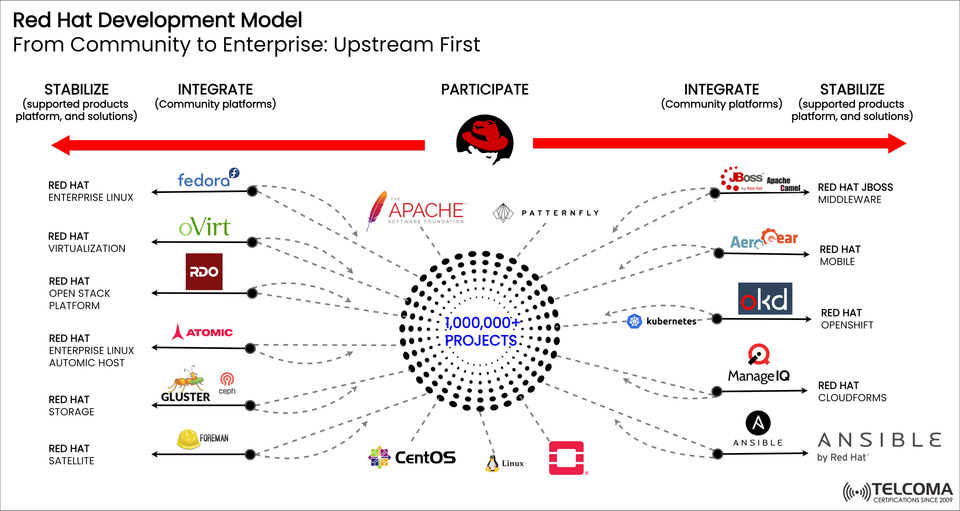

Red Hat Development Model: From Community to Enterprise - Upstream First
Red Hat, a key player in enterprise open-source solutions, employs a distinct development model designed around an Upstream First philosophy. The role of Upstream First clearly exploits the inherent separation between open-source software and enterprise-ready software products. The model allows Red Hat to innovate, stabilize, and contribute to open-source communities throughout the entire product lifecycle. Red Hat's development model is one of contributing and integrating open-source technologies into enterprise products and then stabilizing those products as supported solutions.
In this blog post, we review Red Hat's development ecosystem from a community-centric contribution to enterprise-ready products with an emphasis on some of the key platforms, tools, and technologies Red Hat has relied on.
What is an Upstream First Approach?
Upstream First designates Red Hat's involvement and contributions to open-source projects where potential integrations occur first at the community (upstream) level before integration into their enterprise offerings. The Upstream First model is built around three phases:
Participate: Contribution and participation in community projects (upstream)
Integrate: Inclusion of the promising technologies into the Red Hat ecosystem
Stabilize: Transformation of the promising technologies into reliable, supportable enterprise solutions.
This model supports innovation and positive experiences for both customers in the open-source community and the enterprise customers who come to rely on the innovation, transparency, and reliability of Red Hat products.
Community Contribution:
The Heart of the Innovation Engine
Red Hat participates in and contributes to over 1,000,000+ open-source projects, such as:
Apache Software Foundation
PatternFly
Kubernetes
Linux Kernel
CentOS
OpenStack
These projects create the baselines from which Red Hat's commercial offerings emerge. The community involvement ensures Red Hat is still engaged with the latest advances in open source.
Integration: Connecting Community and Enterprise Platforms
Red Hat integrates community platforms and tools into its ecosystem, enabling scaling and interoperability.
The list of community platforms includes:
Community Platform Red Hat Product Integration
Fedora Red Hat Enterprise Linux (RHEL)
oVirt Red Hat Virtualization
RDO Red Hat OpenStack Platform
Atomic Red Hat Enterprise Linux Atomic Host
Gluster & Ceph Red Hat Storage
Foreman Red Hat Satellite
Kubernetes Red Hat OpenShift
OKD Red Hat OpenShift
JBoss & Apache Camel Red Hat JBoss Middleware
AeroGear Red Hat Mobile
ManageIQ Red Hat CloudForms
Ansible Ansible by Red Hat
Stabilization: Deployable Enterprise Solutions
Once integrated, Red Hat puts the technology through extensive testing, security, and support to stabilize its future as enterprise-grade products. It sets a bar for performance, compatibility, and support for the long haul, appropriate for telecom operators, IT infrastructure providers, and mission-critical environments.
Benefits of the Red Hat Development Model:
✅ Ongoing innovation from the open source community
✅ Stable and secure enterprise products
✅ Accelerated time-to-market for emerging technologies
✅ Transparent development and engaged community
✅ Future-proofing platforms for hybrid and.
Conclusion
Red Hat's Upstream First development framework demonstrates how community collaboration can translate into enterprise innovation. By stabilizing community-driven technologies into production-ready solutions, Red Hat provides trusted, scalable, and secure platforms for organizations around the world. The Upstream First model allows telecom professionals, developers, and IT leaders to deploy state-of-the-art open-source tools, knowing they deliver solid outcomes.
Real-World Implications: Red Hat's Contribution to Modern IT and Telecom
Red Hat's development framework directly impacts the future of IT and telecom networks in the following ways:
- Speeding Up Innovation Cycles
Red Hat uses upstream projects to explore, test and validate emerging technologies as they appear, which dramatically shortens the development cycle for enterprise-based solutions. - Use of Standards and Interoperability
Through upstream contributions, Red Hat ensures the platforms they are building on (kubernetes, Linux, Apache, etc.) comply with the open standards process that is mandatory in telecom and multi-vendor environments. - Safe and Consistent Deployments
Stabilization incorporates enterprise-grade security patches, compliance features, and enterprise level quality assurance to meet the operational considerations of a telecom operator and cloud-native deployments.
Red Hat's Upstream First development model is a prime example of how collaboration in community leads to innovation in enterprise. By securing community based technologies into production ready solutions, Red Hat brings scalable, secure, and trusted platforms to enterprise customers around the world. This model gives telecom engineers, developers, and IT executives the confidence to adopt the most modern open-source tools.
Examples of Real-World Benefit: Red Hat is Critical in the Leading Edge of IT and Telecom Future
By supporting an upstream engagement model, Red Hat is also influencing the future of IT and telecom networks by enabling:
- Speeding Up Innovation Cycles
Red Hat employs upstream projects to engage, experimentation, and validation of emerging technologies in the real world, reducing development cycles to enterprise solutions. - Standards and Interoperability
The upstream contributions made by Red Hat assures that the platforms it builds on (Kubernetes, Linux, Apache) adhere to open standards and are successful in the telecommunications space and multi- vendor scenarios. - Security and Reliability on Deployment
Stabilization includes enterprise-level security patches, compliance features, and uncompromising QA, satisfying the operational requirements of telecom operators and cloud-native deployments. - Concluding Remarks
The Red Hat Development Model goes beyond the idea of workflow, it is a philosophy in how enterprise software can be at the leading edge, security and community oriented.
Through open source innovation, as well as reinvesting resources back into upstream projects, Red Hat not only strengthens its own ecosystem, it also contributes to a better open source world and recalls flexibility.
Though the Red Hat Development Model is understood by most telecom professionals and enterprise architects, it is key to knowing and understanding the model as they consider their informed infrastructure choices in a future that is open, hybrid and multi-cloud.