
Reference Architecture for Open RAN: A Deep Dive into RIC, CU/DU, and Protocol Layers
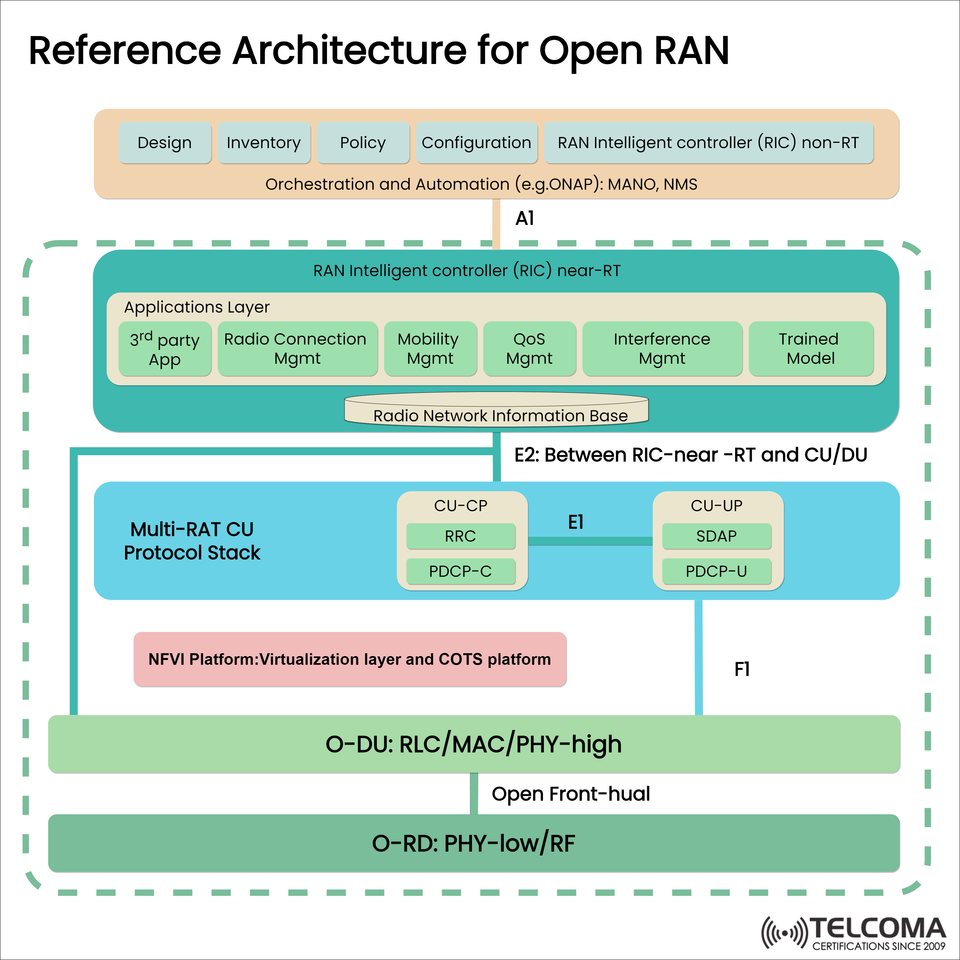

📡 Open RAN Reference Architecture: Explained for Telecom Engineers and Enthusiasts
As Open RAN has gained traction, telecom practitioners are no longer worried about its modular, intelligent, and interoperable architecture. As depicted in the image above, Open RAN Reference Architecture depicts the critical components of Open RAN, including RAN Intelligent Controller (RIC), multi-RAT Centralized Unit (CU) and Distributed Unit (DU), and their respective interfaces (E1, E2, A1).
This blog post will breakdown the Reference Architecture and explain how each layer works together to deliver cloud-native, vendor-agnostic mobile networks.
🧠 Open RAN Architectural Building Blocks
- RAN Intelligent Controller (RIC)
Open RAN divides network intelligence into two RICs:
🔹 Non-Real-Time RIC (Non-RT RIC)
Connects via the A1 interface with near-RT RIC
Implements long-term optimization functions:
Policy management
Configuration
Inventory
AI/ML model training
Design and orchestration
🔹 Near Real-Time RIC (Near-RT RIC)
Connected to CU/DU via E2 interface
Operated in 10 ms to 1 second time scales
Hosts xApps that event control:
Radio connection management
Mobility management
QoS management
Interference mitigation
3rd-party innovations
Contains the Radio Network Information Base (RNIB) for awareness of real-time state.
📶 Multi-RAT Centralized Unit (CU)
The CU is composed of:
CU-CP (Control Plane): Controls RRC and PDCP-C.
CU-UP (User Plane): Controls SDAP and PDCP-U.
Both CU-CP and CU-UP communicate over the E1 interface and are hosted on top of the O-DU (Distributed Unit). This enables separation of control and user planes, resulting in higher scalability/redundancy and flexibility.
🔧 Distributed Unit (O-DU)
The O-DU performs:
RLC (Radio Link Control)
MAC (Medium Access Control)
PHY-High (Physical Layer - High)
The O-DU connects upwards to the CU via the F1 interface and connects downwards to O-RU (Radio Unit) or O-RD (PHY-Low/RF) via Open Fronthaul (e.g. eCPRI or O-RAN Fronthaul)
📡 Open Radio Unit (O-RU / O-RD)
Also known as O-RD, the radio unit is responsible for:
PHY-Low Layer
RF Processing
The physical transmission (Tx) and reception (Rx) of the signal.
🖥️ NFVI Platform: Virtualization and Hardware Abstraction
This architecture utilizes a Network Functions Virtualization Infrastructure (NFVI) platform, which includes:
COTS (Commercial Off-The-Shelf) hardware
Virtualization layer (e.g., Kubernetes, OpenStack)
It abstracts compute and storage resources to host RIC, CU/DU, and other virtualized network functions (VNFs/CNFs).
🔗 Key Interfaces
Interface Connects Purpose
A1 Non-RT RIC → Near-RT RIC Policy, ML guidance, optimization
E2 Near-RT RIC → CU/DU Real-time control and monitoring
E1 CU-CP ↔ CU-UP Control/User plane split
F1 CU ↔ DU Split-2 interface for flexible CU/DU placement
Open Fronthaul DU ↔ RU High speed, low latency radio data delivery
🔄 Advantages of Open RAN Reference Architecture
Interoperable Vendors - open interfaces (A1, E2, E1, F1), multi-vendor ecosystem is enabled.
Programmable control – number of xApps and rApps (future proof), Near-RT RIC simply means operators can change policy in near real-time.
Disaggregated - CU, DU, RIC, RU, all can scale independently.
Machine Learning - Non-RT RIC can help train Optical/Machine Learning models and also embed 'learning' at the same time.
Cloud Native deployments - running containers or VMs on Commercial Off The Shelf infrastructure.
📊 Protocol Stack Perspective: CU and DU Functional Fragmentation
Layer Location Function
SDAP/PDCP-U CU-UP Packet data QoS and encryption functions for user plane
RRC/PDCP-C CU-CP Control layer signalling
RLC/MAC/PHY-High DU data link layer and scheduling
PHY-Low/RF RU Signal processing and transmission
🧭 Open RAN Reference Architecture Deployment Strategies
To transition to Open RAN, operators must have a phased strategy to plan, integrate, and automate. This is generally what operators do:
🔹 Phased Roadmap Deployment
Initial Trials in Greenfield or Private Networks
Phased deployments in well-defined networks (e.g., enterprise 5G or rural connectivity)
These new deployments are isolated to test xApps, CU/DU splits, and open fronthaul without the constraints of legacy technology.
Integration with Legacy RAN (Brownfield)
Deploy hybrid systems to enable an appropriate mix of Open RAN and legacy RAN elements.
Have a phased approach to replacing proprietary baseband units with disaggregated components.
Full-Scale Commercial Deployment
Nation-wide deployments with end-to-end orchestration of network and service functions using ONAP or O-RAN SMO technical functions.
Centralized network and business operations to manage the entire lifecycle of RICs CU, DU, RU, and most importantly, end-user experiences.
🛠️ Open RAN Standards and Alliances
Open RAN depends heavily on global cooperation and standardization to enable modular availability of components, which simplifies interoperability:
🧩 Key Bodies and Specifications
O-RAN Alliance: RIC architecture, E2/A1 interfaces, xApp/rApp lifecycle
3GPP: CU/DU splits (i.e., Option 2, Option 7, etc.)
Telecom Infra Project (TIP): Open RAN trials and plugfests
ONF (Open Networking Foundation): SD-RAN and open source implementations
🧠 RIC Spotlight: The Brains of Intelligent RAN
The RAN Intelligent Controller (RIC) is arguably the most revolutionary aspect of the architecture. Here’s why:
📌 Advantages of Integrating RIC
closed-loop automation: real-time closing of the loop without human intervention
AI/ML model (anomaly detection / predictive resource management)
programmatic interfaces, deploy xApps/rApps via API and use operators.
📦 Examples of Real-World xApps
load balancing xApp: Dynamically balances traffic across cells;
HO Optimization xApp: Higher success rates for handover for users in the urban mobility scenario (due to quicker handovers);
Energy Saving xApp: Cells that have low load can go into sleep mode/base during quiet off-peak hours
🌐 Virtualization and Cloud Native Infrastructure
The NFVI (Network Functions Virtualization Infrastructure) layer supports cloudification of the RAN:
Feature Benefits
Containers (i.e., Docker) Lightweight VNF with faster scaling
Orchestration (i.e., Kubernetes, ONAP) Service chaining and lifecycle automation
Common off the shelf hardware Lowers cost vs. proprietary
Edge Deployment Brings intelligence closer to the user (latency issues)
💼 Who's Deploying Open RAN?
Leading operators have begun their Open RAN journey:
Rakuten Mobile (Japan) World's first large scale cloud-native Open RAN
Dish Wireless (USA) World’s first fully-virtualized 5G network with open interfaces
Telefónica, Vodafone, MTN Open RAN pilots across EU