
Relationship of Service Providers in Edge Computing Network Deployments

The Role of Service Providers in Edge Computing Network Deployments
The telecom sector is changing fast with the emergence of edge computing. Traditional centralized cloud systems aren’t cutting it anymore when it comes to the super-low latency and reliability needed for 5G services, IoT, AR/VR, and autonomous systems. That’s where edge computing network deployments come in, placing computing and storage resources closer to users.
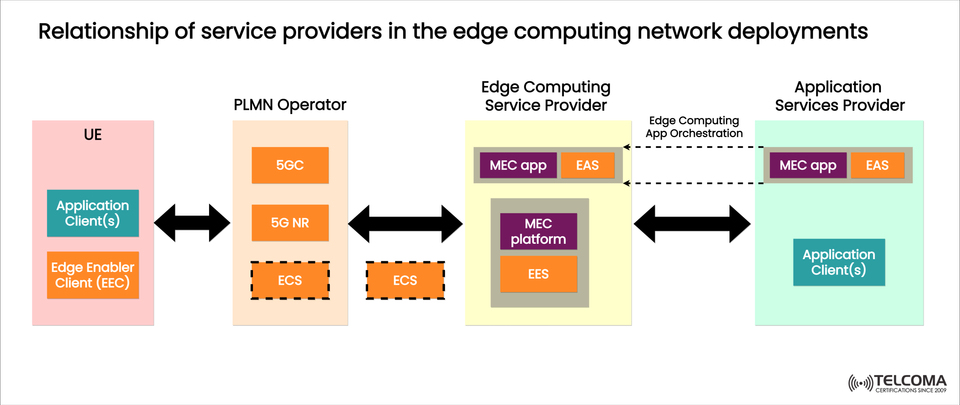
But rolling out edge-enabled services involves a bunch of different players. The image above shows the relationships between service providers in edge computing deployments, illustrating how User Equipment (UEs), PLMN operators, edge service providers, and application service providers collaborate.
In this blog, we’re going to break down the roles of each provider, how they interact, and why this ecosystem is so important for the future of telecom networks.
Understanding the Ecosystem
Edge computing needs a multi-layer ecosystem, where various providers take care of network connectivity, compute resources, orchestration, and application delivery.
This ecosystem generally includes:
User Equipment (UE), featuring client applications and edge enablers.
PLMN Operators, which provide 5G connectivity and network services.
Edge Computing Service Providers that manage MEC platforms and applications.
Application Services Providers responsible for delivering applications to users.
These players have to work together seamlessly to achieve low latency, high throughput, and scalable services.
- User Equipment (UE)
At the left side of the diagram, you can find UE (User Equipment), which consists of devices like smartphones, IoT devices, or AR/VR headsets.
Key Components in UE:
Application Clients: Software or apps on the device that utilize MEC services. Think gaming clients, AR applications, or smart sensors.
Edge Enabler Client (EEC): A specific software component that helps the UE to discover, select, and interact with MEC applications at the edge, ensuring smooth communication with both PLMN operators and MEC platforms.
The UE runs latency-sensitive applications, so the closer the processing gets to the UE, the better the performance.
- PLMN Operator
The Public Land Mobile Network (PLMN) operator is the telecom provider offering mobile connectivity. In edge networks powered by 5G, the PLMN operator guarantees smooth integration of the network core and RAN (Radio Access Network) with MEC.
PLMN Operator Components:
5GC (5G Core): Takes care of core functions like session management, authentication, mobility, and QoS.
5G NR (New Radio): Provides the radio interface that ensures ultra-reliable, high-bandwidth connectivity.
ECS (Edge Configuration Server): Helps with managing service continuity, application discovery, and orchestration between UEs and MEC platforms.
Basically, the PLMN operator acts as a bridge connecting the user equipment and the edge service provider.
- Edge Computing Service Provider
The Edge Computing Service Provider is in charge of hosting and managing the MEC (Multi-access Edge Computing) environment.
Components:
MEC Platform: The backbone that provides APIs and resources for deploying and running MEC applications. It includes resource management, service discovery, and security features.
MEC Applications (MEC app): These are the actual applications running at the edge, such as video analytics, local content caching, and AR/VR rendering.
EAS (Edge Application Server): Supports edge services by offering local APIs for applications, enhancing the MEC setup by enabling third-party integrations.
EES (Edge Enabler Server): Works alongside the Edge Enabler Client (EEC) on the UE to facilitate application discovery and communication.
The Edge Computing Service Provider makes sure applications are deployed closer to users, cutting down latency and boosting QoE (Quality of Experience).
- Application Services Provider
The Application Services Provider (ASP) delivers applications that might run either at the edge or in centralized data centers, depending on what the service requires.
Roles of ASP:
Provides MEC-compatible applications (like gaming, video streaming, industrial IoT apps).
Collaborates with the Edge Computing Service Provider to deploy and orchestrate these applications in the right spots.
Manages Application Clients that run on UEs and connect with MEC apps/EAS.
Orchestration Role
The diagram shows “Edge Computing App Orchestration” between the ASP and the MEC environment, ensuring that:
Applications are placed optimally across the network.
Resources scale dynamically based on demand.
Services maintain high reliability and low latency.
Putting It All Together: The Flow
The UE starts an application request (like AR rendering).
The EEC on the UE chats with the ECS of the PLMN operator to find the right MEC application.
The PLMN operator routes the request through the 5GC and 5G NR.
The Edge Service Provider hosts the application on the MEC platform, supported by MEC apps, EAS, and EES.
The ASP ensures applications are orchestrated and updated, while also optimizing performance with the MEC.
Finally, the UE gets to enjoy the low-latency service from the edge.
This step-by-step process makes sure applications run closer to the user, cutting down latency and making things more responsive.
Advantages of This Multi-Provider Model
Low Latency: Services operate at the network edge, minimizing delays.
Scalability: Applications can scale dynamically across edge nodes.
Interoperability: Clear role separation helps multiple providers collaborate effectively.
Flexibility: Application orchestration allows apps to move between edge and cloud as needed.
Enhanced User Experience: Optimized resource utilization ensures smooth service delivery.
Edge Computing Deployment Example
Let’s look at cloud gaming as a real-world example:
A gaming client runs on the UE.
The PLMN operator’s 5G NR and 5GC provide ultra-low-latency connectivity.
The MEC platform at the edge hosts the gaming engine (MEC app) for local graphics rendering.
The EAS manages sessions, while the EES/EEC coordinate discovery and service continuity.
The ASP ensures updates, orchestration, and scaling of the game service.
This teamwork enables gamers to experience lag-free, high-definition streaming, even on the go.
Comparative Table: Providers and Roles
ProviderKey ComponentsPrimary RoleUEApplication Clients, EECRuns edge-enabled appsPLMN Operator5GC, 5G NR, ECSProvides connectivity and edge integrationEdge Service ProviderMEC Platform, MEC app, EAS, EESHosts and manages edge computing servicesApplication Services ProviderMEC app, EAS, OrchestrationProvides apps and manages orchestration
Conclusion
The relationship among service providers in edge computing deployments is a well-coordinated ecosystem where telecom operators, edge service providers, and application providers team up to offer next-generation low-latency applications.
By making use of MEC platforms, orchestration tools, and enabler frameworks, this setup lets telecom networks support demanding use cases like cloud gaming, autonomous driving, and industrial automation.
For those in telecom, grasping this collaboration is vital as 5G and edge computing converge to reshape how networks and applications function. This multi-provider ecosystem is key to building scalable, interoperable, and future-ready networks.