
Remote CUPS in Telecom Networks: Architecture, Benefits, and Implementation

Remote CUPS in Telecom Networks: Architecture, Benefits, and Implementation
As mobile networks grow to keep up with the skyrocketing demand for data traffic, low latency, and flexibility, network operators have to get smarter about how they deploy the core elements. A major leap forward in this area is the Control and User Plane Separation (CUPS) architecture.
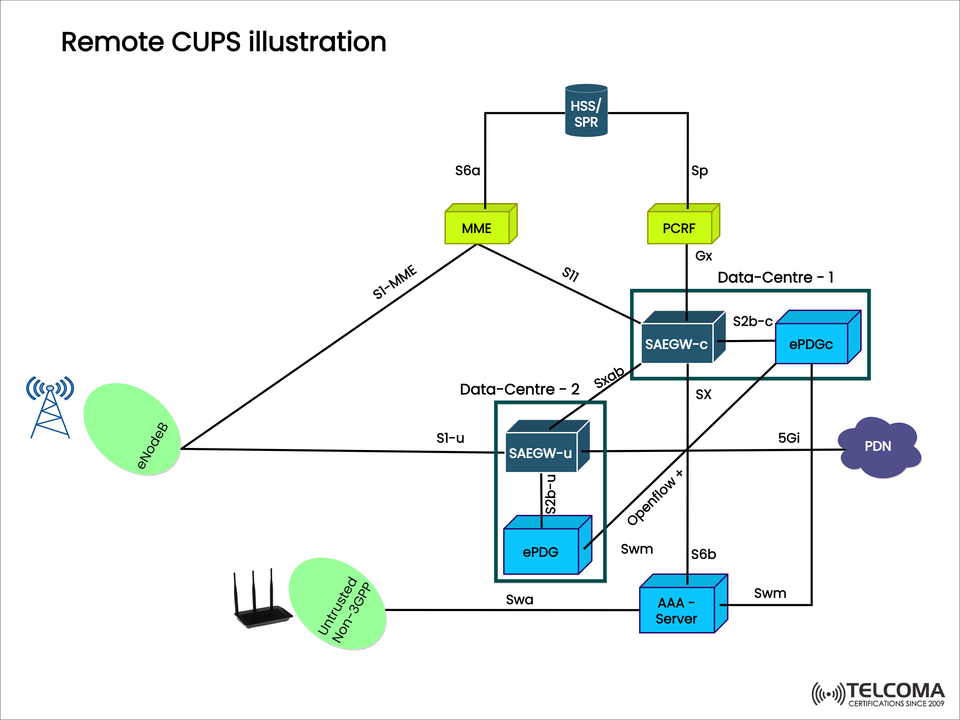
The diagram we uploaded, called Remote CUPS illustration, shows how CUPS is set up across different data centers. It separates SAEGW-C (control plane) from SAEGW-U (user plane), which helps improve scalability and efficiency.
In this blog post, we’ll discuss:
What Remote CUPS is.
Key network components in this architecture.
How Remote CUPS functions within LTE and 5G.
The benefits of deploying Remote CUPS.
Various use cases for telecom operators.
What is Remote CUPS?
CUPS (Control and User Plane Separation) is a core network design that initially appeared in LTE (Release 14) and has been further developed for 5G. It allows the control plane (which handles signaling and session management) to work separately from the user plane (which is responsible for actual data forwarding).
Control Plane (C): Takes care of signaling, mobility, policy enforcement, and setting up sessions.
User Plane (U): Manages real-time user data traffic, routing packets, and forwarding.
Remote CUPS goes a step further by centralizing the control plane functions in one location (like a data center) while enabling user plane functions to be positioned closer to the end-user (in edge data centers). This lowers latency and makes resource allocation more efficient.
Key Components in Remote CUPS Architecture
The diagram illustrates how different elements work together in the Remote CUPS deployment:
eNodeB (evolved Node B): * Connects user devices to the LTE network. * Works with the MME (control) and SAEGW-U (user).
MME (Mobility Management Entity): * Control plane component that manages session setup, mobility, and authentication. * Communicates with HSS/SPR and SAEGW-C.
SAEGW-C (Serving and PDN Gateway Control): * Handles signaling, session control, and bearer establishment. * Works with PCRF (Policy and Charging Rules Function) to enforce QoS and charging rules.
SAEGW-U (Serving and PDN Gateway User): * Deals with actual data forwarding and routing. * Positioned closer to the user to minimize latency.
PCRF (Policy and Charging Rules Function): * Provides policy control for QoS and charging. * Interfaces with SAEGW-C through the Gx interface.
ePDG (Evolved Packet Data Gateway): * Secures traffic from untrusted non-3GPP networks (like Wi-Fi). * Works with AAA Server for authentication.
HSS/SPR (Home Subscriber Server / Subscription Profile Repository): * Stores subscriber information, authentication data, and policy profiles.
AAA Server (Authentication, Authorization, Accounting): * Manages authentication and session handling for Wi-Fi and offloaded traffic.
PDN (Packet Data Network): * The target for user data, usually the internet or an enterprise network.
How Remote CUPS Works
Here's a breakdown of how Remote CUPS operates:
User connects via eNodeB: * The device links up to the LTE network, starting signaling with the MME.
Control session setup: * The MME works with HSS/SPR to verify the subscriber. * SAEGW-C is involved in session configuration and policy enforcement.
Forwarding user plane data: * The system picks the SAEGW-U based on the user’s location and traffic requirements. * Data packets are sent through the nearest SAEGW-U to cut down on latency.
Applying policy and QoS: * The PCRF sends QoS guidelines to SAEGW-C, which adjusts the SAEGW-U accordingly.
Offloading via ePDG (for non-3GPP): * Traffic from Wi-Fi or untrusted networks goes through ePDG, secured with the help of the AAA Server.
Delivering data to PDN: * The final user traffic reaches the internet or the enterprise PDN via optimized routes.
Benefits of Remote CUPS
There are quite a few advantages for telecom operators when they deploy Remote CUPS:
Lower Latency: Positioning user plane nodes (SAEGW-U) closer to the edge supports applications that are sensitive to delays, like AR/VR and IoT.
Scalability: The control and user planes can grow separately according to network needs.
Flexibility: Centralized control allows for global policy enforcement, while distributed user planes enhance local traffic efficiency.
Better Resource Use: Operators can choose the nearest SAEGW-U, which eases backhaul congestion.
Smooth Transition from 4G to 5G: CUPS lays the groundwork for the service-based architecture of 5G.
Cost Efficiency: It cuts transportation costs by processing user data nearer to its origin.
Use Cases of Remote CUPS
Remote CUPS is especially beneficial in current telecom settings:
Mobile Edge Computing (MEC): * Allows local traffic breakout for low-latency services.
IoT Deployments: * Supports a massive number of device connections with efficient data routing.
Video Streaming & Content Delivery: * Routing user data through local gateways enhances the user experience.
Enterprise and Private Networks: * Offers flexible control and user plane deployments for tailored network slices.
5G Preparedness: * Builds on LTE improvements to enable the ultra-low latency and high-capacity services of 5G.
Remote CUPS vs Traditional EPC
Feature Traditional EPC Remote CUPS Architecture Integrated Separated (C and U independent)Latency Higher due to centralized data paths Lower with edge user plane deployment Scalability Limited, tied to integrated nodes Flexible, scale C and U independently Cost Efficiency Higher transport costs Optimized traffic routing, reduced costs5G Readiness Limited Fully compatible with 5G evolution
Challenges in Deploying Remote CUPS
Even though Remote CUPS has many benefits, it also brings some challenges:
Complex Deployment: Needs careful coordination between control and user nodes.
Interoperability: Making sure everything works well together across different vendors’ equipment.
Security: More distributed elements might create new vulnerabilities.
OPEX Considerations: Deploying more edge sites can complicate operations.
Operators will need good network orchestration and automation planning to get past these challenges.
Future Outlook
Remote CUPS isn’t just a tweak to LTE; it’s a stepping stone to 5G. With the rise of network slicing, edge computing, and cloud-native cores, the separation of control and user planes will stay a vital design principle.
Looking forward:
Operators are likely to deploy SAEGW-U at edge sites more to support 5G URLLC (Ultra-Reliable Low Latency Communication).
AI-driven orchestration will help to automatically assign user plane nodes based on traffic patterns.
As networks become denser, Remote CUPS will transition into cloud-native UPFs (User Plane Functions) in the 5G SA (Standalone) architecture.
Conclusion
The Remote CUPS architecture marks a significant innovation in modern telecom networks, providing flexibility, scalability, and decreased latency. By separating the control and user planes, operators can use resources more effectively, cater to a range of applications, and gear up for 5G’s advanced needs.
The diagram illustrates how MME, SAEGW-C, SAEGW-U, PCRF, ePDG, AAA server, and PDN work together in a multi-data center setup. For telecom professionals, grasping the concept of Remote CUPS is essential for building networks that can handle the data demands of tomorrow.