
Routing and Transport in 5G Networks: Enabling Low-Latency and High-Capacity Communication
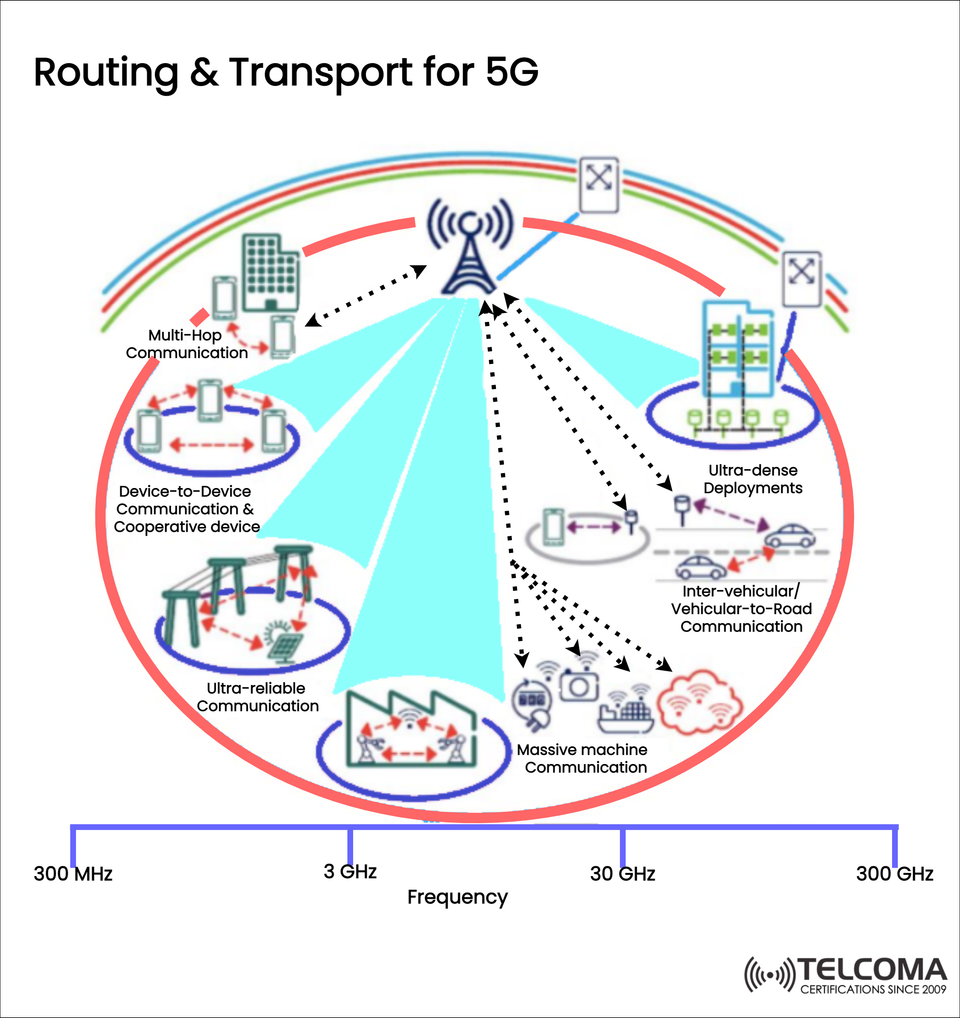

Routing & Transport for 5G: The Backbone of Next-Generation Connectivity
5G technology is changing how we connect and interact with the digital world. While a lot of the focus is on 5G radio access and various applications like AR/VR or IoT, the real magic lies in routing and transport.
The framework we've shared highlights the various roles of routing and transport in 5G networks, underlining their significance across different scenarios:
Multi-hop communication.
Device-to-device (D2D) interaction.
Ultra-reliable communication.
Ultra-dense network deployments.
Inter-vehicular and vehicle-to-road communication.
Massive machine communication (mMTC).
At the heart of it, routing and transport in 5G make sure that data flows smoothly across frequencies—from sub-1 GHz bands that offer wide coverage, to mmWave (30–300 GHz) that provides ultra-high capacity. This blog will dig into each part of the diagram, explaining how routing and transport adapt in 5G to handle unprecedented demands.
Why Routing & Transport Matter in 5G
In older networks, transport mainly served as a backhaul function, moving data between cell sites and the core network. Routing decisions were pretty straightforward, focusing on basic IP transport.
But in 5G, that approach just doesn’t cut it anymore. Here are some key reasons:
Latency sensitivity: 5G demands ultra-low latency (as low as 1 ms) for things like self-driving cars and industrial automation.
Massive capacity: With high-frequency spectrum, 5G transport needs to manage multi-Gbps traffic.
Different traffic types: From eMBB to URLLC to mMTC, transport has to differentiate and optimize resources accordingly.
Network slicing: Routing must be slice-aware to guarantee service levels for different sectors.
So, routing and transport are evolving from being passive enablers to smart, service-aware layers in the 5G framework.
Key Components of Routing & Transport in 5G
The diagram points to six main areas where routing and transport are crucial. Let’s take a closer look at each:
- Multi-Hop Communication
In 5G, multi-hop communication extends coverage and boosts reliability by allowing various devices or nodes to pass data along to its destination.
Useful in places where direct coverage is weak (like rural areas or dense cities).
Decreases reliance on centralized infrastructure.
Enhances spectral efficiency using relay nodes.
Great for disaster recovery and military communications.
Transport Implication: Routing protocols need to be tuned for dynamic, mobile topologies, ensuring quick convergence with minimal packet loss.
- Device-to-Device (D2D) Communication & Cooperative Devices
D2D communication means devices (like smartphones or IoT gadgets) can talk directly without having to go through the base station.
Lowers latency since data doesn’t have to travel through the core network.
Promotes cooperative communication (for instance, IoT sensors can work together to manage energy in smart grids).
Enhances spectral reuse while reducing network congestion.
Transport Implication: Needs localized routing capabilities and secure peer-to-peer connections to maintain quality of service and security.
- Ultra-Reliable Communication (URLLC)
Ultra-reliable communication is critical for mission-critical applications like:
Industrial automation.
Remote surgery.
Smart grids.
Autonomous systems.
These require a stunning 99.999% reliability and sub-millisecond latency.
Transport Implication:
Dedicated low-latency routing paths.
Utilizing redundancy and multipath routing for reliability.
Segment routing and deterministic networking to meet SLA targets.
- Ultra-Dense Deployments
5G networks depend on ultra-dense deployments of small cells, especially in high-frequency bands that don’t travel far.
Supports capacity in crowded areas (like stadiums, airports, or city centers).
Needs backhaul for potentially tens of thousands of small cells in a city.
Increases handovers and signaling requirements, which makes routing smarter.
Transport Implication:
Transport needs to scale up to connect numerous small-cell installations.
Backhaul can involve fiber, microwave, or mmWave wireless.
Dynamic load balancing among cells is essential.
- Inter-Vehicular & Vehicle-to-Road Communication (V2X)
Vehicle communication is one of the super latency-sensitive applications of 5G. It covers:
V2V (Vehicle-to-Vehicle) for collision avoidance.
V2I (Vehicle-to-Infrastructure) for traffic management.
V2R (Vehicle-to-Road) for integrating smart city features.
Transport Implication:
Quick routing updates to handle fast-moving scenarios.
Edge-based routing (via MEC) to minimize latency.
Slice-aware transport for safety-critical communications.
- Massive Machine-Type Communication (mMTC)
As one of the foundational elements of 5G, mMTC supports a vast number of low-power, low-data-rate IoT devices.
Examples include smart meters, sensors, wearables, and pollution monitors.
Focuses on scalability rather than just raw bandwidth.
Transport Implication:
Efficient routing for tiny data packets from millions of devices.
Energy-efficient transport protocols.
Secure, lightweight signaling to prevent congestion.
Frequency Ranges and Their Role in Routing & Transport
The diagram also shows how transport must adapt across different frequency ranges:
<1 GHz (300 MHz): Wide coverage, IoT, rural areas—long-range transport but lower capacity.
Sub-6 GHz (~3 GHz): Balances coverage and capacity—mid-level capacity, mainly for eMBB.
mmWave (30–300 GHz): Ultra-high capacity for hotspots—requires dense transport, short range, similar to fiber backhaul.
Key Insight: Routing and transport need to be flexible depending on the frequency band in use.
Routing Technologies in 5G Transport
To meet these varied demands, several routing technologies are in play in 5G transport networks:
Segment Routing (SR-MPLS / SRv6) for streamlined, slice-aware routing.
Deterministic Networking (DetNet) for low-latency, time-sensitive data.
Software-Defined Networking (SDN) for centralized, programmable control.
Multipath Routing for redundancy and reliability.
Network Slicing Integration for customized transport pathways.
Challenges in 5G Routing & Transport
Even with progress, challenges still exist:
Scalability: Managing billions of connected devices.
Security: Safeguarding D2D and vehicular routing from threats.
Mobility: Ensuring rapid handovers in vehicle scenarios.
Spectrum Fragmentation: Routing must adjust across different bands and operators.
Cost: Setting up dense transport infrastructure, especially fiber, can be pricey.
Conclusion
The routing and transport layer in 5G goes beyond just being a data channel—it’s an intelligent enabler for all 5G applications. From multi-hop communication to vehicle connectivity, and from massive IoT to ultra-dense networks, transport is what allows services to meet strict demands for capacity, latency, and reliability.
As the 5G landscape continues to expand, routing and transport will further evolve with AI-driven orchestration, intent-based networking, and edge computing integration. For telecom experts and tech fans alike, grasping this often-overlooked backbone of 5G is vital to understanding how next-gen networks really work.