
Routing in the OTN: Understanding Step-by-Step, Hierarchical, and Source Routing

Routing in the Optical Transport Network (OTN)
As global data needs keep growing, telecom networks have to ramp up their game, providing faster, more reliable, and scalable communication systems. At the heart of these networks is the Optical Transport Network (OTN) — a digital framework set by ITU-T standards (G.709) that ensures optical signals travel efficiently, get multiplexed, managed, and routed over long distances.
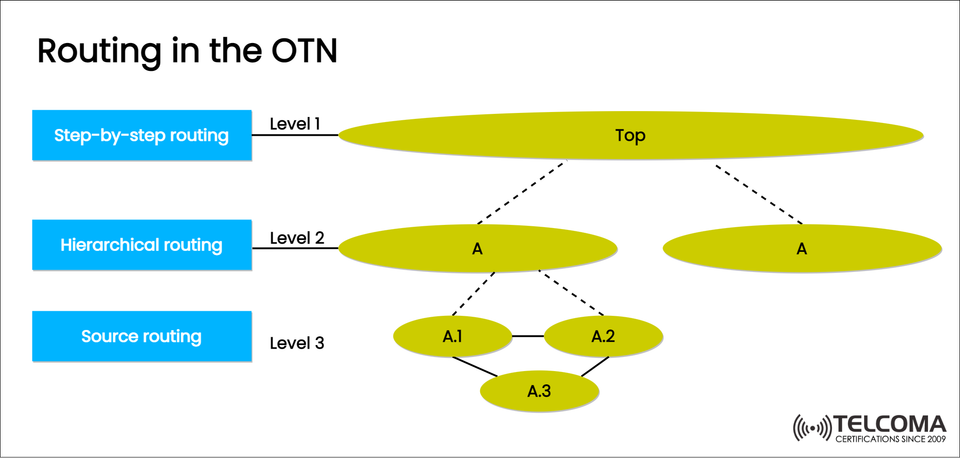
In this article, we’ll dive into the three main routing methods used in OTN — Step-by-step routing, Hierarchical routing, and Source routing — illustrated in the image above. We’ll look into how each method operates, their benefits, and how they work together to enable smart, dynamic routing in high-performance optical networks.
Understanding OTN Routing
Routing in OTN refers to how optical signals (data payloads) move through the network, going from a source node to a destination node. Unlike the traditional IP routing that focuses on packets, OTN routing revolves around optical channels (OCh) or Optical Data Units (ODUs).
This process ensures:
Optimized path selection depending on network layout and available resources.
Fault tolerance and rerouting when links or nodes fail.
Efficient bandwidth use through grooming and multiplexing.
In an OTN, routing choices are made across multiple levels, as shown in the diagram:
Level 1: Top or step-by-step routing
Level 2: Hierarchical routing (area-based)
Level 3: Source routing (specific, detailed control)
- Step-by-Step Routing (Level 1)
What is Step-by-Step Routing?
Step-by-step routing, or hop-by-hop routing, is the simplest method for path selection. Each network node decides independently which is the next hop to forward traffic towards its destination.
In the image, you can see this represented at Level 1 (Top) — a broad layer where each node makes routing decisions locally, without knowing the whole network layout.
How It Works
Each node keeps a routing table with info on neighboring nodes.
When data comes in, the node checks its table to pick the best next hop.
This continues until the data gets to its destination.
Key Advantages
Scalability: Nodes only need to know about their immediate neighbors.
Resilience: If a link goes down, the node can find another neighbor to reroute traffic.
Dynamic Adaptation: It can quickly adjust to real-time changes in the network layout.
Limitations
Suboptimal paths: Without a global network view, routes may be longer than needed.
Increased latency: Each hop adds a bit of delay.
Complex troubleshooting: Figuring out paths gets tough in large networks.
Use Case
You’ll often find step-by-step routing used in distributed optical networks where every node operates independently — making it perfect for mesh topologies or multi-vendor setups.
- Hierarchical Routing (Level 2)
Concept Overview
Hierarchical routing uses a multi-layered approach that splits the network into regions or domains like core, aggregation, and access layers. Each area keeps track of its internal routing info while summarizing external routes for higher layers.
In the image, Level 2 (A) shows this setup — multiple sub-networks (A1, A2, A3) grouped under a single area
Routing in the Optical Transport Network (OTN)
As communication networks keep pushing towards higher bandwidth and lower latency, Optical Transport Networks (OTN) have emerged as the backbone of global telecommunications. They offer a smart digital framework for efficiently managing and transporting optical signals across various layers like metro, regional, and core networks.
Routing is pretty crucial in OTN, as it decides how data moves from one optical node to another. The routing methods employed in OTN — step-by-step, hierarchical, and source routing — aren't just simple ways to move data; they're strategic tools for enhancing performance, ensuring redundancy, and backing automated network operations.
A Closer Look at OTN Architecture
Before diving deeper into the routing methods, it's key to grasp the hierarchical structure of the OTN.
An OTN consists of several layers, each with its own specific function:
Layer | Function | Typical Entity
Optical Channel (OCh) | Manages individual wavelengths (lambdas) | Optical transponder
Optical Multiplex Section (OMS) | Groups several wavelengths | Optical add-drop multiplexer
Optical Transmission Section (OTS) | Manages physical fiber links | Optical line amplifier
ODU Layer (Optical Data Unit) | Bundles and transports client signals | Cross-connect or digital switch
Routing decisions can happen at different layers based on the network abstraction level. The higher layers (ODU) utilize digital control planes for route calculations, while the lower optical layers depend on wavelength routing and spectrum assignment.
Step-by-Step Routing (Level 1: Top Layer)
At the top of the routing hierarchy, step-by-step routing allows each network node to make independent and localized routing choices.
Picture it as a decentralized approach where each OTN node relies on its routing table to determine the next hop for data traffic, similar to how IP routers work on the Internet.
Technical Insight
Uses Link-State Advertisements (LSA) or Topology Discovery Protocols (like OSPF-TE or GMPLS).
Nodes find the shortest path using algorithms like Dijkstra’s.
Path setup is done gradually — one hop at a time.
Advantages for OTN:
Distributed control: Less reliance on a central controller.
Quick adaptation: Responds faster to node or link failures.
Scalable for mesh topologies: Works well when the network dynamically shifts.
That said, since each node doesn’t have full visibility of the entire network, path optimization might not be globally ideal — leading to potential inefficiencies in latency or wavelength usage.
Hierarchical Routing (Level 2: Regional Layer)
As networks expand, step-by-step routing can get complicated. This is where hierarchical routing comes into play.
In the diagram, Level 2 (A) illustrates how the network is divided into logical areas or regions — like regional networks within a national telecom structure. Each area has its internal routing control, while a higher layer manages inter-area communications.
Technical Breakdown
The network is structured into multiple routing domains or autonomous systems (AS).
Each domain is overseen by a controller or supervisor (like an OTN Management System or SDN controller).
Intra-domain routing uses complete topology knowledge; inter-domain routing exchanges summarized routes.
Routing protocols: OSPF-TE (with area concept), IS-IS, or custom implementations of hierarchical GMPLS.
Key Benefits
Scalability: Cuts down routing overhead by abstracting lower-level details.
Simplified management: Lets operators manage domains independently.
Performance efficiency: Reduces control plane flooding and speeds up convergence.
Industry Application
Hierarchical routing is common in carrier-grade optical backbones, where the network stretches thousands of kilometers and includes hundreds of nodes — linking metro rings, national cores, and international gateways.
Source Routing (Level 3: Localized Path Control)
At the most granular level, source routing allows the originating node to set the entire path for data before it even leaves.
This method, shown in the diagram as Level 3, indicates sub-nodes A.1, A.2, and A.3, where the path sequence (A.1 → A.2 → A.3) is clearly defined.
Technical Operation
The source node relies on complete topology information, typically provided by a central controller or a Path Computation Element (PCE).
The calculated path gets encoded into the header, ensuring that each intermediate node just forwards data according to the predetermined instructions.
In OTN, this often aligns with Generalized MPLS (GMPLS) or SDN-based path setup (using NETCONF or RESTCONF).
Advantages
Deterministic performance: Perfect for services with strict SLAs (latency, jitter).
Traffic engineering: Allows wavelength-specific and bandwidth-optimized routing.
Simplified forwarding: Intermediate nodes don’t have to compute routes.
Limitations
Centralization dependency: Needs full network visibility.
Complex topology updates: Re-computation is necessary if network conditions change.
Memory overhead: Managing large route sets can be tough.
Practical Use Case
Source routing is crucial in Software-Defined Optical Networks (SDON), where the control plane is centralized, allowing for dynamic reconfiguration, fault recovery, and service automation.
How These Routing Levels Interact
In real-world optical networks, these routing strategies work together to provide layered control and efficiency.
Step-by-step routing manages node-to-node operations in the access or metro layers.
Hierarchical routing organizes regional and inter-domain routing across the core layer.
Source routing allows precise path setup for mission-critical and SLA-focused services like 5G fronthaul or data center interconnects.
This multi-level routing hierarchy reflects the SDN layered model, ensuring a balance between autonomy, scalability, and control.
Routing Optimization Techniques in OTN
Modern OTN routing uses several smart mechanisms to boost efficiency:
Constraint-based routing: Considers factors like wavelength availability, signal quality, and latency.
Dynamic re-optimization: Employs feedback from the network to recalibrate optimal paths.
Machine-learning-based traffic prediction: Anticipates congestion or potential failures.
Cross-layer coordination: Merges OTN routing with IP/MPLS and Ethernet layers for unified service orchestration.
These advancements turn traditional optical routing into autonomous transport management, enabling adaptive and predictive optical networking.
Conclusion
Routing within the Optical Transport Network goes beyond just directing light signals — it’s about the intelligent orchestration of data flows across layered, high-capacity infrastructures.
Step-by-step routing brings distributed flexibility.
Hierarchical routing adds structure and scalability.
Source routing enables precision and control for advanced services.
Together, they create a multi-dimensional routing architecture that supports the increasing bandwidth needs of 5G, IoT, and cloud-focused applications.
As the industry moves toward AI-driven, self-optimizing optical networks, OTN routing will stay at the forefront of telecom innovation — ensuring speed, reliability, and automation in the backbone of our digital world.