
RRC States in 5G New Radio (5G NR): A Complete Guide to State Transitions
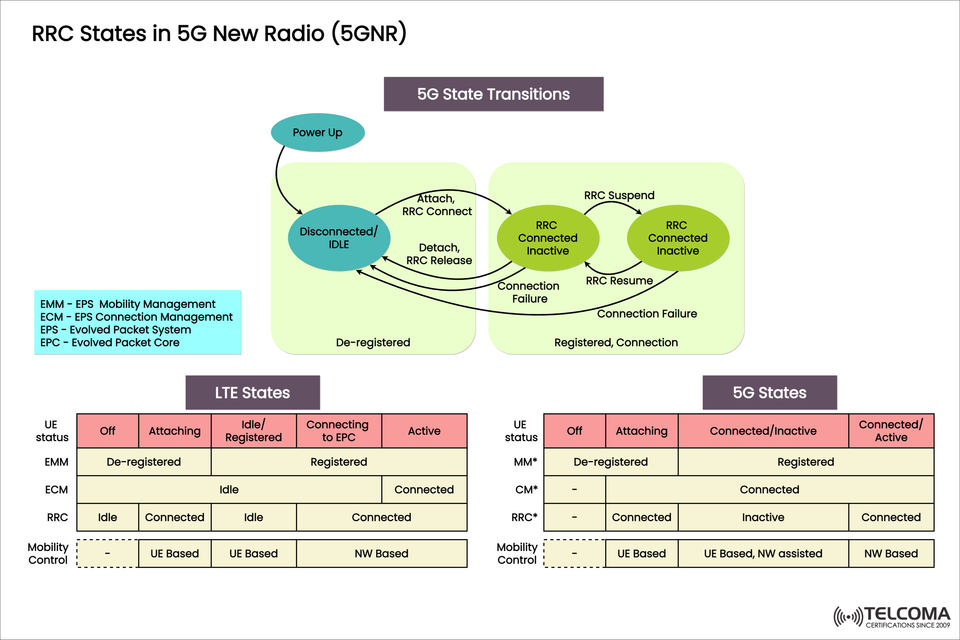

RRC States in 5G New Radio (5G NR)
With the launch of 5G New Radio (5G NR), the way we manage radio resources has changed a lot to keep up with the needs for low latency, high reliability, and the ability to connect a massive number of devices. At the core of this shift is the Radio Resource Control (RRC) state machine, which determines how a device, known as User Equipment (UE), interacts with the 5G network.
The diagram above gives a clear overview of the RRC states in 5G NR, showing transitions, differences from LTE states, and how mobility and connection management work. This blog post will take you through these states, explain what they do, and discuss their effect on network performance.
What is RRC in 5G?
Radio Resource Control (RRC) is a key protocol in the control plane of 5G NR. It mainly handles:
Setting up, maintaining, and ending RRC connections.
Managing mobility (like handover and cell reselection).
Configuring lower layers such as PDCP, RLC, and MAC.
Ensuring security during the connection process.
Optimizing power consumption and reducing latency through various state transitions.
RRC states indicate whether a device is actively connected, idle, or in between, helping to use resources efficiently.
RRC States in 5G NR
5G introduces three main RRC states for UEs:
RRC Idle (Disconnected/Idle)
The UE isn't connected but is camped on a cell.
It listens for paging messages and can perform cell reselection.
This mode is power-efficient, perfect for devices that don’t transmit often.
To communicate actively, the UE must switch to connected mode.
RRC Connected
The UE has a dedicated RRC connection with the gNB (the 5G base station).
It’s able to send and receive data and messaging signals.
This state supports handover, QoS management, and security features.
It uses more power since resources are actively in use.
RRC Inactive (Connected Inactive)
This is a unique 5G innovation that fills the gap between idle and connected states.
The UE is registered and keeps context stored in both the UE and the gNB.
It allows for a fast resume (via RRC Resume) without needing a full re-establishment.
It reduces latency compared to idle mode while being more power-efficient than connected mode.
This state is great for bursty applications like messaging, IoT data, or push notifications.
5G State Transitions
The diagram illustrates how a UE transitions between states:
Power Up → Idle: When the device powers on, it starts in idle mode.
Idle → Connected: When data transfer or signaling starts, the UE attaches and forms an RRC connection.
Connected → Inactive: If there’s a pause in traffic, the UE suspends its RRC connection to conserve resources.
Inactive → Connected: Quick resumes when traffic picks up again, skipping the full setup.
Connected/Inactive → Idle: If the device detaches, gets released, or faces a connection failure, it goes back to idle.
This fluid movement ensures a mix of low latency, energy efficiency, and resource management.
LTE States vs. 5G States
The diagram also contrasts LTE states with 5G NR states, highlighting how 5G boosts efficiency.
LTE States:
Idle: Similar to 5G Idle, where UE is camped on a cell but not connected.
Connected: UE has an active connection, using more resources.
No intermediate state → Any switch between idle and connected means a full setup is required, which adds latency.
5G States:
Idle: Same as LTE idle.
Connected: Like LTE connected.
Connected Inactive: A new intermediate state that enables quicker resumption with less signaling overhead.
Key Difference:
In LTE, Mobility Control: Idle mobility is UE-based, while connected mobility is network-based.
In 5G: it introduces UE-based + network-assisted mobility in the inactive state for more flexibility.
This advancement in 5G allows for a notable decrease in latency while keeping mobility management efficient.
Comparative Table: LTE vs. 5G RRC States
Aspect LTE States5G NR States UE Status Idle, Connected Idle, Connected, Connected Inactive Transition Speed Higher (more signaling)Lower (fast resume via RRC suspend/resume)Mobility Control UE-based (Idle), NW-based (Connected)UE-based, NW-assisted (Inactive), NW-based (Connected)Power Efficiency Limited Improved with RRC Inactive state Latency for Resume High (full setup)Low (resume instead of re-attach)
Why is RRC Inactive State Important?
The RRC Inactive state is a crucial advancement in 5G NR. Here’s why:
Reduced Latency: It eliminates the delays of a full reconnection, allowing for almost instant resumes.
Power Saving: UEs can avoid being fully connected all the time, helping to extend battery life.
Efficient Signaling: There’s less signaling overhead compared to the frequent attach/release cycles seen in LTE.
Enhanced Mobility: This state supports network-assisted mobility, ensuring smooth transitions even when inactive.
For uses like autonomous driving, AR/VR, and large-scale IoT, this state is key for achieving a great balance between responsiveness and efficiency.
Real-World Example: IoT Devices
Take a smart sensor that sends data every few minutes:
In LTE, the device would have to fully reconnect every time, wasting power and causing delays.
In 5G NR, the sensor can stay in RRC Inactive, quickly waking up when it has data to send.
This approach not only saves battery but also ensures data gets sent with minimal delay, which is vital for real-time monitoring.
Advantages of 5G RRC States
Optimized Power Usage: This is especially important for mobile devices and IoT applications.
Improved Latency: Rapid transitions help provide a smoother experience for users.
Flexibility: The inactive state lets networks manage resources in a dynamic way.
Scalability: It can handle billions of devices while managing states efficiently.
Conclusion
The RRC states in 5G NR mark a significant improvement from LTE, introducing the RRC Inactive state for optimizing latency and power efficiency. By allowing for fast resumes, less signaling, and better mobility management, 5G networks can cater to a wide range of applications from autonomous vehicles and immersive AR to large-scale IoT uses.
For telecom professionals, understanding RRC state transitions is essential to grasp how 5G outperforms previous technologies in terms of performance and scalability.
In a nutshell, RRC states are the behind-the-scenes players enabling 5G to deliver seamless, reliable, and efficient connectivity for the networks of the future.