
Samsung 5G Core: Cloud-Native Architecture, Microservices, and Kubernetes Orchestration

Introduction: Why Cloud-Native Matters in 5G
The shift from hardware-based telecom networks to virtualized networks (using VNFs on VMs) has already changed the game. Now, with the introduction of 5G Core (5GC), we need something even more robust—cloud-native architecture (CNA).
Samsung’s 5G Core is built from the ground up as cloud-native, utilizing microservices, containers, Kubernetes, and CI/CD automation.
This architecture is critical, as 5G needs:
Ultra-low latency especially for AR/VR applications and self-driving cars.
Extreme scalability to support billions of IoT devices.
High availability and resiliency for services that are mission-critical.
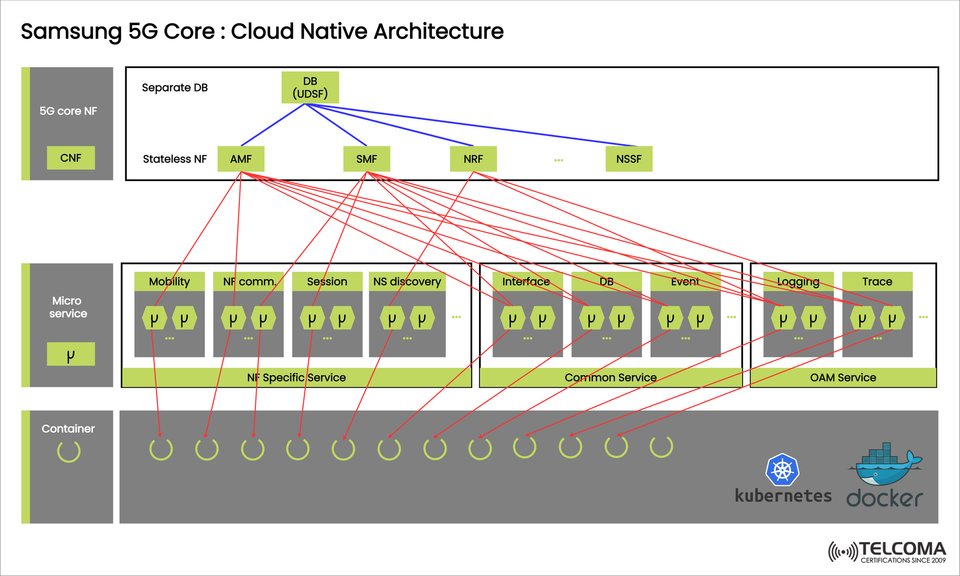
The diagram shared helps illustrate how Samsung integrates CNA into its 5G Core, mixing microservices, containers, and orchestration tools like Kubernetes and Docker.
Core Principles of Samsung’s Cloud-Native 5G Core
- Containerized Network Functions (CNFs)
Unlike traditional VNFs that rely on heavy virtual machines, CNFs operate within lightweight containers.
Containers enable quicker boot times, reduce resource use, and simplify scaling.
Samsung’s 5G Core uses Docker as its container runtime environment.
- Microservices-Based Design
Rather than using large, monolithic network functions, each NF is divided into several microservices.
For instance, the AMF (Access & Mobility Function) is split into microservices that handle mobility, NF communication, and session management.
This modular design boosts agility, allowing for updates and scaling without affecting the whole system.
- Stateless Functions + Shared Database
Core NFs like AMF, SMF, NRF, and NSSF operate in a stateless manner.
All state information is housed in a Unified Data Storage Function (UDSF).
This setup enhances resiliency—if one NF goes down, another can take its place without a hitch.
- Kubernetes Orchestration
To manage deployment, scaling, and lifecycle of containers and microservices, orchestration is essential.
Samsung relies on Kubernetes for automated orchestration, ensuring that CNFs can scale horizontally when demand increases.
- Separation of NF-Specific and Common Services
NF-Specific Services include: mobility, NF communication, session management, and network slice discovery.
Common Services handle interfaces, database access, and event management.
OAM Services focus on logging and tracing for monitoring and analytics.
This modular strategy allows operators to reuse common services across various NFs, enhancing efficiency.
Breaking Down the Architecture (Based on the Diagram)
The diagram showcases three primary layers:
- 5G Core NFs (Stateless + UDSF)
AMF (Access & Mobility Management Function)
SMF (Session Management Function)
NRF (Network Repository Function)
NSSF (Network Slice Selection Function)
Each NF is stateless and pulls data from the UDSF database.
- Microservices for Each Function
Tasks specific to each NF are organized into microservices: * Mobility Management * NF Communication * Session Control * Slice Discovery
Common microservices include: * Interface management * Database access * Event handling
OAM microservices: * Logging * Tracing
- Containerized Deployment
All microservices operate in containers overseen by Docker.
The orchestration is done through Kubernetes, ensuring automation, resilience, and elastic scaling.
Key Advantages of Samsung’s Cloud-Native 5G Core
Elastic Scalability * Network functions can scale in and out seamlessly to adapt to varying traffic.
High Resiliency * Stateless NFs and redundancy in containers allow for automatic failover.
Faster Upgrades with CI/CD * Microservices can be updated independently, paving the way for continuous innovation without any downtime.
Efficient Resource Utilization * Containers demand fewer resources than VMs, and common services prevent duplication.
Multi-Vendor Interoperability * The Kubernetes orchestration simplifies integration with CNFs from various vendors.
Cloud Agnostic * The system can be deployed on public, private, or hybrid clouds.
Samsung 5G Core CNA vs Legacy Architectures
Aspect Legacy EPC (4G)VNF-based 5G (Virtualized)Samsung CNA 5G Core Deployment Hardware-based VM-based (OpenStack)Containerized (Docker + Kubernetes)Architecture Monolithic Modular but VM-heavy Fully microservices-based Scalability Fixed, hardware-limited Moderate, VM scaling Elastic, automated scaling Resiliency Hardware redundancy VM redundancy Stateless + container failover Resource Efficiency Low Medium High (containers are lightweight)Upgrades Slow, hardware replacement Faster but VM image updates Instant, CI/CD microservice updates Cloud Compatibility None Private cloud only Multi-cloud ready
Real-World Implications for Telecom Operators
Samsung’s cloud-native 5G Core is built to tackle operator challenges like:
5G Standalone (SA) Deployment – Quick rollouts with containerized NFs.
Network Slicing – On-demand slices for both enterprise and consumer services.
Edge Computing (MEC) – Positioning CNFs close to the edge for ultra-low latency.
IoT Enablement – Efficiently scaling for millions of connected devices.
Enterprise 5G Solutions – Private 5G networks that offer the flexibility of CNFs.
Future Outlook
As the telecom industry gears up for 6G, expect cloud-native to progress with:
AI/ML-driven orchestration that supports predictive scaling.
Zero-touch automation for operations and maintenance.
Tighter integration with edge and cloud platforms.
Samsung’s approach is already in line with these developments, putting operators in a strong position for the long-term evolution.
Why Stateless and Database Separation is a Big Deal
In the past, telecom functions were state ful, meaning all the session info was connected to a single node. If that node went down, you’d lose the whole session.
With Samsung’s cloud-native model:
Network Functions (NFs) like AMF and SMF are now stateless.
All session and mobility information is kept in the UDSF database.
If one NF container fails, another can quickly take over from where it stopped.
This really boosts resilience, service continuity, and network reliability, which are super important for ultra-reliable low-latency communications (URLLC) in 5G.
Breakdown of Microservices in Samsung 5G Core
Samsung has also sorted network functions into microservices across three main categories:
NF-Specific Services
Mobility management
NF communication handling
Session management
Network slice discovery
Common Services
Interface management
Database handling
Event processing
OAM (Operations, Administration, and Maintenance) Services
Logging
Tracing
This layered approach means:
Common services can be reused.
NF-specific services can scale independently.
Observability is improved thanks to built-in logging and tracing.
Conclusion
Samsung’s 5G Core Cloud-Native Architecture marks a major shift in telecom network design. By blending containers, microservices, Kubernetes orchestration, and stateless NFs with UDSF databases, it offers:
Scalability for changing 5G traffic demands.
Resiliency thanks to stateless failover.
Agility via microservice upgrades.
Efficiency through containerization.
For those in telecom, this architecture isn’t just about adapting to 5G—it’s also about creating a future-ready, cloud-native foundation that can support IoT, MEC, network slicing, and eventually 6G.