
SBA Node Isolation in 5G Core: Ensuring Scalability, Security, and Reliability with PCF, AUSF, and UDM Separation

Introduction: The Power of SBA Node Isolation in 5G
So, the 5G Core (5GC) brings in a Service-Based Architecture (SBA) that’s a whole different ballgame compared to traditional 4G EPC systems. Rather than relying on a single big function, 5G Core utilizes modular, service-based network functions (NFs) that communicate via standardized APIs.
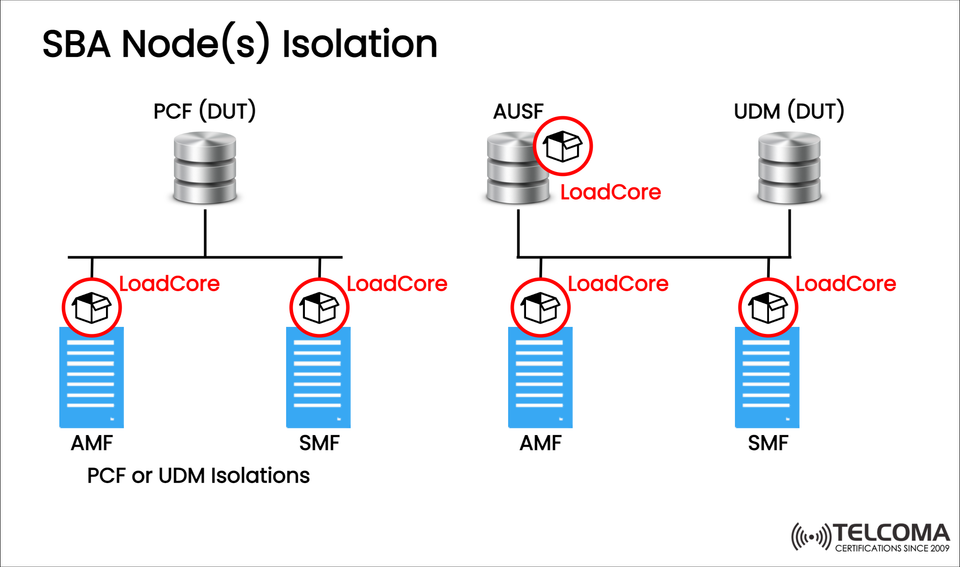
One of the standout features of SBA is node isolation—this means you can test, scale, and secure functions independently. The diagram included shows how PCF (Policy Control Function), AUSF (Authentication Server Function), and UDM (Unified Data Management) can be isolated from AMF (Access and Mobility Management Function) and SMF (Session Management Function), using tools like LoadCore to check for performance and compliance.
For those working in telecom, SBA node isolation isn’t just some design choice—it’s a key ingredient for achieving network reliability, efficiency, and security in 5G and beyond.
What is SBA Node Isolation in 5G Core?
In the context of 5G Core, node isolation is all about the independent deployment, operation, and validation of network functions (NFs) within the SBA. Each NF can be logically separated, tested on its own, and scaled based on network needs.
Logical Isolation: This is the separation at the software/service level.
Physical Isolation: This means having dedicated infrastructure for critical nodes.
Testing Isolation: Tools like LoadCore simulate traffic for validation.
The image provided highlights isolation scenarios for PCF, AUSF, and UDM, showing how AMF and SMF can work with these functions in a controlled setting.
Key Network Functions in SBA Node Isolation
a) Policy Control Function (PCF)
This ensures dynamic policy enforcement for QoS, charging, and slicing.
It collaborates with SMF to apply user session rules.
Isolation testing is important to ensure policies are enforced properly without disrupting AMF or UDM.
b) Authentication Server Function (AUSF)
It deals with UE authentication, with support from UDM.
It validates subscription data and security credentials.
Isolation helps maintain secure authentication even under high traffic or attack scenarios.
c) Unified Data Management (UDM)
It stores important subscription data, identities, and authentication keys.
It provides user context to AMF and SMF.
Isolation ensures data remains consistent and prevents overload.
d) AMF and SMF (Control Plane NFs)
AMF: Manages access, mobility, and connections.
SMF: Takes care of session lifecycles and controls UPF.
In isolation setups, AMF and SMF act as traffic generators to validate PCF, AUSF, and UDM.
e) LoadCore Testing Tool
This tool simulates UEs, AMF, SMF, and signaling workloads.
It stress tests isolated NFs like PCF, AUSF, and UDM.
It checks compliance with the 3GPP SBA interfaces.
Why SBA Node Isolation Matters
a) Security and Reliability
It stops vulnerabilities in AUSF or UDM from affecting AMF or SMF.
Isolating authentication failures makes sure service continues smoothly.
b) Scalability
You can scale PCF or UDM separately without disrupting signaling.
This is key in supporting growth in IoT and enterprise services.
c) Testing and Validation
LoadCore ensures each node can handle expected traffic.
It helps catch bottlenecks early before going live.
d) Service Flexibility
It allows for multi-vendor settings by testing nodes independently.
Supports network slicing by isolating functions for each slice.
Interfaces in SBA Node Isolation
Here are the key interfaces in isolation testing:
Interface NF ConnectionPurposeN7SMF ↔ PCF Policy control and enforcementN8AMF ↔ UDM Subscription data retrieval and authenticationN13AMF ↔ AUSF Authentication signalingN12AUSF ↔ UDM Subscription and security data exchange
By isolating PCF, AUSF, and UDM, telecom operators can validate these interfaces without interference from other NFs.
Practical Use Cases of SBA Node Isolation
a) PCF Isolation
Validate policy enforcement under different load conditions.
Ensure proper QoS decisions in eMBB and URLLC slices.
b) AUSF Isolation
Test resilience against high volumes of authentication requests.
Validate how well it interacts with UDM for secure UE onboarding.
c) UDM Isolation
Stress-test subscription data access during a surge of device connections.
Confirm data consistency across multiple AMFs.
Benefits of SBA Node Isolation
Independent Scaling: You can scale PCF, AUSF, or UDM on their own.
Fault Containment: If AUSF fails, AMF keeps running smoothly.
Improved Security: With contained nodes, the attack surface is smaller.
Operational Flexibility: Nodes can be upgraded or patched individually.
Vendor Interoperability: It supports testing with multi-vendor NFs.
Challenges in SBA Node Isolation
Still, isolation does come with its own set of challenges:
Signaling Overhead: More interfaces lead to increased signaling complexity.
Orchestration Burden: It demands robust MANO frameworks like ONAP.
Testing Complexity: Each node requires individual validation as well as end-to-end testing.
Vendor Integration: Interoperability issues can arise in multi-vendor environments.
Role of LoadCore in Node Isolation Testing
The diagram repeatedly links LoadCore to AMF, SMF, and SBA functions. Here’s what it does:
UE Simulation: It mimics thousands of devices registering and requesting sessions.
Load Generation: It puts stress on AUSF, PCF, or UDM.
Compliance Checks: Validates interfaces like N7, N8, and N12 against 3GPP specs.
Failure Simulation: Shows how isolated nodes react under pressure.
LoadCore makes sure that SBA node isolation isn’t just a theory; it’s validated and ready for deployment.
SBA Node Isolation in the Road to 6G
As telecom moves toward 6G, node isolation is going to become even more crucial:
AI-Driven Orchestration: Automating scaling and recovery across isolated nodes.
Granular Network Slicing: Isolating per service or per customer.
Quantum-Safe Authentication: Making AUSF/UDM operations secure under new encryption models.
Cloud-Edge Convergence: Seamlessly distributing isolated nodes across central clouds and edge sites.
Conclusion
The diagram on SBA Node(s) Isolation highlights a key aspect of 5G Core design: isolating functions like PCF, AUSF, and UDM so they can be tested, scaled, and secured independently. With AMF, SMF, and LoadCore leading the charge in simulation and validation, node isolation emerges as an essential factor for reliability, scalability, and security.
For telecom professionals, SBA node isolation is not just a testing technique—it’s a strategic architectural principle that makes 5G Core networks strong and future-proof. As networks evolve toward 6G, isolation will stay central to a resilient, cloud-native telecom infrastructure.