
SBI and REST in 5G Core (5GC): Service-Based Architecture Explained

SBI and REST in 5G Core (5GC): Understanding Service-Based Architecture
The 5G Core (5GC) is built on a groundbreaking Service-Based Architecture (SBA) that moves away from traditional telecom frameworks. Central to SBA are the Service-Based Interfaces (SBI) and RESTful APIs, which allow network functions to communicate in a flexible, cloud-friendly manner.
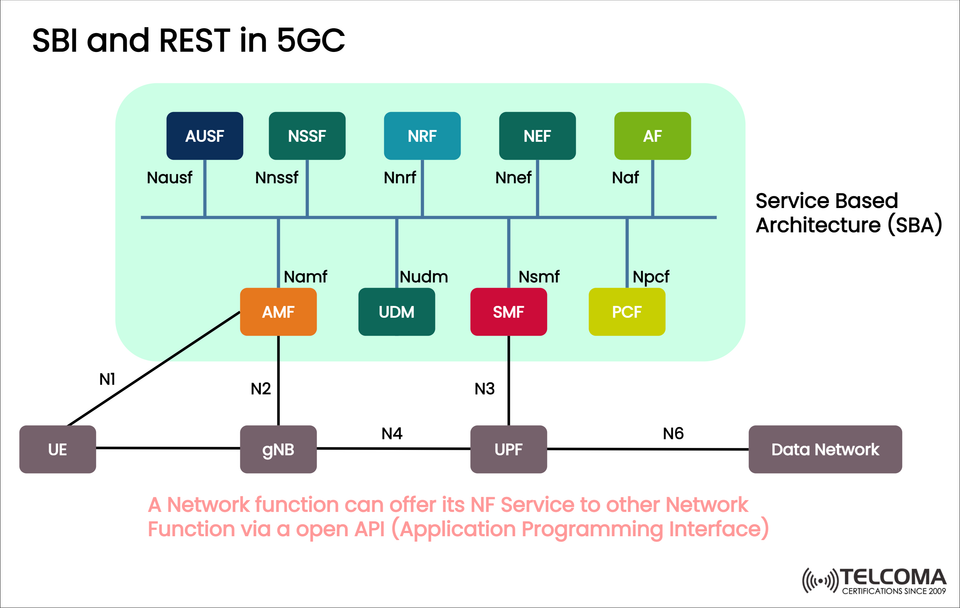
The diagram provided, SBI and REST in 5GC, showcases how various network functions (NFs) within the 5G Core connect through open APIs. This setup is crucial for achieving agility, scalability, and interoperability in 5G networks.
In this blog, we’re going to look at:
What SBI and REST mean for 5GC.
The importance of Service-Based Architecture (SBA).
Key network functions and how they interact.
The advantages of using RESTful communication in telecom.
Challenges in deployment and future perspectives.
What is Service-Based Architecture (SBA) in 5GC?
Service-Based Architecture (SBA) is a design framework where each network function (NF) in the 5G Core offers services that other NFs can find and use through APIs. Unlike earlier generations that relied on fixed, interface-based signaling protocols (like Diameter in LTE), SBA emphasizes flexibility and modularity.
In SBA:
Each NF provides its functionalities as services.
Other NFs can access these services via standardized APIs.
Communication occurs over HTTP/2 using REST principles.
This kind of modular design makes 5G networks operate more like contemporary IT systems, allowing for cloud-native, scalable, and programmable architectures.
What is SBI in 5G Core?
SBI (Service-Based Interface) acts as the communication framework connecting NFs within the SBA. Instead of fixed connections, SBI facilitates service discovery and consumption through APIs.
For instance:
The AMF (Access and Mobility Management Function) exposes services that the SMF (Session Management Function) or PCF (Policy Control Function) can use.
The UDM (Unified Data Management) offers subscriber data services for consumption by both AUSF (Authentication Server Function) and AMF.
With SBI, NFs are kept unaware of internal network specifics—they simply request services whenever they need them.
REST in 5GC
The Representational State Transfer (REST) model is employed in 5GC to outline how services are accessed. REST, widely used in web applications, aligns well with telecom’s shift towards IT-focused, cloud-native networks.
REST in 5G Core allows for:
HTTP/2 communication: NFs share information using web technologies.
Open APIs: Any NF can utilize another NF’s services via published APIs.
Stateless communication: This simplifies scaling and enhances resilience.
JSON or XML payloads: Standardized message formats aid interoperability.
This transforms communication in the 5G Core to be more programmable and in sync with IT and cloud environments.
Architecture of SBI and REST in 5GC (Illustrated)
The diagram illustrates how UE (User Equipment) connects to the 5G Core via gNB and UPF, while the core NFs interact through SBI and REST APIs.
- Access Side
UE → gNB (N1, N2): The user device connects with the 5G base station.
gNB → UPF (N3): The setup for user plane data path gets underway.
- Core Functions in SBA
AMF (Access and Mobility Management Function): Manages UE registration, authentication, and mobility.
SMF (Session Management Function): Manages PDU sessions, QoS, and user plane resource distribution.
UDM (Unified Data Management): Stores and oversees subscriber data.
PCF (Policy Control Function): Implements policy and charging controls.
AUSF (Authentication Server Function): Authenticates subscriber identities.
NSSF (Network Slice Selection Function): Assigns network slices for services.
NRF (Network Repository Function): Facilitates NF discovery and current status.
NEF (Network Exposure Function): Exposes network capabilities to outside applications.
AF (Application Function): Connects with applications to guide service interactions.
- Interfaces
N1/N2/N3/N4/N6: Traditional links between UE, gNB, UPF, and the data network.
Namf, Nsmf, Npcf, Nudm, Nausf, Nnssf, Nnef, Naf, Nnrf: Service-based interfaces employing REST APIs.
Each of these SBI connections happens over HTTP/2 and is governed by RESTful communication.
Example of SBI Interaction
Let’s say a subscriber connects to the network:
UE sends a registration request to AMF.
AMF calls AUSF through the Nausf SBI for authentication.
After successful authentication, AMF requests subscriber profile info from UDM (via Nudm).
Then, AMF collaborates with SMF (via Nsmf) to establish sessions.
SMF works with PCF (via Npcf) to determine policy rules.
Finally, SMF configures UPF (via N4) to direct user traffic toward the data network (via N6).
This sequence exemplifies how SBIs enable service chaining across numerous NFs.
Benefits of SBI and REST in 5GC
Embracing SBI and RESTful APIs in the 5G Core offers major benefits:
Flexibility: Any NF can access services from others without rigid ties.
Cloud-Native: Supports containerized, microservice-driven deployments.
Scalability: Stateless RESTful interactions simplify horizontal scaling.
Interoperability: Standardized APIs guarantee compatibility across different vendors.
Faster Innovation: Operators can quickly expose services to applications via NEF and AF.
Efficient Resource Use: On-demand NF service consumption prevents over-provisioning.
Comparison: Legacy Core vs. 5G Core with SBI
Feature Legacy EPC (LTE)5G Core (SBA with SBI & REST) Architecture Interface-based Service-based Protocols Diameter, GTP-CHTTP/2, REST, JSON/XML Flexibility Rigid, predefined Flexible, on-demand Service Exposure Limited Via NEF and open APIs Cloud-Native Support Minimal Full support Scalability Difficult Easy with stateless design
Challenges in Deploying SBI and REST in 5GC
Despite its perks, adopting SBI and REST comes with hurdles:
Security: REST APIs need protection from cyber threats and unauthorized access.
Latency Issues: HTTP/2 adds some overhead; optimization is a must.
Interoperability: Multi-vendor situations may encounter API compatibility problems.
Complexity: Coordinating numerous APIs demands advanced management.
Operational Shift: Operators must transition to IT-like DevOps approaches.
Future Outlook
The advancement of SBI and REST in 5GC hints at increased programmability:
API Ecosystems: Telecom providers might directly offer APIs to developers, paving the way for new applications (like AR/VR, IoT, smart cities).
Automation & AI: SBI traffic will be analyzed using AI/ML for optimization.
5G-Advanced & 6G: SBA concepts are set to evolve further, incorporating intent-based networking and self-optimizing architectures.
SBI and REST are more than just technical enablers; they’re also business accelerators, assisting operators in monetizing their networks through fresh digital services.
Conclusion
The transition to Service-Based Architecture (SBA) in 5G Core signifies a major transformation in telecom networks. With SBI and RESTful APIs, 5GC becomes adaptable, cloud-native, and open for innovation.
From facilitating seamless NF interactions to supporting multi-vendor ecosystems and enabling new service monetization strategies, SBI and REST are central to the 5G promise.
For telecom experts and technology enthusiasts, getting a grip on SBI and REST is crucial for understanding the future of 5G and beyond.