
SBI and REST in 5G Core: Service-Based Architecture Explained

SBI and REST in 5G Core: Grasping Service-Based Architecture
The 5G Core (5GC) is founded on an innovative idea: the Service-Based Architecture (SBA). Unlike the rigid point-to-point setup of 4G LTE, 5G brings in a flexible, cloud-native structure where network functions (NFs) interact through open Service-Based Interfaces (SBI), typically using RESTful APIs.
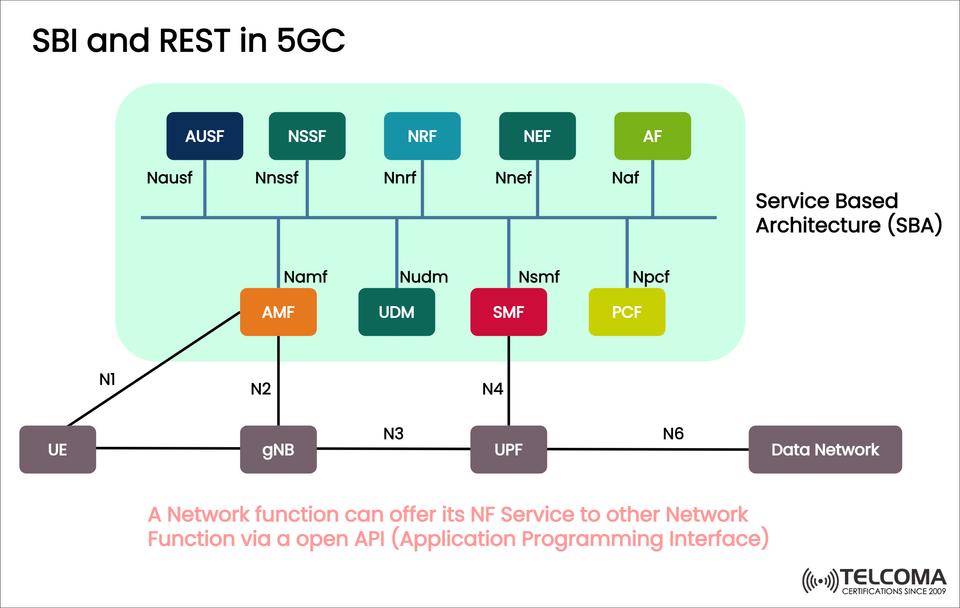
This new approach allows telecom companies to achieve scalability, agility, and interoperability, making the 5G system more in tune with contemporary IT practices. The included diagram gives a clear illustration of how SBI and REST facilitate communication in the 5GC between essential components.
In this piece, we’ll take a closer look at SBI, REST, and the key roles of important 5G Core network functions.
What’s Service-Based Architecture (SBA) in 5G Core?
The Service-Based Architecture (SBA) serves as the backbone of the 5G Core. Rather than relying on closed, vendor-specific protocols, SBA allows modular network functions to communicate via standardized APIs.
Here are some key points about SBA:
Service-Oriented: Every network function (NF) shares its services with others.
API-driven: Emphasizes RESTful APIs and JSON-based communication.
Cloud-Native: Built for containerized, microservice-based setups.
Flexibility: Functions can grow or shrink independently.
Vendor Interoperability: Open standards help minimize vendor lock-in.
Getting to Know SBI (Service-Based Interface)
The SBI acts as the communication framework within the SBA. Each NF can register and offer services to others. Instead of direct connections, SBI supports:
Service discovery: NFs can find and connect with one another dynamically.
Interoperability: Standard APIs facilitate integration across different vendors.
Efficiency: Reduced signaling overhead compared to older reference points.
REST in 5GC
REST (Representational State Transfer) is the protocol style chosen for SBI communication.
Lightweight communication: Utilizes HTTP/2 and JSON.
Stateless interaction: Each API call includes all the needed information.
Scalable design: Fits well with cloud-native deployment models.
Secure: Can work with OAuth2, TLS, and various other security protocols.
In 5G, RESTful APIs allow NFs like AMF, SMF, and UDM to communicate effortlessly.
Key Network Functions in 5GC SBA
The accompanying diagram shows the main network functions (NFs) in the 5G Core and how they connect via SBI. Let’s break them down:
- AMF (Access and Mobility Management Function)
Manages NAS signaling between UE and the 5GC.
Takes care of mobility management, registration, and connection setup.
Serves as a control-plane anchor for the UE.
- SMF (Session Management Function)
Handles PDU session management (creation, modification, release).
Provides IP addresses to UEs.
Collaborates with UPF to route traffic.
- UPF (User Plane Function)
Manages user data traffic (N3 from gNB, N6 to Data Network).
Takes charge of packet routing, forwarding, and QoS enforcement.
Facilitates traffic steering for network slicing.
- UDM (Unified Data Management)
Holds subscriber data.
Supplies authentication credentials and subscription details.
Works closely with AMF and AUSF.
- AUSF (Authentication Server Function)
Offers authentication services.
Ensures secure access through 5G-AKA and EAP-AKA.
- PCF (Policy Control Function)
Establishes policy rules for QoS and charging.
Collaborates with SMF and AF for session-specific policies.
- NSSF (Network Slice Selection Function)
Allocates UEs to network slices based on their subscription and service needs.
Allows operators to deliver varied services (IoT, eMBB, URLLC).
- NEF (Network Exposure Function)
Makes network capabilities available to third-party apps through APIs.
Empowers developers to securely tap into 5G services.
- NRF (Network Repository Function)
Serves as the directory of all NFs in the SBA.
Keeps track of NF registration and service discovery.
- AF (Application Function)
Connects with the PCF to influence application-aware policies.
Supports tasks like video optimization and content delivery.
Interfaces in 5GC SBA
The diagram also pinpoints key reference points:
N1: Between UE and AMF (NAS signaling).
N2: Between gNB and AMF (control plane).
N3: Between gNB and UPF (user plane).
N4: Between SMF and UPF (session management).
N6: Between UPF and Data Network (internet or business applications).
These interfaces work alongside SBI, ensuring backward compatibility and smooth integration.
Advantages of SBI and REST in 5G
Adopting SBI and REST brings several advantages:
Interoperability: A multi-vendor environment with open APIs.
Agility: Quick rollout of new services.
Scalability: NFs can scale independently based on traffic needs.
Service Exposure: APIs enable external apps to utilize network intelligence.
Automation: Streamlines orchestration using cloud-native tools.
Comparing SBI to Legacy Point-to-Point Architecture
Feature4G EPC5G Core with SBAArchitecturePoint-to-pointService-basedCommunicationProprietary protocols (Diameter, GTP-C)RESTful APIs (HTTP/2, JSON)Flexibility Rigid Modular and dynamic Vendor Lock-in High Low (open APIs)Cloud-Native Support Limited Full support
Challenges of SBI and REST
Despite their strengths, SBI and REST pose some challenges:
API Security: Exposing services calls for robust authentication and encryption.
Interoperability Testing: Multi-vendor setups require thorough validation.
Performance Overhead: REST might introduce latency if not optimized.
Complexity: Transitioning from EPC to SBA requires new skills and tools.
Real-World Use Cases
Network Slicing: SBI facilitates dynamic slice assignment through NSSF.
IoT Integration: NEF lets third-party IoT platforms interact with 5GC.
Edge Computing: REST APIs simplify extending functions closer to the edge.
Enterprise Services: APIs make QoS and policy control accessible for business apps.
Conclusion
The arrival of SBI and REST in 5G Core signifies a key transition from outdated telecom architectures to a modern, cloud-native, service-oriented model. By enabling network functions to communicate through open APIs, 5GC promotes flexibility, scalability, and interoperability across various vendors and applications.
SBI facilitates service-based communication.
REST APIs standardize the interactions among NFs.
SBA ensures telecom networks are ready for the future with diverse applications.
For those in telecom, grasping SBI and REST is crucial for designing, implementing, and optimizing next-gen 5G networks. This change aligns telecom with IT best practices, setting the stage for innovations in IoT, edge computing, and immersive applications.