
SBI and REST in 5GC Explained: Service-Based Architecture in 5G Core
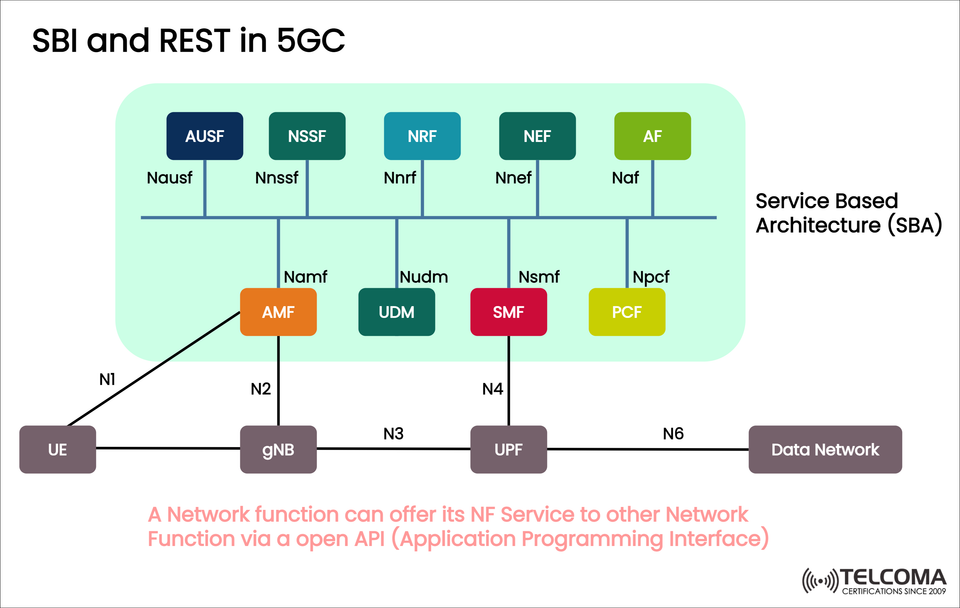

Moving from 4G EPC (Evolved Packet Core) to 5G Core (5GC) isn’t just an upgrade; it’s a complete overhaul in architecture. Whereas LTE used point-to-point connections, 5G adopts a Service-Based Architecture (SBA), which allows network functions (NFs) to communicate through SBI (Service-Based Interfaces) using RESTful APIs.
The diagram we uploaded shows how various network functions (like AMF, SMF, PCF, UDM, AUSF, NRF, NSSF, NEF, AF) interact within the 5GC framework using SBIs. This article will unpack these functions, delve into the roles of SBI and REST, and highlight why SBA is a significant shift for telecom networks.
Why 5GC Needs Service-Based Architecture
In 4G EPC, nodes communicated through fixed reference points such as S1, S5, or Gx, which limited their flexibility and scalability.
The shift to 5G Core opens up new possibilities by:
Utilizing SBI (Service-Based Interfaces) instead of rigid connections.
Presenting network functions as services that can be easily found and used.
Employing REST APIs (Representational State Transfer) for communication among NFs.
This transformation makes 5GC cloud-native, scalable, and compatible with modern IT frameworks like microservices and containers.
Key Concepts: SBI and REST
- Service-Based Interface (SBI)
An interface model where each Network Function (NF) shares its services.
Other NFs can access these services through APIs.
Relies on HTTP/2, REST, and JSON for efficient and scalable communication.
- REST (Representational State Transfer)
A style for designing APIs.
Utilizes HTTP methods (GET, POST, PUT, DELETE) to interact with resources.
Guarantees stateless, scalable, and flexible communication between NFs.
In 5GC, RESTful APIs form the backbone for NF discovery, registration, and interaction.
The Building Blocks: Network Functions in 5GC
The image outlines how different NFs engage within the SBA. Here’s a breakdown:
Network FunctionRole in 5GCAMF (Access and Mobility Management Function)Manages mobility, registration, and access control. Communicates with UE through N1 and with gNB through N2.SMF (Session Management Function)Oversees PDU sessions, assigns IP addresses, and enforces policies. Connects with UPF via N4.
Interfaces in 5GC (From the Image)
Instead of the rigid reference points in LTE, 5GC employs flexible SBIs while also keeping some traditional interfaces for backward compatibility:
N1: Between UE and AMF (for NAS signaling).
N2: Between gNB and AMF (control plane).
N3: Between gNB and UPF (user plane).
N4: Between SMF and UPF (session management).
N6: Between UPF and Data Network (internet or private enterprise network).
SBI (Namf, Nsmf, Npcf, Nudm, Nnrf, Nnef, Naf, Nnssf): Used within SBA for NF-to-NF interactions via REST APIs.
How SBI Works with REST APIs
Service Registration:
Each NF (like AMF or SMF) registers with the NRF through a REST API.
NRF keeps track of their availability and services.
Service Discovery:
When one NF needs a service from another, it checks in with NRF.
For example, AMF can discover UDM to get subscriber authentication data.
Service Consumption:
NFs use RESTful calls to access each other’s services.
For instance, SMF might call PCF over Npcf to enforce session QoS policies.
Scalability:
Since NFs operate as microservices, operators can scale particular functions on their own.
Benefits of SBI and REST in 5GC
- Flexibility and Agility
Any NF can easily share services through APIs.
New NFs can be integrated without overhauling the entire architecture.
- Cloud-Native Readiness
REST and SBI fit well with microservices, containers, and CI/CD workflows.
This setup allows 5GC to be deployed in either private or public clouds.
- Vendor Interoperability
APIs enable multi-vendor NF deployment.
Operators can mix and match NFs from various suppliers.
- Dynamic Service Discovery
NFs aren’t hardwired—NRF ensures they can find each other in real time.
- Support for Network Slicing
NSSF can select slices on the fly based on UE requirements.
APIs facilitate real-time slice management.
Example: End-to-End Call Flow with SBI
Let’s look at how a UE connects to the network:
UE → AMF (N1): The UE starts the registration process.
AMF → AUSF (Nausf): AMF requests authentication.
AUSF → UDM (Nudm): Retrieves subscriber details.
AMF → SMF (Nsmf): Sets up a PDU session.
SMF → PCF (Npcf): Applies QoS and charging rules.
SMF → UPF (N4): Installs forwarding rules.
UPF → Data Network (N6): UE accesses the internet or enterprise services.
All these interactions are powered by REST APIs over SBI, making 5GC both dynamic and efficient.
SBI vs. Legacy Reference Points
Feature Legacy EPC (4G)5GC SBI (5G)Communication Model Point-to-point interfaces Service-based APIs Flexibility Limited Highly flexible Protocols Diameter, GTP-C, SCTPHTTP/2, REST, JSON Service Discovery Static Dynamic (via NRF)Cloud-Native Support Minimal Fully supported
Real-World Impact of SBI and REST
Operators: Can launch new services quicker, adjust NFs dynamically, and manage costs more effectively.
Vendors: Advocate for open APIs and compatibility.
Enterprises: Gain from network slicing, exposing capabilities via NEF for IoT, augmented and virtual reality, and industrial automation.
End-users: Enjoy better QoS, faster connections, and uninterrupted service.
Challenges with SBI and REST
Security: Opening APIs increases vulnerability. Strong security measures like TLS and OAuth2 are essential.
Latency Overhead: REST/HTTP might introduce slight delays compared to binary protocols.
Interoperability Testing: Ensuring smooth integration of NFs from different vendors can be tough.
Orchestration Complexity: This calls for advanced MANO and automation tools.
Future Outlook
The embrace of SBI and REST in 5GC is just the start. Looking ahead, we might see:
Service Mesh frameworks (like Istio) to enhance NF connectivity.
gRPC and HTTP/3 for more efficient interactions.
AI-driven NF orchestration for predictive scaling and fault recovery.
6G Evolution: More distributed SBIs with integration of non-terrestrial networks and AI-native APIs.
Conclusion
The Service-Based Architecture (SBA) in 5G Core, fueled by SBI and REST APIs, signifies a major departure from traditional EPC designs. Instead of fixed point-to-point connections, 5GC adopts a flexible, cloud-native, service-oriented approach, where each network function operates as a microservice.
For those in the telecom field, grasping SBI and REST is crucial for crafting networks that support network slicing, automation, and the massive growth of IoT. As we advance toward Open RAN, cloud-native cores, and 6G, the 5GC driven by SBI will keep transforming the telecom landscape.