
Scope of Smart BAN: Applications, Architecture, and Role in Next-Gen Healthcare

Wireless technology is changing the game for healthcare, fitness, and personal monitoring. One standout innovation is Smart Body Area Networks (Smart BANs).
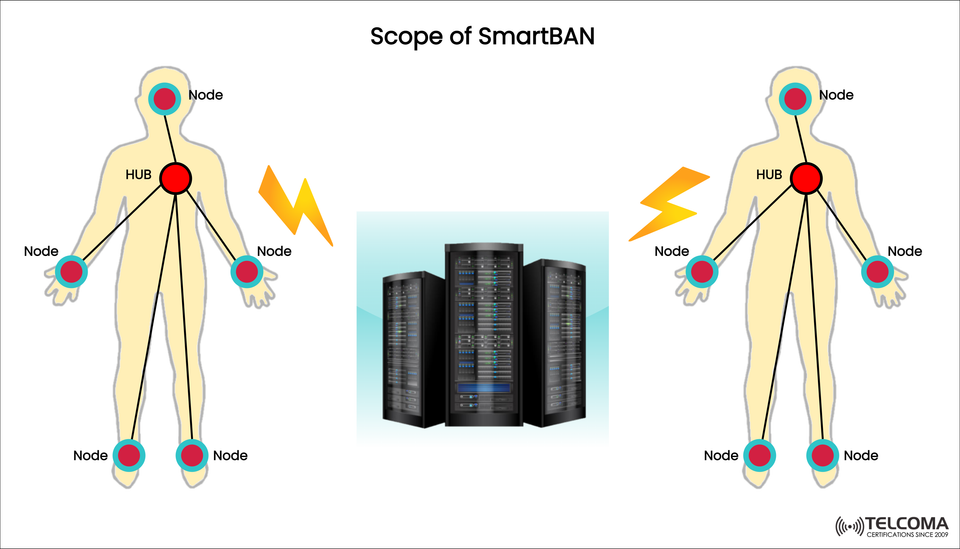
A Smart BAN consists of a network of smart sensors that can be placed on or even inside the body. These sensors gather and send crucial health data to a central hub, which then links up with external systems, like servers or the cloud. If you take a look at the image above, it shows how Smart BANs work—lots of sensors communicating with a central hub, which then connects to servers for processing.
This tech is especially valuable for telemedicine, remote patient monitoring, fitness tracking, and personalized healthcare delivery.
Architecture of Smart BAN
The image illustrates the main parts of Smart BAN:
Nodes (Sensors): These are tiny devices, either wearable or implantable, located on different areas of the body like the wrist, chest, or legs. They measure things like heart rate, temperature, glucose levels, oxygen saturation, and even movement.
Hub (Coordinator): This is a central unit, such as a smartphone, smartwatch, or a specialized medical device, that gathers data from all the nodes. The hub manages communication and ensures secure data transfer.
Central Server/Cloud Integration: After the hub collects the data, it sends it to external servers or cloud platforms for further analysis, storage, and smart decision-making.
This layered setup helps improve efficiency in data collection, processing, and support for healthcare providers and users.
How Smart BAN Works
Data Collection: The nodes constantly monitor vital signs or activity levels.
Data Aggregation: The hub collects and organizes the sensor readings, filtering out unnecessary duplicates.
Wireless Transmission: The hub then sends the data to the cloud or a healthcare system securely using technologies like Bluetooth Low Energy (BLE), Zigbee, or 5G.
Processing and Decision-Making: Central servers analyze the data, spot any anomalies, and notify healthcare providers or trigger automated responses.
Applications of Smart BAN
Smart BANs can be used across various fields, but they're making the biggest waves in healthcare and IoT.
- Healthcare and Remote Patient Monitoring
Continuous monitoring for chronic diseases such as diabetes and heart issues.
Real-time alerts for unusual health conditions, like irregular heartbeats or drops in oxygen levels.
Less frequent hospital visits through remote consultations and monitoring.
- Fitness and Lifestyle
Keeping track of calories burned, heart rate, hydration, and overall activity.
Creating personalized workout plans thanks to real-time data.
Working with fitness apps for setting goals and measuring performance.
- Elderly and Assisted Living
Systems for detecting falls and emergency responses.
Monitoring medication schedules and sleep patterns.
Providing caregivers and doctors with live updates.
- IoT and Smart Environments
Incorporating health data into broader IoT ecosystems.
Smart homes that adjust based on health needs, like changing the temperature or sending reminders.
Improved workplace safety through ongoing monitoring.
Benefits of Smart BAN
Benefit Description Real-Time Monitoring Instant updates on vital health parameters. Early Detection Quick identification of abnormalities for preventive care. Mobility & Freedom Wireless design lets patients move freely while being monitored. Cost-Effective Healthcare Fewer hospital visits and more home monitoring. Integration with AI Enables predictive analytics for customized healthcare.
Challenges in Implementing Smart BAN
Despite its potential, there are some hurdles to overcome:
Energy Efficiency: Nodes need to be small and lightweight, requiring low-power designs to keep battery life long.
Data Security & Privacy: Protecting sensitive health information from cyber threats is crucial.
Interference & Reliability: Wireless transmission can face interference, so ensuring reliable data delivery is key.
Standardization: The lack of universal standards makes it tough for different devices and manufacturers to work together smoothly.
Role of Telecom in Smart BAN Development
The telecom sector is vital for Smart BAN development:
5G Connectivity: High-speed data transfer and low latency allow for real-time monitoring and remote surgeries.
IoT Integration: Telecom providers set up the infrastructure needed for smooth connectivity between devices, hubs, and central systems.
Edge Computing: Processing data closer to where it’s collected reduces delays and increases reliability.
Network Slicing: This ensures dedicated bandwidth is available for critical healthcare uses of Smart BAN.
Future Scope of Smart BAN
Smart BAN has great prospects ahead, especially as AI, ML, and advanced wireless tech come together. Some key trends include:
AI-Driven Predictive Healthcare: Smart BANs can help predict health risks before they happen.
Integration with Wearables: Wider use in consumer devices like smartwatches and fitness trackers.
Smart Hospitals: Seamless integration of patient data into hospital management systems for precise healthcare.
Medical Research & Trials: Large amounts of data from Smart BANs will enhance treatments and drug development.
The Technical Side of Smart BAN Communication
To really grasp the role of telecom in Smart BAN, let's break down the wireless communication stack it uses:
Physical Layer: It uses ultra-low-power radios like Bluetooth Low Energy and the IEEE 802.15.6 WBAN standard.
MAC Layer: This layer focuses on efficient scheduling to cut down on interference and conserve energy.
Network Layer: It provides smooth connectivity to healthcare IoT networks and cloud systems.
Transport Layer: This part is crucial for making sure data is reliable and gets delivered, especially in urgent health situations.
Application Layer: It interacts with apps, dashboards, and healthcare platforms to provide real-time insights.
Telecom technologies, including 5G and edge computing, boost all these layers by offering low latency, dependable coverage, and large-scale data integration.
Real-World Use Cases of Smart BAN
To give you a clearer picture, here are some practical examples of Smart BAN applications:
Emergency Health Monitoring
Smart BAN can pick up on irregular heart rhythms and quickly alert emergency services through the hub.
This helps to shorten response times in critical situations like cardiac arrest.
Remote Rehabilitation
Patients recovering from surgery wear Smart BAN sensors to monitor their healing process.
Physiotherapists can remotely access this data and tweak rehab plans without needing in-person visits.
Athletic Training
Athletes utilize Smart BAN to monitor things like muscle fatigue, hydration, and oxygen levels.
Coaches can analyze real-time data to optimize performance.
Workplace Safety
Smart BAN nodes can identify hazardous conditions, such as toxic gas exposure or extreme fatigue.
Alerts are generated to keep workers safe in environments like mining, construction, and factories.
Benefits for Telecom Professionals
For telecom engineers and other professionals, SmartBAN opens up:
New Business Opportunities: You can provide SmartBAN services as part of IoT-enhanced healthcare solutions.
Network Innovation: There's a growing demand for wireless technologies that are low-power and highly reliable.
Partnership Ecosystems: This includes working with healthcare providers, wearable tech manufacturers, and AI platforms.
Data Monetization: Secure and anonymized SmartBAN data can be used for research, predictive modeling, and smart city projects.
Conclusion
Smart BAN marks a big advancement in personal health monitoring and connected healthcare. By linking sensors on the human body through hubs to centralized systems, it creates a reliable, secure, and smart network for real-time health tracking.
For those in telecom and tech, Smart BAN isn’t just another medical tool—it’s a foundation of IoT, 5G healthcare, and smart living environments.
With the growing need for remote healthcare and personalized solutions, SmartBAN is set to broaden its reach, paving the way for safer, smarter, and more connected lives.