
SD-WAN Service Components: Architecture, Functions & Enterprise Benefits

With businesses quickly moving to cloud apps and embracing digital changes, old WAN setups are finding it tough to keep up with the agility, security, and scalability that companies are looking for. That’s where Software-Defined Wide Area Networking (SD-WAN) comes into play. It takes control away from the hardware and allows smarter traffic management across different transport options like MPLS, broadband, and LTE.
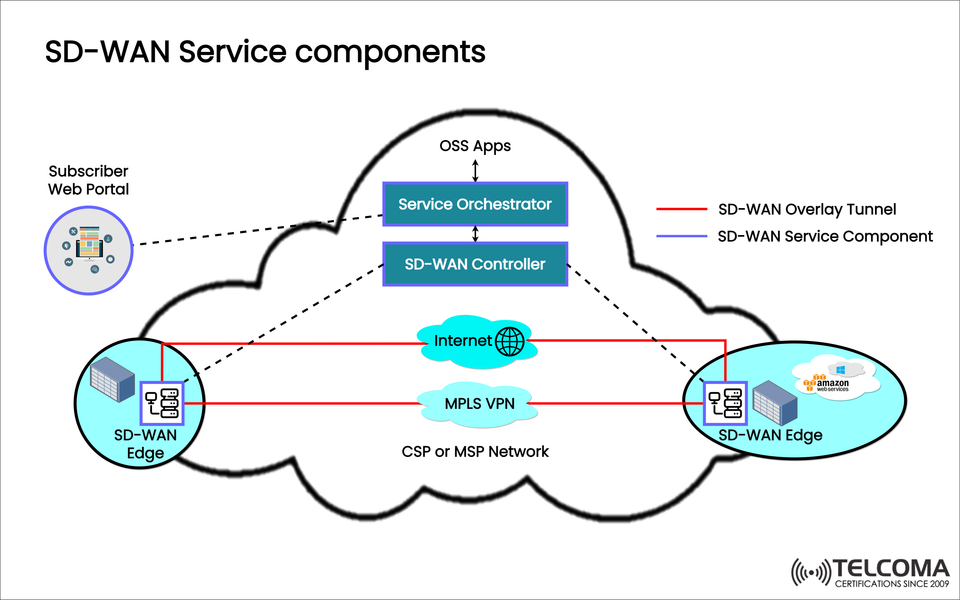
In this blog, we’ll dive into the SD-WAN service components, discuss what each one does, and how they fit together to deliver dependable, secure, and high-performing connectivity. The diagram above shows the key parts of an SD-WAN solution: the Service Orchestrator, SD-WAN Controller, SD-WAN Edges, Overlay Tunnels, and Subscriber Web Portal.
What is SD-WAN?
SD-WAN (Software-Defined Wide Area Network) is a modern WAN setup that simplifies how we manage and operate wide area networks by separating the control from the physical hardware. Unlike traditional WANs that lean heavily on MPLS, SD-WAN can work with various connectivity options and smartly directs traffic based on application needs, performance, and cost.
Some of its top benefits include:
Centralized management thanks to orchestration and automation.
Better cloud access with direct internet breakout.
Cost savings by using broadband alongside MPLS.
Enhanced security thanks to encrypted tunnels and built-in firewalls.
Core SD-WAN Service Components
The diagram we uploaded outlines the fundamental elements of an SD-WAN setup. Let’s take a closer look.
- Subscriber Web Portal
The Subscriber Web Portal serves as the entry point for users to manage their SD-WAN services. It lets businesses:
Check service dashboards.
Keep an eye on traffic usage and app performance.
Set policies, security configurations, and QoS rules.
Make change requests and report any issues.
This interface is self-service, so businesses have the control and oversight they need without waiting on service provider help.
- Service Orchestrator
The Service Orchestrator automates service provisioning and handles lifecycle management. It collaborates with OSS (Operations Support Systems) applications to make network operations smoother.
Its main tasks include:
Automating the deployment of SD-WAN edges.
Coordinating site configurations.
Setting policies for traffic routing and application optimization.
Ensuring end-to-end service assurance.
By simplifying the complexities of the networks underneath, the orchestrator helps deliver SD-WAN services consistently and efficiently.
- SD-WAN Controller
The SD-WAN Controller acts as the network’s brain, overseeing real-time decision-making. It works with the Service Orchestrator and manages the connection between the control plane and data plane.
Its responsibilities include:
Maintaining the overlay topology across various sites.
Sending policies and routing instructions to the SD-WAN Edges.
Monitoring traffic patterns and link conditions.
Allowing for dynamic path selection based on SLAs.
Paired with the orchestrator, the controller guarantees centralized intelligence while ensuring distributed enforcement.
- SD-WAN Edge Devices
Located at branches, data centers, or the cloud, SD-WAN Edge devices (whether physical or virtual) are in charge of forwarding the actual traffic. These devices can be found at customer locations or in cloud setups (like AWS or Azure).
Key features include:
Creating encrypted overlay tunnels (IPsec/GRE) between different sites.
Enforcing local security and QoS rules.
Routing traffic intelligently through MPLS, Internet, or LTE.
Facilitating direct cloud connectivity for SaaS/IaaS applications.
In the diagram, you can see two SD-WAN Edge nodes, one at the corporate branch and another in the cloud (AWS).
- Overlay Tunnels
The red lines in the diagram illustrate the SD-WAN Overlay Tunnels. These are secure and encrypted tunnels established over any transport network—MPLS, broadband, or LTE.
With Overlay tunnels, you get:
Encryption and authentication for traffic.
Smooth failover between various WAN links.
Path optimization, monitored in real-time.
Complete application visibility across the network.
Unlike traditional WANs, SD-WAN keeps overlay (logical traffic forwarding) separate from the underlay (physical transport network), giving you flexible and reliable connectivity.
- Transport Options: Internet & MPLS VPN
The diagram points out two transport networks—Internet and MPLS VPN. SD-WAN lets companies use both at the same time:
MPLS VPN: Offers high performance with guaranteed SLAs, but comes at a cost.
Internet Broadband: More cost-effective, scalable, and perfect for cloud/SaaS traffic.
Using a combination of these allows businesses to strike a good balance between cost and performance. SD-WAN can automatically pick the best route depending on what the application needs.
- OSS Applications Integration
The orchestration and control layers connect with OSS (Operations Support Systems) for billing, service assurance, and monitoring. This integration allows CSPs/MSPs to provide SD-WAN as a managed service with high levels of automation and visibility.
SD-WAN Architecture in Action
Here’s a look at how these components work together:
The Subscriber Web Portal gives users access to set policies and check performance.
The Service Orchestrator automatically provisions services, linking up with OSS.
The SD-WAN Controller sends out policies to the SD-WAN Edge devices.
The edges set up secure overlay tunnels using Internet or MPLS transport.
Traffic is directed smartly, making sure that critical apps (like VoIP or ERP) get priority while SaaS apps can use direct internet connections.
This architecture combines centralized intelligence with distributed enforcement, offering the best of both agility and performance.
Benefits of SD-WAN Service Components
Bringing these components together offers several business and technical perks:
Agility: Quick deployment for branches and cloud connections.
Cost Savings: Smart use of broadband cuts down reliance on pricey MPLS.
Cloud Optimization: Direct and secure access to SaaS/IaaS platforms.
Security: Encrypted tunnels and security features built right in.
Centralized Management: Operations are simplified with full visibility.
High Availability: Automatic failover and application-aware routing.
Key Differences: Overlay vs Service Components
Aspect
Overlay Tunnels (Red)
Service Components (Blue)
Function
Data forwarding & traffic security
Control, orchestration & management
Location
Between SD-WAN Edges
Cloud/control layer
Purpose
Transport abstraction
Centralized decision-making & automation
Conclusion
The effectiveness of SD-WAN hinges on how well its service components work together. The Service Orchestrator and Controller provide centralized intelligence, while SD-WAN Edge devices make sure policies are enforced and traffic flows smoothly through overlay tunnels that utilize various transport methods.
For telecom experts and businesses, grasping these components is crucial for designing, rolling out, and managing high-performance WAN architectures. As more companies embrace cloud solutions, SD-WAN is shaping up to be the backbone of modern enterprise networking—offering agility, cost-effectiveness, and secure global connectivity.