
SDN Architecture Explained: Layers, Components, and Benefits

Understanding SDN Architecture
Today’s telecom and enterprise networks need to be more flexible, automated, and scalable than ever before. Traditional setups, with their static configurations, tend to be complicated, costly to maintain, and slow to adjust to new demands. That’s where Software-Defined Networking (SDN) comes into play.
SDN architecture distinguishes the control plane from the data plane. This centralizes the intelligence and programmability of the network, allowing operators to manage networks in a more dynamic way, making them both more agile and efficient.
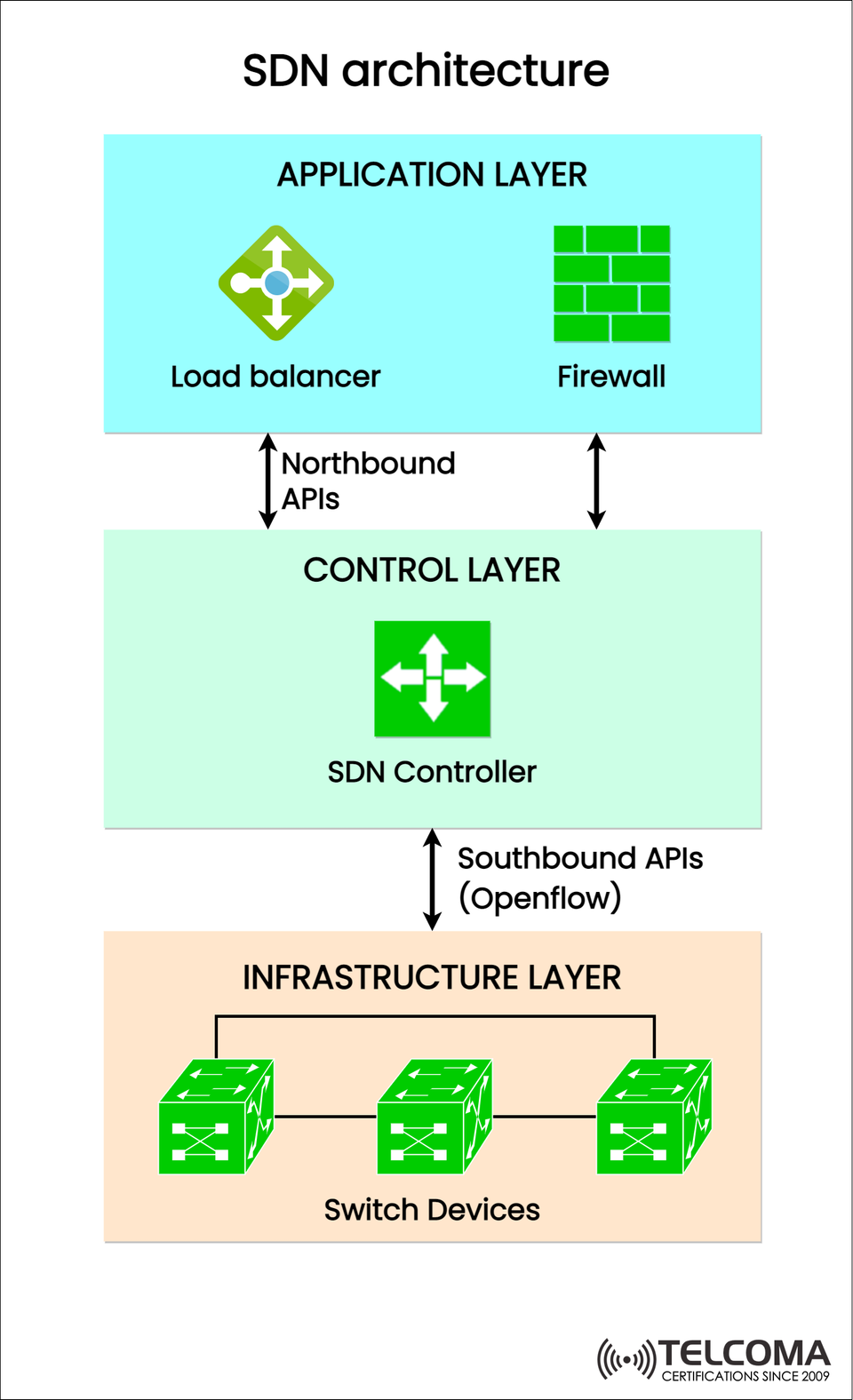
The image provided gives a clear picture of the three main layers of SDN architecture: the Application Layer, Control Layer, and Infrastructure Layer. It also highlights the APIs that permit communication between these layers.
The Three Layers of SDN Architecture
SDN architecture is broken down into three key layers, each with its own responsibilities.
- Application Layer
The Application Layer is where you'll find network applications and services.
Examples include load balancers, firewalls, intrusion detection systems, and traffic analyzers.
These applications set the rules for network policies, security measures, and performance needs.
They communicate with the SDN controller through northbound APIs, enabling applications to request certain behaviors from the network.
Key Functions of the Application Layer:
Policy enforcement (like bandwidth control and traffic prioritization).
Security management (firewall rules and intrusion detection).
Service delivery (including load balancing, VPNs, and QoS).
- Control Layer
The Control Layer acts as the brain of the SDN setup.
It contains the SDN controller, the central hub for decision-making.
This controller has a full view of the network, making resource optimization a breeze.
It communicates upward with applications through northbound APIs and downward with network devices via southbound APIs.
Key Functions of the Control Layer:
Turning application needs into network configurations.
Overseeing routing, forwarding, and traffic management.
Offering programmability and abstraction for easier network operations.
- Infrastructure Layer
The Infrastructure Layer is made up of physical and virtual network devices like switches, routers, and access points.
These devices manage the data plane, which forwards packets based on the instructions received from the SDN controller.
The controller and these devices communicate through southbound APIs, such as Open Flow.
Key Functions of the Infrastructure Layer:
Packet forwarding and switching.
Carrying out commands from the SDN controller.
Serving as the backbone for programmable network operations.
SDN Interfaces: APIs Connecting the Layers
The true strength of SDN is in the seamless communication between its layers, made possible by APIs.
Northbound APIs: * Link the Application Layer and the Control Layer. * Enable applications to request network services from the SDN controller. * For example, an application might tell the controller to block harmful traffic by creating new firewall rules.
Southbound APIs (like Open Flow): * Connect the Control Layer to the Infrastructure Layer. * Let the controller program how switches and routers forward data. * Open Flow is the most widely used protocol in this area of SDN.
Advantages of SDN Architecture
Adopting SDN architecture comes with several significant benefits compared to traditional networking methods:
- Centralized Control
The SDN controller has a comprehensive view of the network, streamlining routing and traffic management.
- Simplified Network Management
Policies can be defined at a higher level and automatically enforced across devices.
This takes away the need for manual setups for each device.
- Agility and Flexibility
Applications can request adjustments in real time, making networks adaptable to changing needs.
This is especially useful in cloud, 5G, and IoT environments.
- Cost Reduction
SDN relies on regular hardware (like basic switches) managed by smart software.
This approach cuts down on the reliance on expensive proprietary hardware.
- Enhanced Security
Centralized policies improve overall security and lessen vulnerabilities.
Threats can be quickly detected and dealt with via programmable firewall rules.
- Improved Innovation
Open APIs promote development by allowing engineers to create their own applications.
This speeds up the introduction of new services.
SDN Architecture in Action: Example Use Cases
SDN is gaining traction in telecom, enterprise, and cloud settings thanks to its programmability and automation features.
- Data Center Optimization
Automated traffic management ensures that the load is balanced across servers.
Supports multi-tenant cloud services with high reliability.
- 5G Networks
SDN enables dynamic slicing of networks to cater to various use cases (like eMBB, URLLC, and mMTC).
Great for handling applications sensitive to latency.
- Security Applications
Programmable firewalls can adapt to emerging threats in real time.
Centralized monitoring makes compliance and auditing much simpler.
- Enterprise Networks
Branch networks are easily managed through centralized controllers.
This is perfect for implementing SD-WAN solutions.
Comparison: Traditional Networking vs. SDN
Aspect Traditional Networking SDN Architecture Control Plane Distributed among devices Centralized in SDN controller Flexibility Limited, hardware-bound Highly flexible, software-driven Configuration Manual, device by device Automated, policy-based Cost High (proprietary gear)Lower (commodity hardware plus software)Scalability Complicated and slow Easily scalable through software Innovation Vendor-locked Open and programmable
Challenges of SDN Architecture
While there are many advantages to SDN, there are also challenges to consider:
Security Risks: Centralized controllers might become single points of failure.
Interoperability Issues: A variety of SDN standards and protocols can lead to compatibility challenges.
Migration Complexity: Transitioning from legacy systems to SDN requires thorough planning.
Scalability of Controllers: Managing very large networks needs specially designed scalable controllers.
Future of SDN Architecture
SDN is vital in shaping the next generation of networks, particularly in cloud-native 5G, edge computing, and IoT environments. As reliance on automation and AI grows, SDN controllers are evolving into more intelligent systems capable of predictive analytics, self-healing, and automated optimization.
Emerging trends include:
Integration with NFV (Network Functions Virtualization).
AI-driven SDN controllers for predicting traffic management needs.
Support for intent-based networking.
Conclusion
SDN architecture signifies a major transformation in how networks are designed, managed, and optimized. By separating the control plane from the data plane, and establishing a programmable framework, SDN introduces flexibility, agility, and centralized intelligence.
The three-layer architecture — Application, Control, and Infrastructure — along with APIs ensures smooth communication and programmability. This positions SDN as a key player in cloud services, 5G rollouts, enterprise automation, and secure networking.
For telecom professionals and businesses, embracing SDN is about future-proofing their networks against increasing complexity while preparing for a digital-first world.