
SDN Architecture Zoom-In: Layers, Interfaces, and Control Plane Explained

🔍 Introduction: What is SDN architecture?
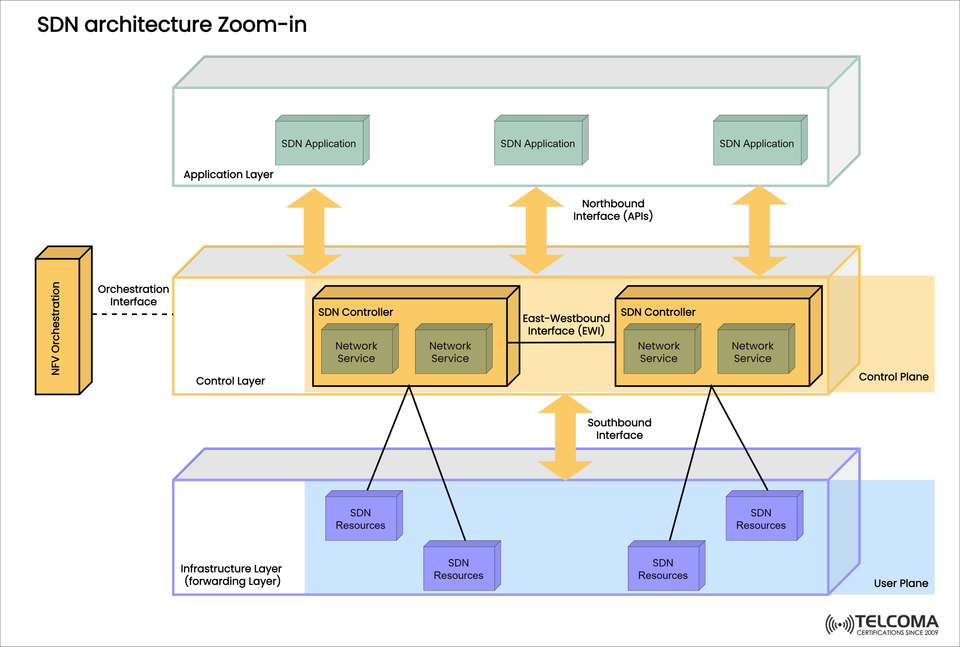
Software Defined Networking (SDN) is a relatively new networking technology that separates the control plane from the data (user) plane to offer centralized control, programmability and agility. The detailed view that follows highlights SDN architecture and how the various elements like applications, controllers, and infrastructure resources interact.
🧱 Key Layers of SDN Architecture
The SDN architecture consists of three primary layers and several interfaces for interaction between elements:
- Application Layer (Top Layer)
Hosts SDN Applications like traffic engineering, security policies, load balancing etc.
Interacts with the control layer using Northbound APIs.
Provides dynamic network programming based on business logic.
- Control Layer (Middle Layer)
Central component: SDN Controller
Session management for Network Services (routing, QoS, analytics, etc)
Functions as the brain of the SDN architecture.
Provides:
Northbound Interface (addressed to applications)
Southbound Interface (addressed to Network devices)
East-West Interface (EWI): self-explanatory, route through other Controllers using EWI. Works fine for scaling and fault-tolerance.
Connects remotely to NFV Orchestrator through orchestration interfaces.
2. Infrastructure Layer (Bottom Layer)
Also known as Forwarding Layer/User Plane.
Contains SDN Resources: actual network devices (switches, routers) for forwarding traffic.
Controlled by Southbound Interfaces (e.g., OpenFlow, NETCONF, gNMI) or similar.
🔄 Understanding Key Interfaces
Interface Definition and Purpose
Northbound Interface Defines how SDN applications communicate with the SDN controller.
Southbound Interface Defines how SDN controllers communicate with devices for forwarding. This allows real-time changes via configuration.
East-West Interface Defines how to coordinate between distributed SDN controllers.
Orchestration Interface Defines how to coordinate and communicate with the NFV orchestrator to deliver end-to-end service.
⚙️ Functional Workflow of SDN in Action
Applications have policies and intended behavior.
SDN Controllers translate the policies into low-level commands.
SDN resources (network devices) will implement the rules to ensure data traffic behaves properly.
NFV Orchestrator oversees virtual functions provisioning and dynamically manages network functions with NFV.
💡 Advantages of Architecture in SDN
✅ Centralized management of the network.
✅ Simpler configuration of the network and automation.
✅ Scalable by design through distributed managed controllers.
✅ Rapid provisioning of services through NFV.
✅ More security and ability to enforce policies in real-time.
✅ Very good use case for 5G, edge computing, and private networks.
📘Real-World Applications in Telecom
5G Core and RAN Control
Network Slicing Management
Dynamic QoS Routing
Cloud and Edge Network Optimization
Private LTE/5G Deployments
🧾 Summary Table
Layer Key Component Interface(s) Used Purpose
Application Layer SDN Applications Northbound APs Network policy, logic, user-facing functions
Control Layer SDN Controllers North/South/East-West Policy translation, orchestration, coordination
Infrastructure Layer SDN Resources Southbound APs Physical/virtual data forwarding
🧭 Conclusions
This detailed zoom-in explanation on SDN architecture presents the essential building blocks that enable the next generation of network control and flexibility. What SDN enables next generation telecom infrastructure and the ability to orchestrate service delivery to potential real-time policy enforcement called "closed-loop" network management. If SDN is constructed properly, what is required for 5G, cloud-native networks and edge networks will be foundational in the telecom industry.
By understanding each layer of the hardware, software, interfaces and protocols that comprise SDN, telecom professionals and operators will be able to architect and build networks that are programmable, dynamic, agile, and ready for what's next.
🧵 How SDN Connects with NFV: Orchestration Synergy
SDN and Network Functions Virtualization (NFV) integrate across many deployment scenarios today--for the sake of network agility, programmability, scalability and economical network services--telecom companies will utilize them together.
🔗 Integration Overview:
NFV orchestrator can interface with the SDN control layer of an SDN architecture to allocate communication resources dynamically to the telecom network.
Orchestrator creates and initiates routing paths of VNFs dynamically, using the SDN controller.
The integration orchestrates closed-loop automation through monitoring the KPIs, and using the KPIs to auto-trigger corrective action(s) in multiple VNFs simultaneously, for completed service chaining.
📚 Use Cases: The SDN Architecture at Work
The following are very common use cases within the telco industry where SDN has a vital application.
Use Case SDN Role
5G Core Slicing Provides on-demand slicing of networks through centralized controlling functions
Traffic Engineering Public cloud-based networks that dynamically reroute traffic based on tight parameters to deliver the best overall experience
Data Center Networking Network provisioning informed by workload awareness
Enterprise VPNs Provides on-demand secure virtual networks
Security Enforcement Centralized ACLs and DDoS mitigation policies
🛠️ Tools and Technologies supporting SDN
The following are the common open-source and commercial available technologies that feature within SDN deployments:
Layer Tools/Technologies
Application ONOS app, OpenDaylight apps, Intent NBI
Control OpenDaylight, ONOS, Ryu, Cisco APIC-EM
Infrastructure Open vSwitch (OVS), traditional or white-box switches
Orchestration OpenStack, ETSI NFV MANO, Kubernetes
🔖 Proposed WordPress Tags
(Using a temperature of 0.3, of the tagging strategy you pursed)
Tags
SDN Control Architecture, SDN orchestration framework, NFV and SDN deployment, telecom network automation, programmable networking layers, 5G SDN controller
The "zoom-in" view of SDN architecture reveals the depth and modularity, which can accelerate the change seen in networking. Through the decoupling of control from forwarding, adding programmable interfaces, and layers of orchestration, SDN can provide telco operators with networks that are agile, resilient and cloud-native.
🧩 SDN Architecture:
Control Plane vs User Plane
Control Plane (CP) User Plane (UP)
Function Decides where traffic goes Forwards user data packets
Example Components SDN Controllers, Policy Engines Switches, Routers, Physical/Virtual Devices
Interface Northbound, Southbound, East-West Interfaces with forwarding hardware
Intelligence High (policy, routing, orchestration) Low (executing forwarding rules from controller)
This CP/UP separation causes SDN to be foundational, especially for 5G Core and cloud-native networks.