
SDN Framework Explained: Components, Architecture, and Interfaces

Plane Separation
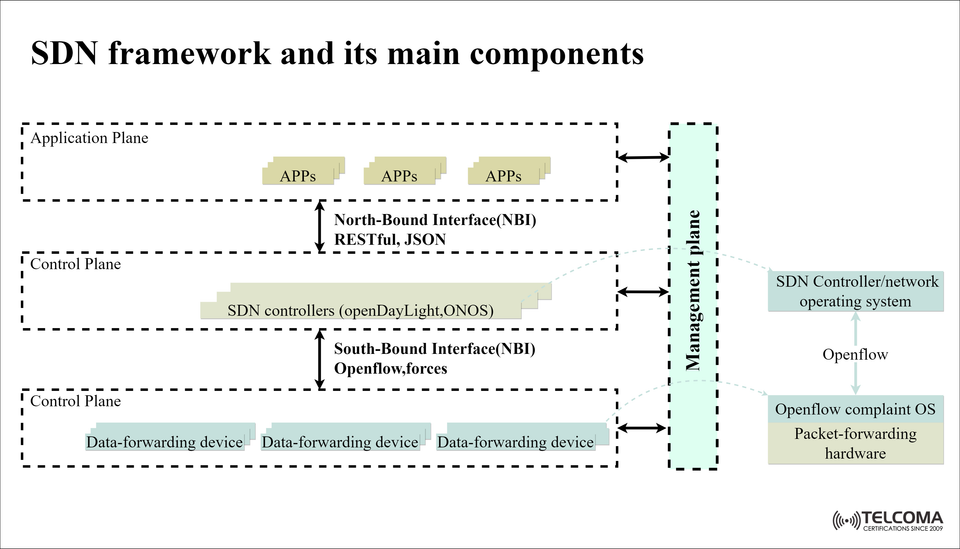
Software-Defined Networking (SDN) provides new opportunities and possibilities for new solutions to be designed as part of a new telecom and IT infrastructure that is programmable, more agile, and cost effective. The diagram below shows the separation of the three layers (planes) of the SDN architecture and their Northbound/Southbound interfaces.
- The architecture of SDN
SDN separates the Control Plane from the Data Plane. Separation abstracts the hardware which allows SDN to provide centralized programmable management through software applications.
The core layers of the SDN framework are:
Application Plane - contains network applications and services
Control Plane - the control plane contains SDN controllers, which programmatically translates the application requirement into the behaviour of the network.
Data Plane - contains hardware devices that forward packets.
- Application Plane
The Application Plane contains an array of network applications (APPs) outlined below:
Traffic engineering
Load balancing
Security enforcement
QoS management
The applications interact with the SDN controller via the Northbound Interface (NBI) and most often uses:
RESTfull APIs
Data in JSON format
Key function: translates business & service requirements to technical instructions for the control plane.
3. Control Plane
The Control Plane is the "brain" of the network. The Control Plane contains the SDN controllers e.g.,
OpenDaylight
ONOS (Open Network Operating System).
The key responsibilities of the Control Plane including:
Network topology management
Policy enforcement
Path computation.
- Data Plane
The data plane includes the data forwarding devices, or the hardware used to switch or route data, such as switches and routers, or specialized packet-forwarding devices. These forwarding devices do the following:
Accept forwarding rules from the SDN controller
Make packet route and switch decisions
Run an OpenFlow compliant OS
- Management Plane
The management plane is responsible for overseeing and coordinating the application, control, and data planes. It provides
Configuration consistency
Performance monitoring
Fault management
- Northbound and Southbound Interfaces
Interface Direction Purpose Common Protocols
Northbound (NBI) Application → Control Enables applications to program the network RESTful, JSON
Southbound (SBI) Control → Data Instructs data-forwarding devices on how to handle traffic OpenFlow, ForCES - Advantages of the SDN Framework
Centralized control – A single controller manages multiple forwarding devices.
Programmability – Configuration can be completed dynamically without any physical changes on hardware.
Vendor Neutral – Allows interoperability, or compatibility, between multiple vendor devices.
Scalable – Network can be easily expanded to extend capacity or add features.
Conclusion
The SDN framework changes how a network is built, managed, and extended. By separating the application, control, and data planes while connecting them using standardized interfaces, SDN provides the opportunity to innovate faster, manage resources simpler, and be more operationally efficient in telecom and enterprise networks.
- The Role of SDN in Telecom Networks
In the telecom business, SDN is being utilized in several ways:
5G Core Networks: Using SDNs to slice networks provides for a much more flexible utilization model.
Backhaul Optimization: Steering traffic in the most efficient way between RAN and core.
Edge Computing Integration: Open SDN will make it possible to dynamically route workloads between the edge and the cloud.
NFV (Network Functions Virtualization): Software orchestrators for NFV are open to SDN automation.
Telecom operators have increasingly used SDN to streamline service delivery timelines and provide greater network agility and flexibility, in addition, to reduced operational expenditure (OPEX).
- Before we delve into SDN illusions in further detail we should cover some of the SDN control devices in detail. In the previous section, we made mention of two, very widely used open-source SDN controllers: OpenDaylight and ONOS.
OpenDaylight (ODL)
Is a modular and extensible SDN controller.
Is one of the most supported controllers for multi-protocol environments.
Open Network Operating System (ONOS)
Carrier class performance.
High availability and scalability.
Both OpenDaylight and ONOS controllers provide support for OpenFlow and NETCONF/YANG to drive or communicate with devices.
- Packet Forwarding with OpenFlow
OpenFlow has become a widely used, Southbound protocol in SDN.
OpenFlow defines a flow table within the switches and devices to allow for match-action rules (e.g., match on IP, MAC, VLAN) and separates the data path and control path.
Simply put, it separates forwarding decisions from switching hardware.
Each time an SDN is developed, OpenFlow will be pushed at run-time as opposed to against the Cisco device CLI for new routing rules.
- Future Developments in SDN
AI-Driven Networking – So, it will not be long before controllers will start predicting traffic patterns and routing intentions by using AI to automatically swap paths as needed.
End-to-End Network Slicing for IoT – We can expect to see SDN emerging as part of the dynamic spectrum allocation for these types of applications, and bandwidth to be allocated to critical IoT applications (including autonomous vehicles for example).
- Future Trends in SDN
AI-Driven Networking - Controllers will leverage AI to analyze past traffic patterns, predict traffic burst and automate disruption routes.
Network Slicing for IoT - SDN will allow controlled bandwidth allocation to ensure optimal performance of IoT critical applications.
Cloud-Native SDN - SDN integrates with Kubernetes and containerized workloads in cloud-native architecture.
Security-Embedded SDN - Utilizing programmable rules, SDN devices will be able to identify and mitigate DDoS in real-time.
SEO Keywords to Target
SDN architecture
SDN framework
Northbound interface
Southbound interface
OpenFlow protocol
SDN controller
SDN in telecom
Programmable networking
Final Thoughts
The SDN framework is a networking architecture of methodologies, in the interest of the future readiness of enterprises and telecom networks. If professionals effectively understand the application, control and data planes, NBI and SBI protocols, the capability to define and design programmable, scaleable, and vendor neutral, infastructure will be unleashed.