
Search Space Design of 3GPP PDCCH | CSS vs USS Explained

Introduction
Getting resource allocation right and having solid control signaling are crucial for how well LTE and 5G networks perform. At the core of downlink control signaling is the Physical Downlink Control Channel (PDCCH), which is responsible for sending out Downlink Control Information (DCI) like scheduling grants, resource assignments, and Hybrid ARQ (HARQ) feedback.
To make sure control messages are detected reliably, the 3GPP standard outlines search spaces in the PDCCH structure. These search spaces, namely the Common Search Space (CSS) and UE-Specific Search Space (USS), dictate where a User Equipment (UE) looks for its control messages.
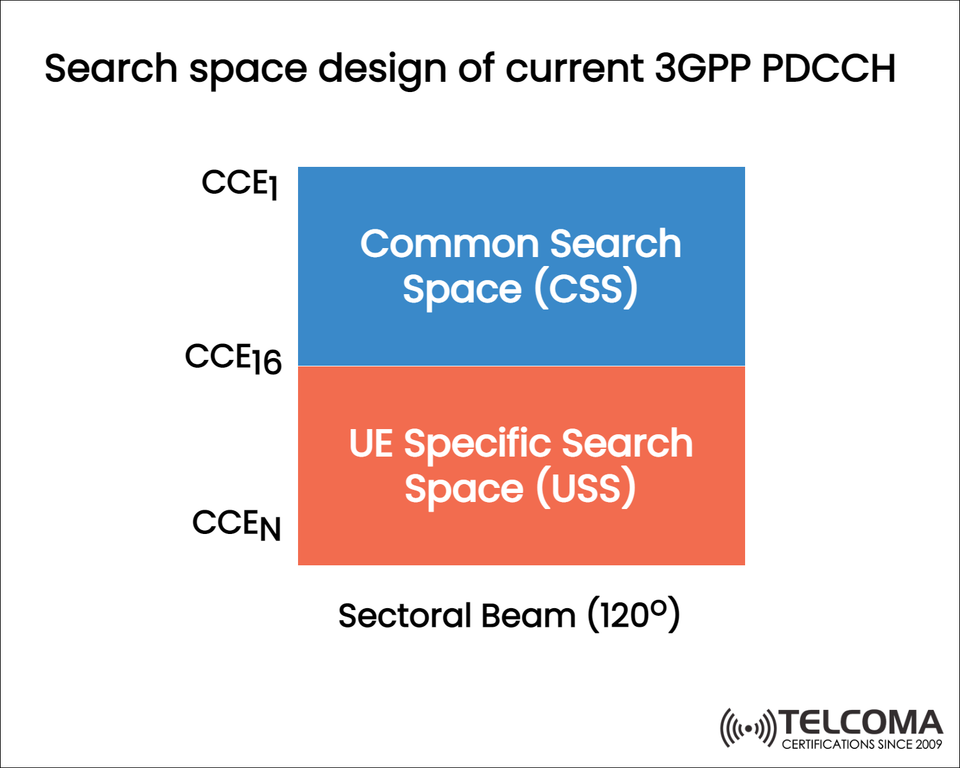
The uploaded image illustrates how the PDCCH is divided into CSS and USS, spread out across Control Channel Elements (CCEs). This blog post will delve into their functions, differences, and how they impact network performance.
PDCCH and Its Role in LTE/5G
The PDCCH is one of the vital channels in LTE and NR (New Radio):
It carries DCI (Downlink Control Information).
It notifies UEs about resource allocation for both uplink and downlink.
It provides HARQ scheduling information.
It keeps user data (PDSCH) synchronized with control signaling.
How well the PDCCH is detected is critical for network efficiency and user satisfaction. This is where the design of the search space becomes important.
What is Search Space in PDCCH?
A search space refers to the potential spots within the PDCCH that a UE can try to decode its control message. Since the PDCCH is made up of Control Channel Elements (CCEs), the search space points the UE to which CCEs to keep an eye on.
This setup cuts down on unnecessary decoding attempts and optimizes the detection process.
Key Functions of Search Space:
It limits how many decoding attempts the UE has to make.
It separates control signaling into common and dedicated groups.
It minimizes interference and simplifies decoding.
It enhances scheduling flexibility for network operators.
Common Search Space (CSS)
In the image, the upper part (CCE1–CCE16) is labeled as the Common Search Space (CSS).
Characteristics of CSS:
It's shared by all UEs within a cell.
It's utilized for common signaling, which includes: * System Information (SI) scheduling. * Random Access Response (RAR). * Paging messages. * Broadcast-type control info.
Usually takes up the first 16 CCEs.
Makes sure vital cell-wide messages can always be decoded.
👉 Example: When a new UE tries to connect, it first checks the CSS for system-level control messages.
UE-Specific Search Space (USS)
The lower section (CCE16–CCEN) in the image represents the UE-Specific Search Space (USS).
Characteristics of USS:
It's unique to each UE.
It's used for dedicated control signaling, such as: * Uplink and downlink scheduling grants. * HARQ acknowledgments for specific UEs. * Power control commands.
Its size and position depend on the RNTI (Radio Network Temporary Identifier) assigned to the UE.
Offers more flexibility in scheduling than CSS does.
👉 Example: Once a UE is online, it mainly monitors its USS for downlink grants and uplink assignments.
CCEs and Aggregation Levels
The Control Channel Elements (CCEs) are the building blocks of the PDCCH. Each CCE consists of multiple Resource Element Groups (REGs).
To boost robustness, PDCCH messages are sent over an aggregation level (1, 2, 4, or 8 CCEs).
Higher aggregation levels mean more redundancy, which improves coverage (especially at the edge of the cells).
Lower aggregation levels are more efficient (ideal when the signal quality is good).
So, both CSS and USS search spaces dictate how many CCEs are monitored at any given aggregation level.
CSS vs USS: Key Differences
Aspect Common Search Space (CSS)UE-Specific Search Space (USS)Purpose Cell-wide control signaling UE-dedicated control signalingLocationCCE1 to CCE16CCE16 to CCEN Accessibility Shared by all UEs Unique per UE (based on RNTI)Typical Use Cases RAR, paging, SI scheduling Grants, HARQ, power control Scheduling Flexibility Limited (fixed structure)High (UE-specific allocation)Robustness Requirements Very high Adaptive (based on UE channel conditions)
Importance of Search Space Design
The search space design in the PDCCH directly influences:
Network efficiency: Properly separating CSS and USS prevents overlap and avoids congestion in signaling.
UE battery consumption: Fewer blind decoding attempts help conserve device power.
Reliability of signaling: Ensures critical broadcast messages (CSS) and UE-specific instructions (USS) are delivered effectively without conflict.
Coverage enhancement: High aggregation levels in CSS provide strong signaling even in weak coverage areas.
Practical Example
Consider a subframe that has 40 CCEs available:
CCE1–CCE16: Reserved for CSS.
CCE17–CCE40: Used for USS.
When a new UE begins random access:
It checks the CSS for the Random Access Response (RAR).
Once connected, it transitions to USS for dedicated scheduling.
The scheduler at the e N o d e B dynamically assigns CCEs within USS based on UE load and channel quality.
This layered strategy ensures both scalability and efficiency in control signaling.
LinkedIn Carousel Script: Search Space Design of 3GPP PDCCH
Slide 1 – Cover
Title:
📡 Search Space Design of 3GPP PDCCH
Subtitle:
How CSS and USS enhance LTE & 5G signaling
Slide 2 – Intro
The Physical Downlink Control Channel (PDCCH) is crucial for carrying important control info:
Resource allocations
HARQ scheduling
Power control
To boost signaling efficiency, the PDCCH is split into search spaces.
Slide 3 – What’s a Search Space?
A search space refers to the set of Control Channel Elements (CCEs) that a User Equipment (UE) checks for its control messages.
👉 This helps cut down on blind decoding attempts.
👉 It also increases efficiency.
Slide 4 – Two Types of Search Spaces
1️⃣ Common Search Space (CSS) – accessible to all UEs.
2️⃣ UE-Specific Search Space (USS) – tailored for individual UEs.
Slide 5 – Common Search Space (CSS)
🔹 Found in CCE1–CCE16
🔹 Available to all UEs
🔹 Contains shared info like:
Paging
Random Access Response (RAR)
System Information
Slide 6 – UE-Specific Search Space (USS)
🔹 Located from CCE16–CCEN
🔹 Dedicated to each UE (based on RNTI)
🔹 Contains:
Scheduling grants
HARQ ACK/NACK
Power control commands
Slide 7 – CSS vs USS (Quick Comparison)
Feature CSS (Common)USS (UE-Specific)Scope All UEs One UELocationCCE1–CCE16CCE16–CCEN Use Cases Paging, RAR, SI Grants, HARQ, Control flexibility Fixed Adaptive per UE
Slide 8 – Why It Matters
✅ Provides reliable broadcast signaling (CSS)
✅ Allows for personalized scheduling (USS)
✅ Enhances network efficiency & helps with UE battery life
✅ Scales with LTE-Advanced & 5G
Conclusion
The 3GPP PDCCH search space design—which splits resources into Common Search Space (CSS) and UE-Specific Search Space (USS)—is a vital advancement in LTE and NR networks.
CSS ensures all UEs can reliably receive system-wide control messages.
USS provides personalized, flexible control signaling tailored for individual UEs.
Together, they achieve a balance between robustness, efficiency, and scalability.
For telecom professionals, getting a handle on this architecture is key for network optimization, scheduling strategies, and managing interference. As LTE keeps evolving and 5G becomes more prevalent, search space design continues to be a cornerstone of reliable mobile communication.