
Search Space Design of BF-PDCCH in 5G | Beamformed Control Signaling Explained

Introduction
The rise of 5G networks has pushed wireless technology to provide faster data speeds, lower latency, and better spectrum efficiency. A key improvement in this development is beamforming, which helps direct signal strength more precisely to users. But, there's a flip side: beamforming brings some challenges, particularly with control channel design for users situated at the edges of the beam where signal quality tends to drop.
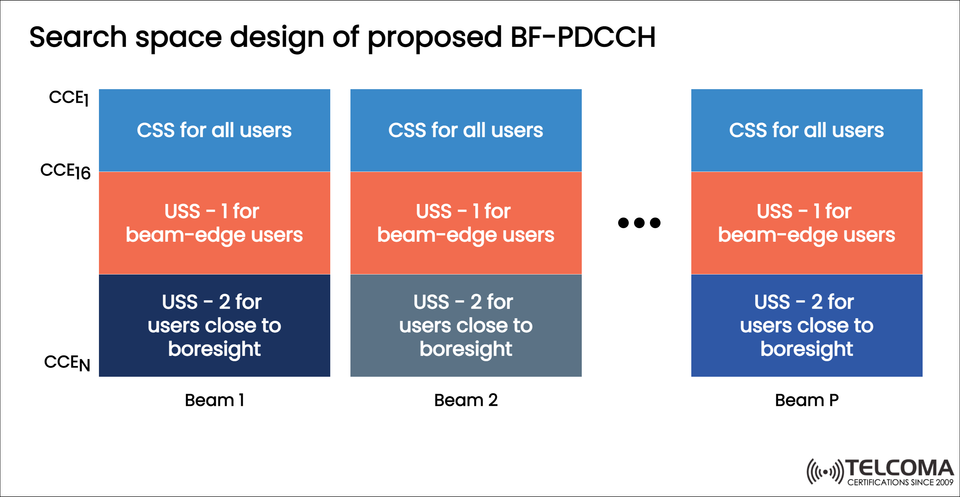
To tackle these issues, the Beamformed Physical Downlink Control Channel (BF-PDCCH) has been suggested to rethink how we allocate search spaces within the PDCCH. The image shared illustrates how search space design in BF-PDCCH is organized, distributing resources across various beams while optimizing signaling for users at the edges and those closer to the center of the beam.
This blog dives into the concept, layout, and advantages of the BF-PDCCH search space.
Background: PDCCH and Search Spaces
In LTE and NR (New Radio), the Physical Downlink Control Channel (PDCCH) carries Downlink Control Information (DCI), which includes:
Scheduling grants for downlink (PDSCH) and uplink (PUSCH)
Hybrid Automatic Repeat Request (HARQ) acknowledgments
Power control commands
Since UEs can’t just search the entire PDCCH, we define search spaces to narrow down the potential spots for their control messages.
Traditional PDCCH Search Spaces
Common Search Space (CSS): * Available to all UEs. * Used for broadcasting messages, Random Access Response (RAR), paging, and system information.
UE-Specific Search Space (USS): * Reserved for individual UEs. * Used for scheduling grants and other user-specific control signals.
Limitation of Traditional Design
While this setup works fine for omnidirectional or sectoral beams, it falters in beamformed transmissions because:
Users on the beam's edge get weaker signal quality.
A single USS allocation isn’t flexible enough to adjust for user location within a beam.
What is BF-PDCCH?
The Beamformed Physical Downlink Control Channel (BF-PDCCH) is an upgrade from the standard PDCCH. It utilizes beam-specific search spaces to enhance reliability, especially in beamforming-based 5G deployments.
Rather than having just one USS per user, BF-PDCCH introduces two USS categories for each beam:
One for beam-edge users (who have weaker channel conditions).
One for boresight users (who enjoy stronger channel conditions).
This separation makes signaling more adaptable and robust.
Search Space Design in BF-PDCCH
The image provided clearly depicts the design:
CCE1 to CCE16: Allocated to the Common Search Space (CSS) for all users.
CCE16 onwards: Split into two distinct USS allocations per beam.
Per Beam Allocation
Every beam (Beam 1, Beam 2, … Beam P) follows this structure:
CSS (top part): Available to all users in the beam.
USS-1: Dedicated to beam-edge users, who need more robust error protection and higher aggregation levels.
USS-2: Reserved for boresight users, located closer to the center of the beam, who can manage with lower aggregation levels.
Benefits of This Division
Beam-edge users benefit from greater reliability.
Boresight users gain higher efficiency since there's less overhead.
Resources are allocated more intelligently, striking a balance between robustness and spectrum efficiency.
Technical Features of BF-PDCCH Search Space
- Beam-Specific Control
Each beam comes with its own designated search space, ensuring that signaling adjusts to the beam's geometry.
- User Location Awareness
By distinguishing between beam-edge and boresight users, the design accommodates different channel qualities within the same beam.
- Aggregation Level Optimization
Beam-edge USS utilizes higher aggregation levels (more CCEs, greater redundancy).
Boresight USS operates on lower aggregation levels (fewer CCEs, less redundancy).
- Improved Reliability for Edge Users
Beam-edge UEs, often facing signal gaps, gain from stronger signaling.
- Enhanced Spectrum Efficiency
Boresight users, who don’t need redundant signaling, help free up capacity for the whole system.
BF-PDCCH vs Traditional PDCCH
Feature Traditional PDCCH Design Proposed BF-PDCCH Design CSS Allocation Fixed for all UEs Fixed for all UEs per beam USS Allocation Single USS per UE Separate USS for beam-edge & boresight users Adaptation to Beam Geometry Limited Beam-specific signaling Reliability for Beam-Edge Users Standard, less robust Enhanced via higher aggregation Efficiency for Boresight Users Not differentiated Optimized with lower aggregation
Why BF-PDCCH Matters in 5G
The BF-PDCCH design is crucial for beam-centric 5G networks for several reasons:
Beamforming is central to 5G NR. Users pick up signals through narrow beams, moving away from traditional sectoral broadcasting.
User positioning within a beam isn’t uniform. Users at the edges of the beam struggle with lower SINR (Signal-to-Interference-plus-Noise Ratio) as compared to those at the center.
Reliability of the control channel is essential. If DCI delivery isn’t robust, it could jeopardize data scheduling as well as uplink/downlink operations.
So, BF-PDCCH guarantees that control signaling is reliable, adaptive, and efficient, no matter where users are positioned within beams.
Practical Example
Think of a 5G base station with 3 beams serving various UEs:
Beam 1:
CSS relays broadcast information for all users in Beam 1.
USS-1 provides dependable signaling for a UE at the beam's edge.
USS-2 efficiently meets the needs of a UE near the center.
Beam 2 & Beam 3:
The same structure applies, ensuring that each beam tailors its signaling to match user positioning.
This method guarantees a consistent user experience across different spots in the network.
Advantages of BF-PDCCH Search Space
🔹 Better coverage for edge users
🔹 More efficient spectrum use for users at the center
🔹 Beam-specific adjustments for advanced 5G deployments
🔹 Scalability across multiple beams
🔹 Well-balanced trade-offs between robustness and efficiency
Conclusion
The BF-PDCCH search space design marks a big leap in optimizing control signaling for 5G beamformed networks. By segmenting resources into CSS for all users, USS-1 for beam-edge users, and USS-2 for boresight users, the system ensures:
Reliable signaling even for users facing tough conditions.
Efficient use of spectrum for those with stronger connections.
Adaptability across various beams.
For telecom engineers and network planners, BF-PDCCH shows how careful design of control channels can maximize the potential of beamforming in 5G.