
Self-Scheduling, Cross-Carrier Scheduling, and Multi-Cell Scheduling in 5G NR: Explained with Examples

Self-Scheduling, Cross-Carrier Scheduling, and Multi-Cell Scheduling Explained
In today’s mobile networks, especially with LTE-Advanced and 5G NR, the role of scheduling is crucial for managing radio resources effectively across various carriers and cells. Basically, scheduling is what decides when and where user data gets sent, making sure we achieve the best possible throughput, latency, and power efficiency.
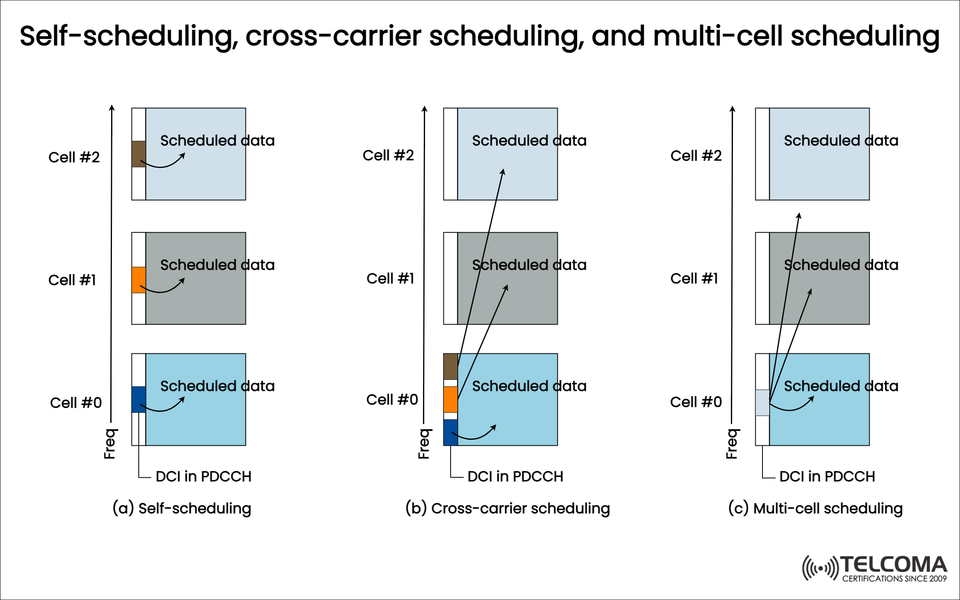
The image above from Telcoma gives a clear view of the three main scheduling methods used in multi-carrier and multi-cell networks:
Self-Scheduling
Cross-Carrier Scheduling
Multi-Cell Scheduling
Let’s dive into each to get a better grip on how they work, their use cases, and the perks they offer.
What Is Scheduling in 5G NR?
Scheduling in 5G NR (New Radio) refers to how the gNodeB (gNB) or base station assigns radio resources to user equipment (UE) for both uplink (UL) and downlink (DL) communication.
The scheduler decides:
Which UEs to serve at a particular time
What frequency-time resources to allocate
How much power and modulation scheme to use
This info gets sent out through Downlink Control Information (DCI), which is transmitted on the Physical Downlink Control Channel (PDCCH).
Why Scheduling Matters in 5G
Given 5G’s massive bandwidth, multi-carrier aggregation, and dense cell deployments, efficient scheduling is key to ensuring:
High data throughput
Load balancing across carriers
Reduced interference
Improved spectral efficiency
Energy savings for the UE
The three types of scheduling — Self, Cross-Carrier, and Multi-Cell — offer flexible and smart ways to manage resources.
Self-Scheduling
Concept
With Self-Scheduling, each carrier (or cell) takes care of its own scheduling. The DCI (Downlink Control Information) and data are sent within the same carrier or cell.
So, the PDCCH carrying the scheduling command and the PDSCH (data channel) are on the same frequency carrier.
How It Works (as shown in the image)
Each cell (#0, #1, #2) sends out its own DCI in its own PDCCH.
The DCI points to the data scheduled in the same frequency band.
The UE keeps an eye on multiple cells, each scheduling on its own.
Advantages
Simplicity: Each carrier manages its own schedule, which cuts down coordination complexity.
Reliability: Since scheduling and data are together, signaling delays are minimized.
Independence: Works best for single-carrier setups.
Limitations
More control signaling is needed when there are several carriers.
It’s not the most efficient in carrier aggregation scenarios.
Use Case
Single-carrier LTE or 5G NR setups.
Simpler UEs (like Category 4/5 LTE or entry-level 5G devices).
Cross-Carrier Scheduling
Concept
In Cross-Carrier Scheduling, the DCI (scheduling command) for one carrier is sent over the PDCCH of another carrier. This allows a single carrier to control and schedule data transmission for multiple carriers.
How It Works (from the diagram)
The PDCCH with the DCI is sent out in Cell #0.
This DCI manages data (PDSCH) that could be in Cell #1 or Cell #2.
So, one control channel (in Cell #0) is in charge of scheduling across multiple carriers.
Benefits
Reduced Control Overhead: Just one control channel (PDCCH) is used to manage several data carriers.
Improved Flexibility: Control and data can be handled on different frequencies.
Optimized Aggregation: Works great for Carrier Aggregation (CA) in LTE-Advanced and 5G NR.
Challenges
Requires precise timing and coordination between carriers.
More complex for UEs to track control info across carriers.
There’s a chance of scheduling misalignment in high-latency links.
Example Use Case
Carrier Aggregation (CA): where a Primary Cell (PCell) schedules additional Secondary Cells (SCells).
Used in LTE-Advanced and 5G NR to enhance throughput by merging bandwidths from different frequency bands.
Multi-Cell Scheduling
Concept
Multi-Cell Scheduling takes cross-carrier scheduling a step further by letting a single control signal (DCI) schedule data transmissions across several cells or nodes — often managed by a centralized scheduler.
This is especially important in advanced 5G scenarios with Coordinated Multi-Point (CoMP) or Multi-TRP (Transmission Reception Point) setups.
How It Works (based on the image)
The DCI in PDCCH from one cell (e.g., Cell #0) can schedule data across neighboring cells (Cell #1 and Cell #2).
A UE could get data from multiple cells at once, which supports coordinated transmission.
Advantages
Enhanced Throughput: Multiple cells work together to provide higher data rates.
Improved Coverage: Particularly helpful at the edges of cells where the signal is weaker.
Load Balancing: The scheduler evenly distributes data among cells.
Interference Reduction: Coordination helps lessen inter-cell interference.
Limitations
Needs a robust, low-latency backhaul for coordination.
The complexity of the scheduler increases significantly.
Requires tight synchronization among cells.
Use Cases
CoMP (Coordinated Multi-Point) in LTE and 5G.
5G NR Multi-TRP (Transmission Reception Point) operations.
Heterogeneous networks (HetNets) featuring macro and small cells.
Comparison Table
Feature Self-Scheduling Cross-Carrier Scheduling Multi-Cell Scheduling Control and Data Location Same cell/carrier Different carriers Different cells Control Signaling (PDCCH)Per carrier Shared across carriers Shared across cells Scheduling Complexity Low Medium High Resource Efficiency Moderate High Very High Coordination Needed None Inter-carrier Inter-cell Use Case Single carrier Carrier aggregation Co MP / Multi-TRP Main Advantage Simplicity Flexibility Through put & coverage gain
Technical Insights
Control Channel Elements (CCE) and DCI Mapping
In all types of scheduling, Downlink Control Information (DCI) is carried over Control Channel Elements (CCEs) within the PDCCH.
In environments with multiple carriers or cells:
The Carrier Indicator Field (CIF) lets you know which carrier or cell is being scheduled.
The UE monitors several PDCCH search spaces for DCI messages.
5G NR Flexibility
With 5G NR, the Slot-based structure and Bandwidth Part (BWP) mechanism give more scheduling flexibility:
A single BWP can accommodate various scheduling setups.
Different DCI format variations enable efficient control across multiple carriers and cells.
Advantages of Advanced Scheduling in 5G NR
Enhanced Spectral Efficiency – Makes the most of fragmented spectrum across multiple carriers.
Massive MIMO Support – Coordinates beamforming and transmission layers across cells.
Dynamic Load Balancing – Distributes user data smartly among cells based on load conditions.
Reduced Control Overhead – Shared scheduling cuts down on redundant signaling.
Seamless User Experience – Delivers continuous high throughput even at cell edges or during mobility.
Practical Example: Carrier Aggregation Scenario
Imagine a UE connected to:
PCell (Primary Cell) using a low-frequency band (like 700 MHz)
SCell (Secondary Cell) using a high-frequency band (like 3.5 GHz)
Through cross-carrier scheduling, the PDCCH in the PCell sends out the DCI that schedules PDSCH data in both the PCell and SCell.
This setup reduces the monitoring effort for the UE and minimizes latency while maximizing bandwidth use.
Conclusion
Scheduling is at the heart of efficient radio resource management in 5G NR and LTE-Advanced networks.
Self-scheduling is straightforward and independent.
Cross-carrier scheduling boosts flexibility and makes carrier aggregation possible.
Multi-cell scheduling allows for coordinated multi-point transmissions and network densification.
Together, these methods ensure optimal data delivery, efficient spectrum use, and a better user experience — all hallmarks of the next generation of mobile communications.