
Separation of Control Plane and User Plane in EPC – 3GPP Release 14 CUPS Architecture Explained
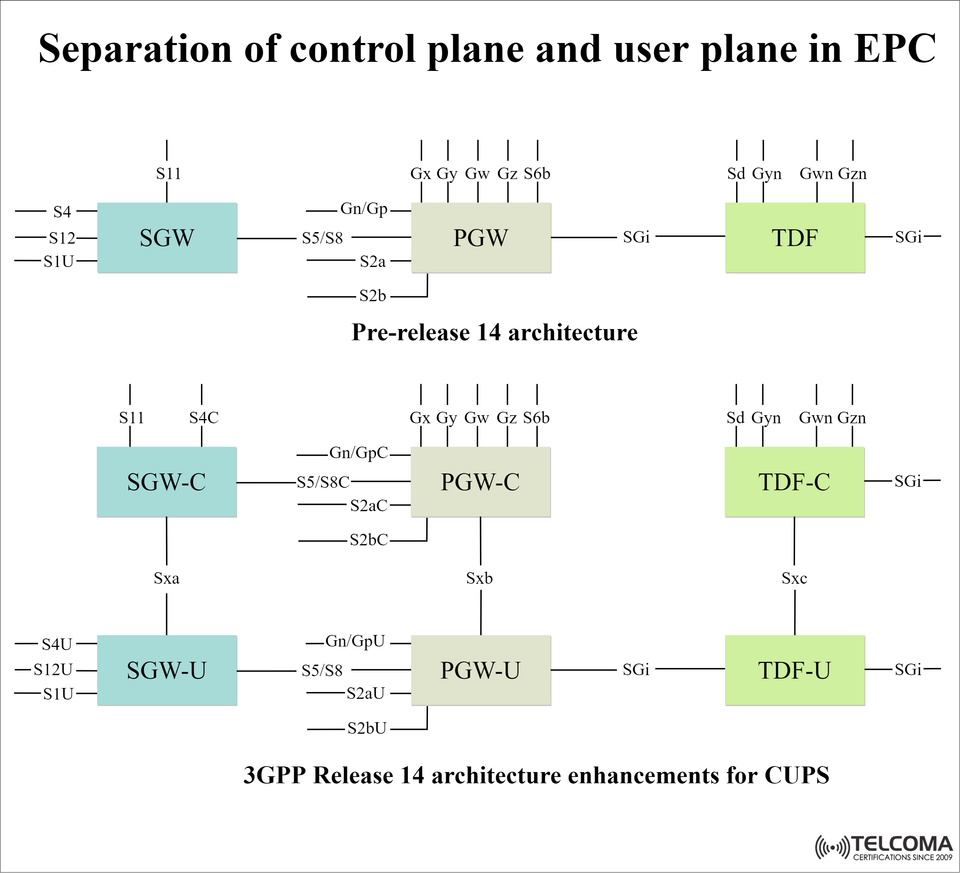

Control Plane and User Plane Separation in EPC
In the context of the development of the mobile network, Evolved Packet Core (EPC) plays an important role in connecting subscribers to IP-based services. In 3GPP Release 14, a major architecture advancement was introduced - Control and User Plane Separation (CUPS).
Pre-Release 14 EPC Architecture
Before Release 14, EPC elements included both control and a user plane functions:
SGW (Serving Gateway) - combining the handling of control signaling (S11) and the user traffic (S1U, S5/S8).
PGW (Packet Data Network Gateway) - combining the handling of policy control (Gx, Gy) and user traffic routing (SGi).
TDF (Traffic Detection Function) - combining the control and user functions for traffic shaping and detection.
Some disadvantages of the pre-Release 14 EPC concepts:
Inflexible scaling - if an operator wanted to increase user capacity, it had to increase the control plane capacity.
Greater operating costs due to limited resource optimization.
3GPP Release 14: CUPS Architecture Improvements
In Release 14, each EPC element was split in to Control (C) and User (U) components:
EPC Function Control Plane User Plane
Serving Gateway SGW-C SGW-U
Packet Gateway PGW-C PGW-U
Traffic Detection Function TDF-C TDF-U
Noteworthy New Interfaces in CUPS
Sxa – Between SGW-C and SGW-U
Sxb – Between PGW-C and PGW-U
Sxc – Between TDF-C and TDF-U
S4C, S5/S8C, S2aC, S2bC – control plane specific interfaces
S4U, S5/S8U, S2aU, S2bU – user plane specific interfaces
Benefits of CUPS in EPC
Scale – independent scaling of control or user plane resources.
Latency – Avoid latency by having user plane functions as close as possible to the user.
Cost – Invest licenses and hardware on only what you need at that particular location.
Deployment Option – deploy control plane nodes as necessary, but place user plane nodes as close to the edge as possible, closer to users will provide better performance.
Easy Transition to 5G Core – The CUPS interface aligns with the transition towards a 5G SBA (Service-Based Architecture) interface.
Visual Summary
As you can see in the provided diagram:
The top half of the diagram is before EPC Release 14 (SGW, PGW, TDF are combined).
The bottom half of the diagram is EPC Release 14 which has a CUPS architecture with SGW-C/SGW-U, PGW-C/PGW-U, and TDF-C/TDF-U and are connected using interfaces Sxa, Sxb, Sxc.
How CUPS Works in EPC
Control and User Plane Separation's fundamental principles are that the control (session management, policy control, mobility) functions are logically separate from the user traffic forwarding functions.
When a data session is created:
Control plane nodes (SGW-C, PGW-C, TDF-C) are responsible for the signaling, authentication, and establishment of a session.
User plane nodes (SGW-U, PGW-U, TDF-U) use instructions from the control plane via Sxa/Sxb/Sxc interfaces to forward the actual user data packets.
This architecture allows the ability to independently scale both signaling load and data throughput.
CUPS Deployment Scenarios
- Centralized Control, Distributed User Plane (Edge Computing)
Control plane functions are centralized in a data center.
User plane nodes are located close to the end-user (at the edge).
Minimizes latency and can support low-latency applications such as AR/VR, online gaming, autonomous systems, etc. - High Throughput Networks
Multiple user plane Gateways may be deployed without increasing control plane capacity.
Best suited where mobile data consumption density is high (i.e., excessive mobile data consumers per square KM). - Gradual 5G Migration
An EPC with CUPS can work alongside a 5G Core Network (5GC) to simplify interworking and to re-use existing facilities.
CUPS and 5G
CUPS was developed for LTE EPC, but the concepts are reflected in 5G Service-Based Architecture (SBA):
5G separates the Control Plane (the AMF and SMF nodes) from the User Plane (the UPF node).
This means operators can utilize similar operational strategies to transit to 5G networks.
Key Considerations
Prior to Release 14: parts of the control and user planes were functionally interdependent in EPC nodes (the SGW, the PGW and the TDF).
After Release 14 (CUPS): the EPC nodes have been divided into Control plane (the C part) and User plane (the U part), which are connected via new standardized interfaces.
The major benefits of this decoupling employment of pure logical separation between control and user planes, independent scaling between control and user planes, lower latency, and flexible deployments.
Pre-Release 14 vs. Release 14 CUPS EPC
Feature / Aspect Pre-Release 14 EPC Release 14 EPC with CUPS
Architecture Integrated—Control and user plane functions provided at each EPC node. Disintegrated—Control and user planes are both independent functions.
SGW Single EPC— SGW provides signaling and handles the traffic forever. SGW-C (control) and SGW-U (user) connected over the Sxa.
PGW Single — PGW provides policy control and connections for data routing. PGW-C (control) and PGW-U (user) connected over the Sxb.
TDF Single— TDF for control and detection of user traffic. TDF-C (control), TDF-U (user) connected across Sxc.
Scalability —Scalability is based on scaling both planes together. Control and user planes can be scaled independently.
Latency Optimization User plane functions physically co-located with control plane functions. User plane functions can be deployed at the edge upside-down, to optimize for low-latency.
Deployment Flexibility None—Yielding to style of deployment is centralized only.
Some—Control is centralized and user plane functions multiplied and distributed.
5G Readiness Would require a lot of change to "align" to 5g. Provides an easier and clearer migration path to the 5g Control/User Plane separation model.
Conclusion
Control and User Plane Separation in EPC is more than a technical evolution, it is an important strategic move in the evolution of mobile networks for the future. For operators CUPS provides a straightforward approach to managing exponential data growth in the short-term while remaining agile in the following evolution towards 5G.
Through making engineers and telecom networks more modular, affordable and optimized around performance, CUPS guarantees that networks will handle today’s LTE traffic while meeting tomorrow’s 5G missions easily without prescribed disruption of both network or service changes.