
Service-Based Framework with Autonomic Networking: A Future-Ready Architecture for 5G and Beyond

Autonomic Networking with Service-Based Framework: A New Intelligent Telecom Infrastructure
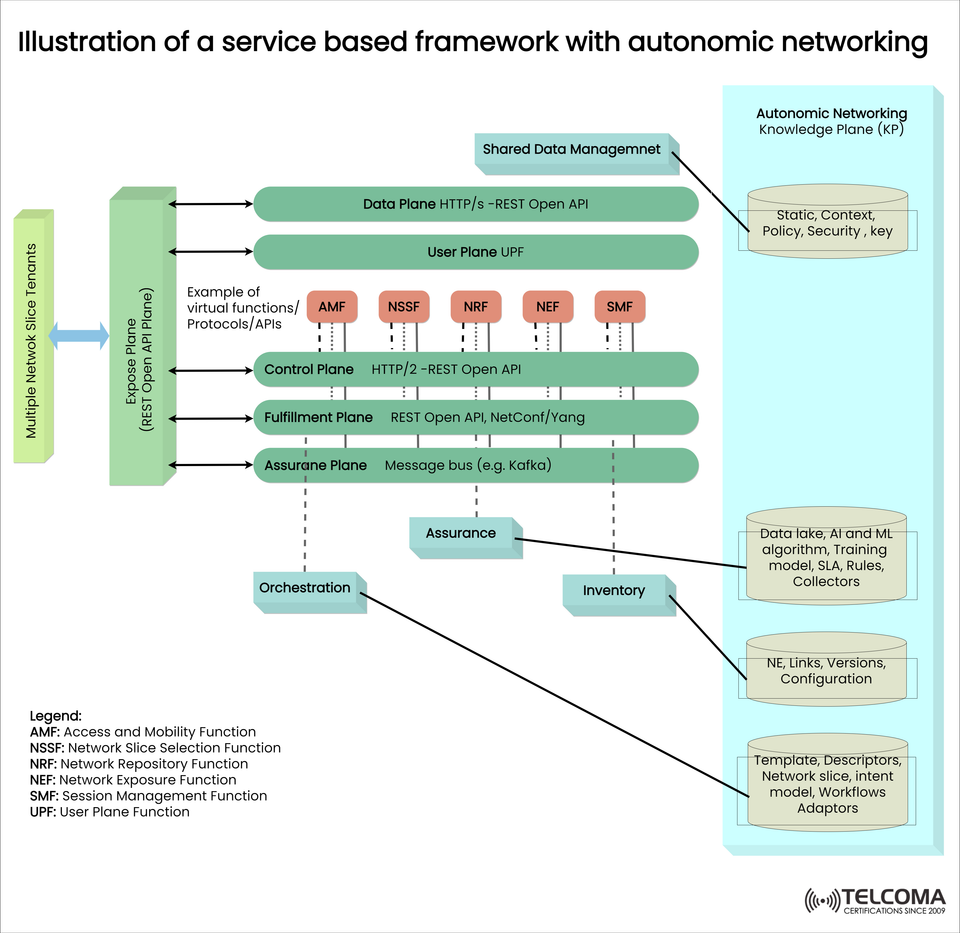
The telecom world is changing rapidly with the advent of 5G (and shortly, 6G). Network automation, intelligent orchestration and self-managing systems are becoming mainstream and building blocks for future-ready networks and infrastructures. As outlined in the illustration above, a Service-Based Framework with Autonomic Networking shows a clear architectural direction for achieving the forgoing goals. This blog focuses on how such a framework would allow for agile, scalable, and intelligent networking by means of open APIs and AI-based knowledge planes.
Let’s Discuss the Framework
The framework in the illustration incorporates the concepts of autonomic networking with a service-based architecture (SBA) to create an intelligent, modular, and flexible network environment. Below is a summary of the core components:
- Expose Arm (REST Open API Plane)
Interface for Multiple Network Slice Tenants
Enables integration through RESTful APIs to ensure both internal network functions, plus any external systems and slices can communicate with one another.
2. Service Planes and Functions
Each plane is intended to assist management of the network lifecycle.
Data Plane
Protocols: HTTP/s - REST Open API
Manages data traffic on the network
In conjunction with UPF to forward the data plane
User Plane
Implements UPF to separate control and user traffic
Primary Functionality:
AMF: Access and Mobility Management
NSSF: Network Slice Selection (NSSF)
NRF: Network Repository, Function Discovery
NEF: Network Exposure, API Gateway Services
SMF: Session Management
Fulfillment Plane
Protocols: REST Open API, NetConf/YANG
Manages provisioning and configuration of network resources
Assurance Plane
Uses something like a message bus (e.g., Kafka)
Monitors real-time performance, SLA compliance, and fault management
Key Supporting Elements:
Shared Data Management
Enable all planes to access cohesive, updated data
Provides a central point for metadata and policies
Autonomic Networking Knowledge Plane (KP)
The AI/ML engine of the architecture:
Stores static context, policy rules, security configuration, and keys
Integrates with:
Data Lakes for historical analytics
specialized ML/AI algorithms for intelligent decision making
SLA rules and collectors for real-time insight
Integration Components and Operational Support
Component Description
Orchestration Automates onboarding and lifecycle of network functions
Inventory Discovery of resources, versions, and topology
Assurance Measures metrics for SLA assurance and performance optimization
Templates & Descriptors Standardizes slice and workflow definitions
Adaptors Links legacy and current networks
Real-World Use Cases of a Service-Based Framework with Autonomic Networking
- 5G Network Slicing
Network slicing is an essential use case for multiple tenants working on the same infrastructure. The Expose Arm and Network Slice Selection Function (NSSF) allow operators to:
Deliver customized services to industries such as healthcare, automotive and smart cities.
Enforce strict SLAs through automated assurance and monitoring.
Dynamically allocate resources without human intervention.
- Closed-Loop Automation with AI/ML
Using the Assurance Plane and Knowledge Plane, operators can implement closed-loop automation. For example:
The Assurance Plane detects a traffic congestion condition in real time.
KP (Knowledge Plane) processes the information with ML algorithms.
Fulfillment and Orchestration planes adjust resource allocation/network paths.
This reduces downtime, improves quality of service (QoS), and lowers operational costs.
- DevOps and CI/CD in Telco
The Fulfillment Plane enables continuous integration and delivery (CI/CD) via APIs, automation tools. Operators can:
Deliver virtual functions (VNFs/CNFs) in a timely manner.
Connect DevOps pipelines to push updates without disruption to live services.
Use NetConf/YANG to structure network changes, programmable.
Security and Policy Management
Standards and Interoperability
The framework aligns with multiple standards in the industry:
3GPP - service-based architecture and interfaces such as NRF, AMF, SMF.
IETF - NetConf/YANG and RESTful APIs.
ETSI ZSM - closed-loop automation and assurance.
This ensures interoperability with vendors and platforms, enabling telecoms to scale and innovate.
Looking to the Future: Preparing for 6G
As the industry shifts towards 6G, demand for networks that are even more autonomous and intelligent will rise. This architecture represents:
A building block for intent-based networking, where users identify what they want to achieve, then the network decides how to achieve it.
Better integration with edge computing and IoT ecosystems.
Tighter AI/ML loops enabling predictive network behavior and pro-active optimization.
Concluding Thoughts
The service-oriented framework with autonomic networking is not just a theory, but the architectural strategy required for telecom operators to stay relevant in the 5G/6G period. It illustrates modularity, automation, intelligence and openness, allowing operators to replace their brittle, siloed systems with an architecture based on services.
Conclusion
A service-oriented framework with autonomic networking is a design for next-generation telecom infrastructure. Operators using service planes, open APIs, and AI-augmented assurance with the ability to respond in real-time, operate with a self-optimizing network and become autonomic. All of this fits very nicely within the need to embrace 5G, private networks, and future 6G ecosystems and should be understood and embraced by telecom practitioners and technical strategists.
Regardless of your exact role in the network, whether network architect, AI/ML engineer in telecom, or service provider, this architectural representation outlines a scalable, intelligent, and secure future.
Resources for Telecom Professionals
To make adoption and internal presentations more accessible, the deliverables demonstrated are suggested for sharing and training-documents:
📘 Formats Available Upon Request
● PDF Whitepaper: Full description with technical details and impact to business.
● PowerPoint Slide Deck: For internal presentations, team engagement, and stakeholder alignment.
● Annotated Diagram (Hi-resolution): With callouts and explanations for each component.
● Excel-based function mapping: How functions provided by the network (AMF, SMF, etc.) are reflected in the planes and APIs of the framework.
Now available:
📘 Whitepaper (PDF): Overall look at the framework, complete with technical descriptions and a discussion of enterprise impact.
📣 PowerPoint Slide Deck: For running an internal session, team meeting, or a stakeholder alignment type of meeting.
📃 Annotated Diagrams (high-res): There should be callouts with detailed component descriptions.
📊 Excel-based Functions Mapping: Great option to see the relationship from a network function (AMF, SMF, etc) perspective to the various planes and APIs.