
Sidelink Channel Mapping in LTE and 5G: Logical, Transport, and Physical Channels Explained

Introduction: The Significance of Sidelink
As mobile communication continues to evolve, the ability for direct device-to-device (D2D) communication has become crucial in LTE-Advanced Pro and 5G networks. This feature, known as sidelink, allows devices to share information without going through the base station (eNodeB/gNodeB).
Sidelink is key for various applications, including:
Public Safety Networks → Allows direct communication in emergencies.
Vehicular Networks (V2X) → Enables cars to share information for enhanced safety and automation.
IoT and Proximity Services → Facilitates direct interaction among smart devices.
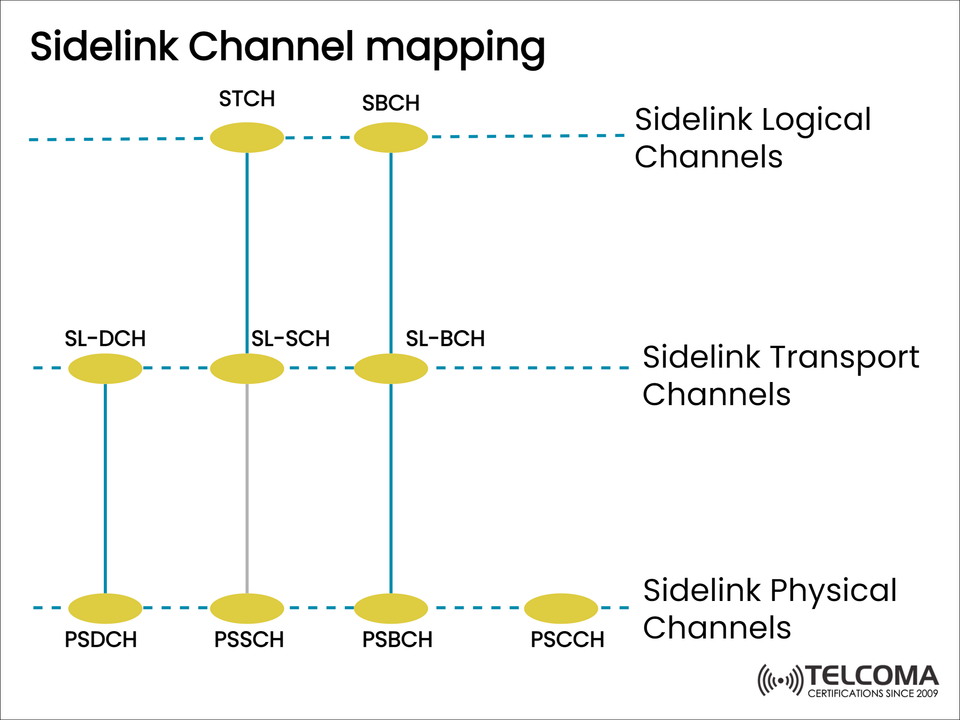
At the heart of sidelink operations is channel mapping, where information is transmitted through logical, transport, and physical channels. The diagram provides a clear overview of how these sidelink channels are arranged across different layers.
The Three Layers of Sidelink Channels
Just like LTE’s regular uplink and downlink, sidelink utilizes a hierarchy of channels:
Logical Channels → Indicate what kind of information is being transmitted.
Transport Channels → Specify how that information is conveyed.
Physical Channels → Define where the data is sent over the radio interface.
This structured mapping promotes clarity, flexibility, and efficiency in sidelink communications.
Sidelink Logical Channels
Logical channels focus on the type of information being exchanged between devices. They operate at the top layer of the sidelink mapping.
Types of Sidelink Logical Channels:
STCH (Sidelink Traffic Channel): * Transmits user data directly between devices. * Used for activities such as video sharing, file transfers, and vehicular messages.
SBCH (Sidelink Broadcast Channel): * Carries broadcast control information. * Assists devices in detecting and syncing with others nearby.
These logical channels are then mapped to transport channels, determining how data and control messages flow.
Sidelink Transport Channels
Transport channels act as the bridge linking the logical and physical layers. They define how data travels over the radio interface.
Types of Sidelink Transport Channels:
SL-DCH (Sidelink Dedicated Channel): * Allows dedicated communication between two specific devices. * Ideal for unicast D2D scenarios.
SL-SCH (Sidelink Shared Channel): * Used by multiple devices to transmit user or control information. * Supports group communications and dynamic resource management.
SL-BCH (Sidelink Broadcast Channel): * Sends messages to all devices within a defined area. * Responsible for essential information like synchronization and resource pool setup.
These transport channels ensure the logical information (either traffic or broadcast) is correctly formatted before reaching the physical layer.
Sidelink Physical Channels
Physical channels determine the actual transmission over radio resources (time, frequency, and code). This is the foundational layer of sidelink communication.
Types of Sidelink Physical Channels:
PSDCH (Physical Sidelink Dedicated Channel): * Implements SL-DCH. * Enables direct communication between two user equipment (UEs).
PSSCH (Physical Sidelink Shared Channel): * Implements SL-SCH. * Used for both user data transfer and group communications.
PSBCH (Physical Sidelink Broadcast Channel): * Implements SL-BCH. * Sends broadcast messages to all nearby devices.
PSCCH (Physical Sidelink Control Channel): * Transmits control information necessary for decoding shared channel data (PSSCH). * Ensures proper coordination and decoding occurs.
By linking transport channels with physical ones, sidelink communication effectively manages both data exchange and control signaling.
Sidelink Channel Mapping: Putting It All Together
The diagram demonstrates how sidelink channels interconnect through layers:
STCH → SL-DCH → PSDCH
STCH → SL-SCH → PSSCH
SBCH → SL-BCH → PSBCH
Control Signaling → SL-SCH → PSCCH
This hierarchy establishes a logical flow:
Logical channels identify the type of traffic.
Transport channels prepare it for transmission.
Physical channels manage the actual radio transmission.
Example: V2X (Vehicle-to-Everything) Communication
Let’s look at a practical scenario — vehicular communication (V2X) in LTE sidelink:
Broadcast Safety Message: * A car spots a hazard and needs to alert nearby vehicles. * The message travels from SBCH (logical) → SL-BCH (transport) → PSBCH (physical).
Unicast Communication: * Two cars share specific information (like platooning control). * Data flows through STCH → SL-DCH → PSDCH.
Group Communication: * Multiple cars in a convoy share relevant data. * Information moves via STCH → SL-SCH → PSSCH, coordinated by PSCCH.
This example illustrates how sidelink channel mapping supports versatile communication setups.
Comparison of Sidelink Channels
Layer|Channel|Purpose
Logical|STCH|Carries user traffic between devices
|SBCH|Broadcast control information
Transport|SL-DCH|Dedicated D2D communication
|SL-SCH|Shared/group communication
|SL-BCH|Broadcast information
Physical|PSDCH|Implements SL-DCH
|PSSCH|Implements SL-SCH
|PSBCH|Implements SL-BCH
|PSCCH|Carries control information for decoding
Importance of Sidelink Channel Mapping
Sidelink channel mapping offers several advantages:
Efficiency: Separates control and data flows to minimize overhead.
Flexibility: Accommodates unicast, broadcast, and group communication needs.
Reliability: Ensures dependable message delivery, especially in public safety situations.
Low Latency: Allows direct communication without involving the core network.
Scalability: Designed to support extensive IoT and vehicular networks.
Challenges in Sidelink Channel Design
Despite its benefits, sidelink communication presents some challenges:
Interference Management: A shared spectrum can lead to collisions.
Resource Allocation: Efficient scheduling is crucial in dense network environments.
Backward Compatibility: Integrating with LTE and 5G must provide seamless functionality.
Security: Direct device communication needs protection against spoofing and eavesdropping.
These challenges are being tackled with 5G NR sidelink enhancements, which expand sidelink design beyond what's available in LTE.
Future Outlook: Sidelink in 5G and Beyond
In 5G NR, sidelink is set to advance with greater flexibility and support for ultra-reliable low-latency communication (URLLC). Some key improvements include:
Enhanced resource allocation for V2X applications.
Improved synchronization for larger groups of devices.
Integration with network slicing for IoT and public safety purposes.
With these changes, sidelink is poised to be vital in autonomous driving, mission-critical IoT, and Industry 4.0 applications.
Conclusion
The structure of sidelink channel mapping guarantees efficient and effective device-to-device communication in LTE and 5G. By organizing traffic into logical, transport, and physical channels, the system supports:
Direct communication (D2D) for public safety and V2X.
Flexible modes for unicast, broadcast, and group communication.
Scalable and reliable designs to accommodate future IoT and vehicular networks.
For telecom professionals, understanding sidelink channels is key to optimizing LTE and 5G networks. For tech enthusiasts, it offers a fascinating look at how our devices communicate directly, paving the way for autonomous systems and connected intelligence.