
Signaling Architecture in 5G vs Legacy Cellular Networks: A Comparative Guide

Comparing Signaling Architecture: 5G vs. Legacy Cellular Networks
In cellular networks, the signaling architecture is crucial for managing both control and user-plane functions. As we shift from older systems like 3G and 4G LTE to 5G networks, one major change is how signaling paths have become simpler.
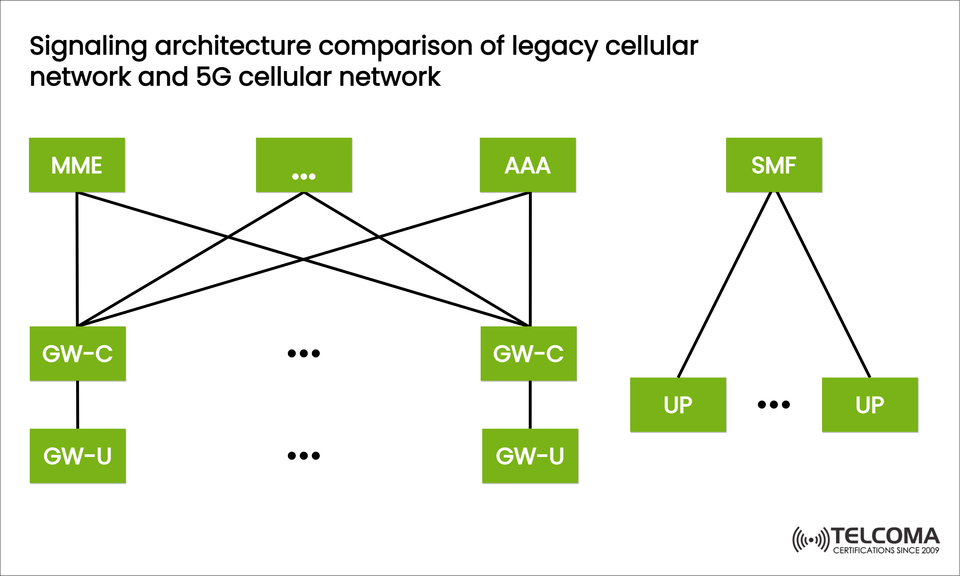
The diagram provided really shows this difference well. On one side, you have the legacy cellular architecture, which is pretty complicated, with various connections between elements like MME, AAA, GW-C, and GW-U. On the other side, the 5G architecture looks much cleaner, with the Session Management Function (SMF) handling signaling and directly interacting with User Plane (UP) functions.
This blog will dig into the differences between these two architectures, their pros and cons, and what they mean for the future of telecom.
What You Need to Know About Legacy Cellular Signaling Architecture
In older cellular networks, the signaling architecture is quite complex.
Main Components of Legacy Architecture:
MME (Mobility Management Entity): * Handles user authentication, mobility management, and bearer establishment.
GW-C (Gateway Control Plane): * Manages control functions for gateways, including policy enforcement.
GW-U (Gateway User Plane): * Takes care of forwarding user traffic.
AAA (Authentication, Authorization, Accounting): * Validates subscriber identity and manages access rights.
Features of Legacy Signaling:
There are numerous control interfaces connecting MME, AAA, GW-C, and GW-U.
The system has redundant signaling paths, leading to higher complexity and latency.
Scaling these networks is tough due to the close ties between control-plane and user-plane functions.
Drawback: As networks expanded to support IoT, VoLTE, and faster broadband, this intricate web of connections became unwieldy and costly.
5G Signaling Architecture: A Whole New Approach
5G brings in a Service-Based Architecture (SBA), making functions more modular and lighter compared to older systems.
Key Components in 5G Architecture:
SMF (Session Management Function): * Acts as the main signaling control point. * Manages sessions, IP address allocation, and policies.
UP (User Plane Functions): * Takes care of user traffic forwarding. * Can be placed flexibly across the network, closer to the edge for quicker service.
Features of 5G Signaling:
Easier connections: The SMF talks directly to multiple UP functions.
Control and User Plane Separation (CUPS): This allows each plane to scale independently.
Cloud-native design: Functions are made as microservices, which makes them more agile and scalable.
Advantage: All this simplification in signaling can lead to lower latency, more flexibility, and smoother integration of new services.
Legacy vs. 5G Signaling: A Quick Comparison
Aspect Legacy Cellular Networks5G Cellular Networks Architecture Style Hierarchical, tightly coupled Service-based, modular, loosely coupled Key Control Node MME, AAA, GW-C SMF User Plane Node GW-U UP (User Plane Function) Interconnections Complex mesh of signaling links Simplified direct signaling Latency Higher, due to multiple hops Lower, optimized for real-time communication Scalability Hard to scale due to rigid coupling Highly scalable with cloud-native deployment Support for IoT/URLLC Limited Optimized for massive IoT and ultra-low latency Deployment Flexibility Centralized, rigid Edge-enabled, distributed UP for low latency
Why 5G’s Simplified Signaling is Important
The simplification of signaling in 5G isn’t just for show—it actually improves performance, scalability, and how efficiently things run.
- Reduced Latency for Next-Gen Applications
In older networks, signaling has to go through many hops.
With 5G, the SMF takes charge of sessions directly, allowing for the super-fast response times essential for things like autonomous vehicles and industrial automation.
- Control and User Planes Separated
Legacy systems tied together the control and user-plane functions.
5G enables operators to scale them separately, which is more cost-effective.
- Support for Massive IoT
Older signaling struggled to accommodate large numbers of IoT devices.
5G’s lightweight and modular approach makes it feasible to support mMTC (massive Machine-Type Communication).
- Edge Computing Integration
In 5G, user-plane functions can be situated closer to the edge, which supports low-latency experiences like AR/VR streaming and real-time gaming.
What This Means for Telecom Operators
Telecom operators really stand to gain from moving to 5G signaling:
Operational Efficiency: Fewer interconnections mean easier troubleshooting and lower operational costs (OPEX).
Quick Service Deployment: Cloud-native functions allow for faster rollout of new services.
Better Network Reliability: Simplified signaling means there are fewer potential failure points.
Vendor Interoperability: The SBA design supports multi-vendor setups, which decreases reliance on any single provider.
Challenges in Transitioning
Even with all its benefits, switching from legacy to 5G signaling comes with hurdles:
Interoperability with Legacy Networks: Since 4G LTE will still be around alongside 5G for a while, seamless handovers are essential.
Security Risks: The simplified signaling means it needs robust encryption to prevent vulnerabilities.
Investment Costs: Operators will have to upgrade their infrastructure, which can be a big financial commitment.
Skill Gaps: Engineers will need retraining to handle these new cloud-native, service-based architectures.
Real-World Applications
Autonomous Vehicles: * Need ultra-reliable, low-latency signaling to avoid collisions. 5G’s straightforward architecture makes this a reality.
Smart Factories: * Industrial IoT depends on real-time communication between machines. 5G’s modular UP deployment guarantees scalability.
Healthcare Applications: * Things like remote surgery and telemedicine require zero-latency communication. Legacy networks just can’t deliver that level of reliability, but 5G can.
Enhanced Mobile Broadband (eMBB): * High-definition streaming and AR/VR need effective user-plane management. 5G’s simplified signaling can handle higher throughput.
Looking Ahead
The 5G signaling architecture lays down the groundwork for:
6G networks, where AI-driven improvements might cut latency even more.
Network Slicing, allowing signaling functions to adjust based on specific service needs.
Quantum-Resistant Security, to ensure reliable signaling against future cyber threats.
Wrap-Up
The contrast between legacy and 5G signaling architectures clearly shows a shift: moving from a complicated, tightly linked system to a more straightforward, modular, and scalable design.
In older networks, the complexity of signaling held back efficiency and scalability. With 5G, the Session Management Function (SMF) and flexible User Plane Functions streamline processes, lower latency, and pave the way for groundbreaking services like IoT, URLLC, and AR/VR.