
Similarities Between 4G EPC and 5G Core: A Detailed Comparison of Control and User Plane Separation

Similarities Between 4G EPC and 5G Core
The shift from 4G LTE to 5G is often seen as a major leap, but at its core, a lot of the architectural ideas are pretty similar. One of the key concepts is the separation of the Control Plane (CP) and User Plane (UP), known as CUPS (Control and User Plane Separation). Both 4G EPC (Evolved Packet Core) and the 5G Core rely on this principle to promote scalability, flexibility, and effective resource management.
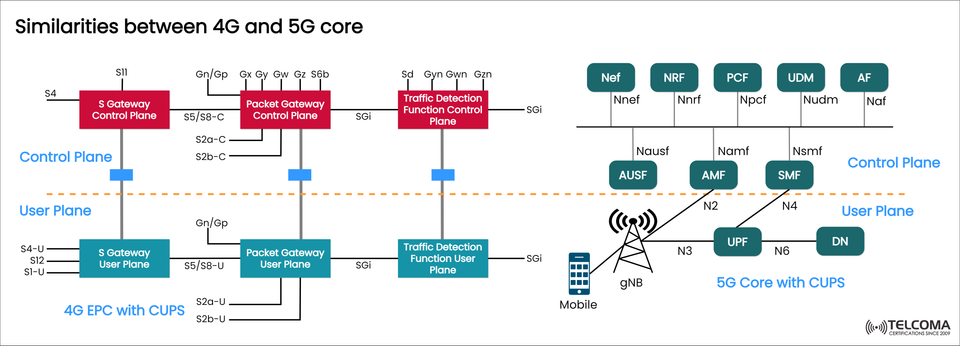
The diagram included gives a visual representation of how 4G EPC with CUPS and 5G Core with CUPS share a comparable design approach, although their implementations vary. Let’s unpack that a bit.
Understanding CUPS in Mobile Networks
CUPS is all about separating the control functions (like signaling, session management, and mobility) from the user plane functions (which are responsible for managing actual data traffic).
Control Plane (CP): Takes care of tasks like authentication, policy enforcement, and mobility management.
User Plane (UP): Focuses on data forwarding between the device (UE) and the data network (whether that’s the internet or specific private apps).
By separating these functions, you can scale them independently. So, for instance, you can ramp up the user plane to handle more data without having to change anything in the control plane—and vice versa.
- 4G EPC with CUPS
Previously, the Evolved Packet Core (EPC) in 4G LTE mixed both control and user plane functions together. However, with the arrival of CUPS in Release 14, they separated these functions to boost performance and allow for distributed deployment.
Components of 4G EPC with CUPS (shown in the diagram):
Serving Gateway (SGW): * Control Plane (S-GW-C): Manages signaling. * User Plane (S-GW-U): Forwards user traffic.
Packet Data Network Gateway (PGW): * Control Plane (P-GW-C): Oversees session and IP address allocation. * User Plane (P-GW-U): Links users with external data networks.
Traffic Detection Function (TDF): * Control Plane (TDF-C) and User Plane (TDF-U): Aids in traffic optimization and content awareness.
Interfaces in 4G EPC with CUPS:
S11: Connects MME and SGW-C.
S5/S8-C: Between SGW-C and PGW-C.
S5/S8-U: Between SGW-U and PGW-U.
SGi: Between PGW-U and data networks.
- 5G Core with CUPS
The 5G Core (5GC) was built from scratch to be cloud-native and service-oriented, but it still adheres to the CUPS principle. Functions are broken down into independent modules known as Network Functions (NFs), which use service-based interfaces (like HTTP/JSON APIs) rather than fixed point-to-point links.
Components of 5G Core with CUPS:
Access and Mobility Management Function (AMF): Similar to MME in 4G, it manages registration and mobility.
Session Management Function (SMF): Works like SGW-C and PGW-C, managing session setup and control.
User Plane Function (UPF): Acts like SGW-U and PGW-U, forwarding user data.
Authentication Server Function (AUSF): Handles authentication tasks.
Unified Data Management (UDM): Comparable to HSS in LTE, it stores subscriber information.
Policy Control Function (PCF): Similar to PCRF in LTE, overseeing policies and service quality (QoS).
Network Exposure Function (NEF): Facilitates APIs for external applications.
Network Repository Function (NRF): Manages service discovery among NFs.
Interfaces in 5G Core with CUPS:
N2: Links gNB and AMF (control plane).
N3: Connects gNB and UPF (user plane).
N4: Between SMF and UPF.
N6: Between UPF and Data Networks.
Key Similarities Between 4G EPC and 5G Core
From the diagram, it's clear that both architectures utilize CUPS, leading to several common features:
Control and User Plane Separation (CUPS): * 4G EPC introduced it in Release 14; 5G Core has it natively. * Both allow for independent scaling of control and data functions.
Functional Decomposition: * In 4G EPC, SGW and PGW are divided into both control and user components. * In 5G, functions like AMF, SMF, and UPF are partitioned into smaller modules.
Flexible Deployment: * Control functions can be centralized to boost efficiency. * User plane functions can be placed closer to the edge for lower latency.
Data Plane Anchoring: * Both 4G PGW-U and 5G UPF anchor user traffic before passing it along to external data networks.
Policy and QoS Enforcement: * 4G employs PCRF; 5G uses PCF, but the overall function remains quite similar.
- Side-by-Side Comparison of 4G EPC and 5G Core with CUPS
Aspect 4G EPC with CUPS 5G Core with CUPS
Control Plane MME, SGW-C, PGW-C, TDF-C AMF, SMF, AUSF, PCF, NEF, NRF, UDM
User Plane SGW-U, PGW-U, TDF-U UPF
Interface to gNB/eNB S1-U, S11, S5/S8 N2 (control), N3 (user)
External Network Link SGi N6
Design Approach Point-to-point interfaces Service-based architecture (HTTP/JSON APIs)
CUPS Concept Introduced in LTE Release 14 Built-in from the start
Policy Control PCRF PCF
Why These Similarities Matter
The shared principles between 4G EPC and 5G Core can make it easier for operators to transition:
Simplified Evolution: Those familiar with EPC and CUPS will find it easier to switch to 5GC.
Investment Protection: Investments in hardware and expertise from 4G continue to have value.
Operational Consistency: Network teams will follow similar processes for scaling, deploying, and managing both systems.
Edge Deployment Possibilities: Both systems let user plane functions migrate closer to the edge for applications like URLLC and IoT.
Differences Beyond the Similarities
While there are commonalities, the 5G Core also broadens capabilities:
Service-Based Architecture (SBA): Utilizes APIs for added flexibility, unlike 4G’s direct interfaces.
Cloud-Native Deployment: Tailored for containers and microservices.
Network Slicing: 5G Core can manage dedicated logical networks for various services.
Greater Flexibility: NFs like NEF and NRF allow for dynamic service discovery and exposure.
Conclusion
The transition from 4G EPC to 5G Core not only shows a continuity in architectural principles, especially around Control and User Plane Separation (CUPS), but also highlights some key features:
They separate control signaling from user data.
Both enable independent scaling and flexible deployments.
They support policy enforcement and QoS through specific functions.
Still, 5G Core takes things a step further with service-based architecture, a cloud-native design, and advanced options like network slicing.