
Slice-Based Architecture for Vehicular Applications in 5G | V2X & Connected Mobility

The automotive industry is experiencing a significant shift with the rise of 5G networks. Cars have moved beyond being simple mechanical machines; they’re now becoming smart, connected platforms that can communicate with infrastructure, other vehicles, and cloud applications. To handle a wide range of important use cases, slice-based architecture in 5G provides an ideal solution.
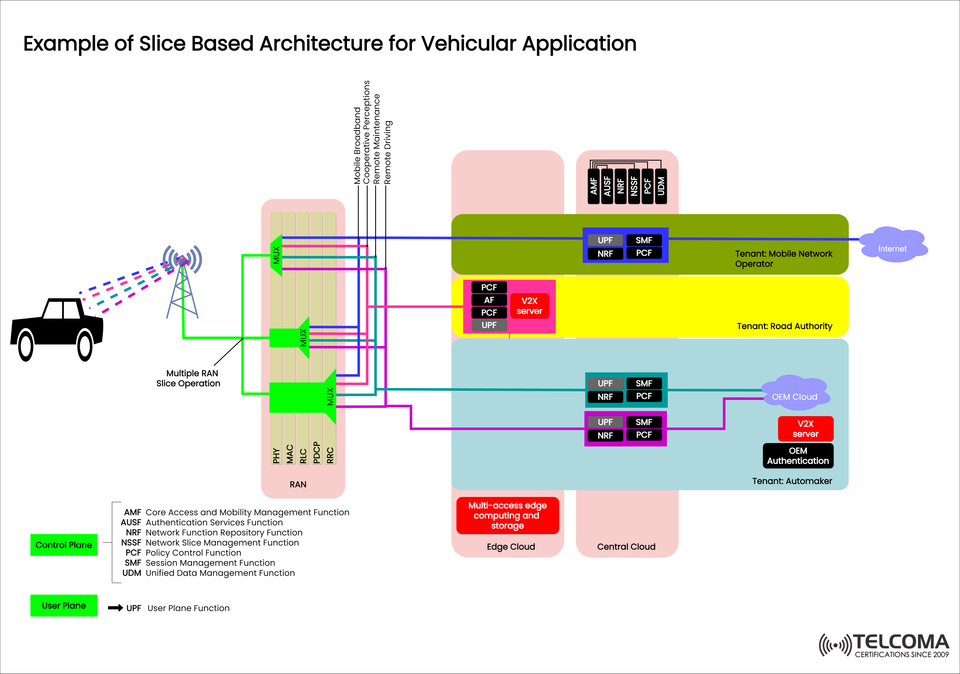
The image included shows an Example of Slice-Based Architecture for Vehicular Applications, which illustrates how different stakeholders (like mobile operators, road authorities, and car manufacturers) utilize dedicated network slices for specialized vehicle services. This article dives into the architecture, details its key components, and discusses how it enables advanced vehicular applications.
What is Slice-Based Architecture?
In 5G, network slicing refers to the creation of distinct virtualized and independent logical networks on a shared physical infrastructure. Each slice can be tailored to meet the specific needs of different applications or industry sectors.
For vehicular applications, these slices can be crafted to support:
Ultra-reliable low latency communication (URLLC): crucial for autonomous driving and safety features.
Enhanced mobile broadband (eMBB): for in-car entertainment and infotainment.
Massive machine-type communication (mMTC): for IoT-enabled vehicle sensors and smart city integration.
Key Components of Vehicular Slice Architecture
The architecture depicted in the image highlights three main stakeholders and the network elements that support them.
- RAN (Radio Access Network) with Multiple Slices
The RAN (which includes PHY, MAC, RLC, PDCP, and RRC layers) can handle multiple slice operations at once.
A multiplexer (MUX) ensures that vehicle traffic gets routed to the right slice.
Use cases span mobile broadband, cooperative perception, remote maintenance, and remote driving.
- Control Plane Functions (Green Blocks)
AMF (Access and Mobility Management Function): Manages user registration, connection, and mobility.
SMF (Session Management Function): Oversees sessions and allocates IP addresses.
PCF (Policy Control Function): Enforces qualitative rules for service and billing.
NRF (Network Repository Function): Keeps track of available network function instances.
NSSF (Network Slice Selection Function): Makes sure users/devices connect to the right slice.
UDM (Unified Data Management): Stores user subscription and authentication information.
User Plane Function (UPF – Purple Blocks)
UPF is in charge of directing and forwarding user traffic to the right application servers or cloud services.
In vehicle applications, UPF facilitates quick packet delivery for V2X communication, OEM services, and cloud connections.
Tenants in Vehicular Network Slicing
- Mobile Network Operator (MNO)
Supplies connectivity slices for internet access and general vehicle communication.
Hosts functions like UPF, SMF, and PCF.
Keeps the vehicle connected to the broader internet ecosystem.
- Road Authority
Operates a V2X (Vehicle-to-Everything) server to oversee road safety, traffic updates, and infrastructure communication.
Ensures that vehicles receive real-time updates on road conditions, accident alerts, and cooperative awareness messages.
Guarantees high reliability for applications that are critical for safety.
- Automaker (OEM)
Manages its own slice for delivering services like remote vehicle diagnostics, over-the-air updates, and cloud-based vehicle features.
Hosts an OEM Cloud and Authentication System to provide secure access.
Integrates with V2X servers for collaborative applications.
Edge and Central Cloud Integration
The architecture includes Multi-access Edge Computing (MEC) at the Edge Cloud, which allows for ultra-low latency processing close to the vehicle.
Edge Cloud: Deals with time-sensitive vehicular tasks like collision avoidance or real-time navigation.
Central Cloud: Used for data analytics, large-scale storage, and less latency-critical applications like predictive maintenance.
This mixed cloud model strikes a balance between speed and computing power.
Use Cases Enabled by Slice-Based Vehicular Architecture
Here are some real-world applications supported by this structure:
- Autonomous Driving and Remote Driving
Needs URLLC slices for safety-related decision-making.
Edge processing ensures response times are in the milliseconds.
- V2X (Vehicle-to-Everything) Communication
Vehicles interact with infrastructure, pedestrians, and one another.
Road authority servers enable cooperative driving and accident prevention.
- In-Vehicle Infotainment
Enhanced Mobile Broadband (eMBB) slices allow passengers to stream HD videos, play cloud-based games, and use AR/VR apps.
- Predictive Maintenance & Remote Diagnostics
Automaker slices link vehicles to OEM cloud systems.
Sensor data from the vehicle gets analyzed to foresee part failures, reducing downtime.
- Smart City Integration
Vehicles connect with smart utilities and city systems (like traffic signals and charging stations).
This supports smoother urban transportation and energy-efficient transit.
Advantages of Slice-Based Vehicular Architecture
Flexibility: Multiple stakeholders can operate simultaneously without interference.
Low Latency: Edge computing ensures real-time processing for critical tasks.
Security: Each slice is isolated, helping to prevent data breaches.
Scalability: New services can be added without needing a complete system overhaul.
QoS (Quality of Service): Network settings can be customized to ensure each application gets the performance it needs.
Example Workflow: Vehicle Using Multiple Slices
A connected car communicates with the RAN, which supports multiple slices.
The multiplexer directs traffic based on the application: * Infotainment traffic → Mobile Network Operator slice. * Safety traffic (accident alert) → Road Authority slice. * Diagnostics data → Automaker slice.
User traffic is processed through UPF and sent to the right application server (Internet, V2X server, or OEM cloud).
The Edge Cloud handles urgent tasks like collision alerts, while the Central Cloud manages data-heavy analytics.
Conclusion
The slice-based architecture for vehicular applications is a fundamental part of the 5G ecosystem, ensuring that connected vehicles, autonomous cars, and mobility services function smoothly and securely. By facilitating dedicated slices for various stakeholders—from mobile operators to road authorities and car makers—5G promises tailored performance for every vehicle-related use case.
As the automotive sector continues evolving towards fully autonomous and connected mobility, network slicing alongside edge computing will be vital for delivering ultra-reliable, low-latency, and secure vehicular services.
In essence, 5G-powered vehicular slice architecture isn't just about connectivity; it's about paving the way for the future of transportation.