
Smart City Architecture Explained: Layers, Use Cases, and Technologies Driving Urban Intelligence

The rise of smart cities represents a significant step towards a future where urban areas are both digitally connected and sustainable. By using IoT devices, edge computing, and 5G technology, these cities can manage resources more efficiently, improve transportation, and enhance services for residents.
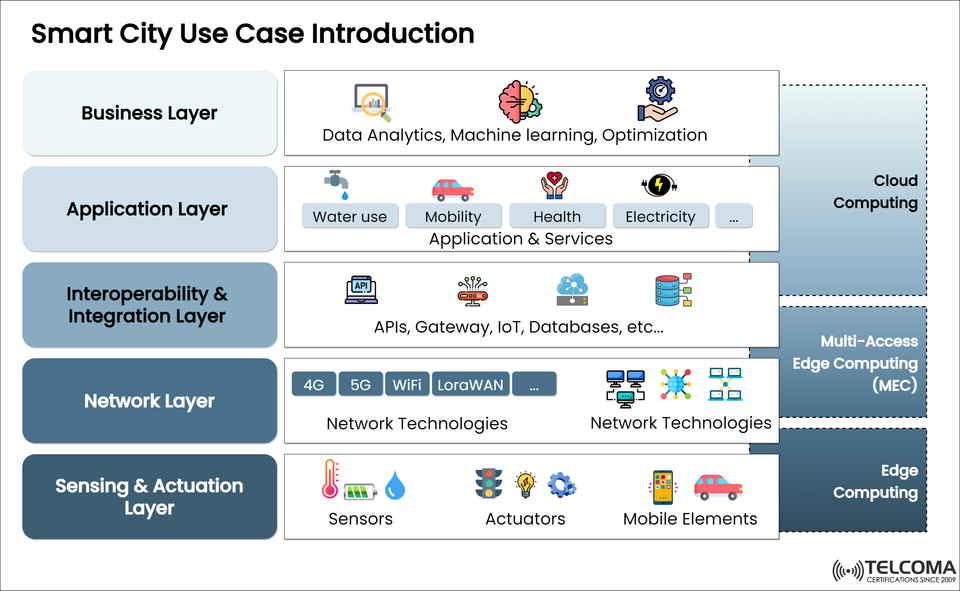
The diagram titled "Smart City Use Case Introduction" gives a clear view of a smart city's layered structure. It starts from the Sensing Layer, which gathers real-world data, up to the Business Layer that turns that data into actionable insights. Every layer is essential in connecting the physical and digital realms, allowing for smooth communication and processing.
This article dives into the smart city architecture, showing how technologies such as AI, machine learning, MEC (Multi-Access Edge Computing), and cloud computing come together to make urban areas smarter, safer, and more efficient.
Understanding Smart City Architecture
Smart city systems are built on five core layers, with each layer supporting the next to form a cohesive and intelligent network.
The five layers include:
Sensing & Actuation Layer
Network Layer
Interoperability & Integration Layer
Application Layer
Business Layer
These layers are backed by Edge Computing, MEC, and Cloud Computing, which bring real-time processing, scalability, and analytical capabilities into the mix.
Let’s break down each layer in detail.
Sensing & Actuation Layer: The Foundation of Smart Cities
This layer acts as the physical link between the environment of the city and its digital control systems. It includes devices that sense, collect, and respond to environmental data.
Key Components:
Sensors: They track things like temperature, pollution, humidity, traffic flow, and energy consumption.
Actuators: These respond to commands, like adjusting streetlights or controlling water supply.
Mobile Elements: Items such as vehicles, wearables, and smartphones help gather data and maintain communication.
Functions:
Detect environmental changes.
Allow for immediate actions through automation.
Provide data inputs for higher layers.
This layer works closely with Edge Computing, processing data on-site to cut down on delays and support real-time decisions—crucial for tasks like managing traffic or smart lighting.
Network Layer: The Connectivity Backbone
When data is created, it needs to be sent effectively. The Network Layer ensures this connection through various wired and wireless technologies.
Key Technologies:
4G and 5G networks: Offer high-speed, low-latency data transmission.
Wi-Fi: Enables local connections for IoT devices in homes and public areas.
LoRaWAN and NB-IoT: These are low-power networks that are great for long-range IoT sensors.
Functions:
Supports device-to-device (D2D) and machine-to-machine (M2M) communication.
Helps route data between IoT devices and processing centers.
Integrates network slicing in 5G to prioritize essential services like healthcare and public safety.
This layer is foundational for Multi-Access Edge Computing (MEC), bringing computing power closer to users for better speed and reliability in smart city tasks.
Interoperability & Integration Layer: Bridging Systems Together
Smart cities use a variety of technologies and platforms, which makes interoperability vital. This layer guarantees smooth communication and integration across different systems, vendors, and data types.
Key Components:
APIs (Application Programming Interfaces): Allow devices, software, and cloud services to interact.
IoT Gateways: Aggregate and prepare sensor data for transmission.
Databases and Middleware: Manage and standardize diverse data sources.
Functions:
Changes raw sensor data into structured, useful formats.
Ensures old systems coexist with modern IoT setups.
Supports secure data exchanges between public and private sectors.
This layer serves as a middleware hub, facilitating scalability and secure data transfer for thousands of interconnected smart devices.
Application Layer: Smart City Services in Action
The Application Layer brings smart city features into play, hosting the applications and services that directly assist citizens, businesses, and government.
Common Smart City Applications:
Water Use Management: Keeps track of consumption, finds leaks, and ensures fair distribution.
Mobility Solutions: Powers smart traffic lights, connected vehicles, and optimizes public transport.
Health Services: Blends telemedicine, remote diagnostics, and emergency response systems.
Electricity Management: Monitors energy demand and optimizes grid use to cut waste.
Functions:
Turns data insights into practical urban services.
Improves user experience and safety.
Aims for sustainability and efficient use of resources.
This layer benefits from MEC and Cloud Computing, handling complex tasks like AI-driven analytics or predictive modeling dynamically.
Business Layer: Intelligence and Optimization
The top layer, the Business Layer, is where city-wide data analysis happens to support decision-making and policy development. It acts like the strategic brain of the smart city framework.
Key Functions:
Data Analytics: Pulls insights from vast datasets collected across the city.
Machine Learning: Helps forecast trends like traffic jams, pollution, and energy needs.
Optimization Algorithms: Refine city operations for peak efficiency.
By utilizing AI, ML, and advanced analytics, this layer empowers governments and private enterprises to make proactive, data-informed decisions. It typically runs on Cloud Computing platforms for better scalability and performance.
Computing Paradigms Supporting Smart City Architecture
The graphic illustrates how computing resources are spread across different layers—from edge devices right up to the cloud.
Computing Type Location Purpose
Edge Computing Near sensors/actuators Real-time processing, reduced latency
MEC (Multi-Access Edge Computing) Telecom edge (base stations) Low-latency services, AI-based decision-making
Cloud Computing Data centers Large-scale analytics, data storage, machine learning
Together, these computing types create a layered computing environment, ensuring that data is processed where and when it’s needed.
How the Layers Work Together
Here’s how a typical smart city operates:
Sensors in the Sensing Layer spot an event (like rising water levels).
The Network Layer sends this data through 5G or LoRaWAN.
The Integration Layer aggregates and standardizes data using APIs and IoT gateways.
The Application Layer uses the data to trigger actions—like notifying authorities.
The Business Layer analyzes trends to prevent similar issues in the future using AI predictions.
This interconnected process drives data-driven automation throughout urban systems, creating an intelligent ecosystem.
Benefits of Layered Smart City Architecture
Scalability: Modular design makes it easy to add new applications and devices.
Interoperability: Standardized APIs and data models ensure different systems work well together.
Real-time Decision-Making: Edge computing and MEC lower latency for critical tasks.
Sustainability: Optimized resource usage leads to greener cities.
Improved Citizen Experience: Streamlined digital services enhance urban living.
Real-World Applications of Smart City Architecture
Traffic Optimization: Smart sensors adjust lights based on how busy the roads are.
Energy Efficiency: Smart grids dynamically balance supply and demand.
Water Man agement: IoT sensors find leaks and monitor usage.
Public Safety: AI-enhanced surveillance speeds up emergency responses.
Healthcare: Connected ambulances send patient data while on the way to hospitals.
Conclusion
The Smart City Use Case Architecture is fundamental for developing sustainable, data-driven, and connected urban environments. By adopting a layered approach—from edge sensors to cloud analytics—cities can better manage infrastructure and provide efficient services to their residents.
For telecom experts and engineers, grasping this architecture is key to designing robust, scalable, and interconnected systems that connect technology with everyday life.
Smart cities are more than just about connectivity; they’re about crafting intelligent, adaptable surroundings that empower individuals, conserve resources, and reshape the future of city living.